

A home buying workspace is a private digital space where you track every listing, tour note, comparison, and offer in one place instead of scattered texts and spreadsheets. For buyers touring multiple homes over weeks, it keeps decisions sharp and makes it easier to loop in an agent when it counts. Tools like NestNoted build this approach around privacy by default, so candid notes stay candid.
TL;DR:
- A private home buying workspace helps prevent recency bias by organizing structured notes, comparisons, and offer details over a median search of ten weeks.
- Essential features include private notes by default, pipeline stages, side-by-side comparisons, and import/export capabilities from major real estate sites.
- Consistent use of the workspace, including importing listings and logging impressions immediately after tours, maximizes its effectiveness and preserves decision accuracy.
- Privacy controls and permission settings are crucial to prevent over-sharing, especially when inviting agents or partners into specific properties or stages.
- Financial tracking of estimated payments, mortgage rates, and repair costs alongside listings ensures a realistic view of affordability and tradeoffs during the search.
Table of Contents
- Why a private home buying workspace matters
- Core features to expect from a buyer-facing workspace
- A seven-step workflow for a typical ten-week search
- Privacy, permissions, and AI: practical safeguards
- Get started: a checklist and templates you can use today
- Tips for customizing the workspace to fit your priorities
- Tracking your budget and mortgage details alongside listings
- Common pitfalls when adopting a workspace, and how to avoid them
- A checklist for evaluating whether a workspace fits you
- What a workspace can and cannot do for you
- How NestNoted fits this exact workflow
- Sources
- FAQ
Why a private home buying workspace matters
The search itself is long enough to erode memory. Buyers spend a median of about 10 weeks searching for a home, touring homes that start to blur together by week six. Without structured notes, the most recent showing tends to dominate judgment even when an earlier property was objectively stronger, a pattern often called recency bias.
Agents compound the value of good notes rather than replace the need for them, as discussed in Empowering real estate agents in a changing market. More than half of buyers in the same NAR 2025 profile say their agent pointed out features or flaws they had missed on their own. A workspace that captures dated impressions gives agents something concrete to react to instead of a vague secondhand description days after the showing.
The practical payoff shows up at decision time:
- Dated, structured notes prevent the newest listing from unfairly winning by default.
- Selective sharing lets you give an agent or partner full context without making private doubts public.
- A searchable record means you can defend a final choice with specifics instead of gut feeling.
Buyers who centralize listings early avoid the scramble of hunting through old emails and texts for a detail from week two, a problem covered in more depth in this guide to centralizing listings.
Core features to expect from a buyer-facing workspace
Not every note-taking app is built for this job. A workspace earns its place in a multi-week search only if it covers the full cycle from first listing to signed offer.
The features that actually change outcomes:
- Private notes by default: candid impressions stay yours until you choose to share them.
- Pipeline or status stages: a clear view of where each property sits, from shortlisted to under contract.
- Structured tour fields: consistent spots for date, ratings, pros, cons, and follow-up questions.
- Side-by-side comparison: finalists lined up on the same criteria instead of memory alone.
- Offer tracking: price, terms, and status logged against each property.
- Listing import: pulling details from sites like Zillow or Redfin instead of retyping them.
- Alerts: price drops or status changes surfaced automatically.
- Photo and document attachments: visual proof tied to the notes that explain it.
- Permission controls: workspace-level decisions about who sees what.
Some of these move the needle on speed and negotiation readiness: pipeline stages and offer tracking directly affect how fast you can act when a property heats up. Others, like attractive layouts, are convenience features that matter less than getting the fundamentals right. Before your first tour, agree on a consistent rating scale so every property gets judged the same way. A six-part property rating system is one practical way to standardize this across an entire search.
Pro Tip: Lock in your rating categories before the first tour, not after the third, or your early comparisons will not line up with your later ones.
A seven-step workflow for a typical ten-week search
A workspace only pays off if you use it consistently from the first saved listing to the signed offer. This sequence maps to the real moments of a search rather than to abstract features.
- Import listings as you find them so nothing lives only in a text thread or browser tab.
- Sort into pipeline stages such as shortlist, tour scheduled, and toured, so status is visible at a glance.
- Set your criteria before each tour, writing down the two or three things that would make or break the property.
- Capture impressions immediately after the showing, while details are still fresh, not after dinner or the next morning.
- Compare finalists side-by-side once you have three or four strong candidates rather than ranking them from memory.
- Invite your agent or partner into the relevant workspace once you are ready for their input.
- Log offer activity, including price, terms, and any counteroffers, as it happens.
What belongs in step four matters more than people expect: the exact date, specific observations rather than general impressions, rough repair cost guesses, and photos of anything you will want to point to later. A home tour checklist built around these fields keeps every showing consistent.
Side-by-side comparison at step five is where recency bias loses its grip, since the property you saw yesterday sits next to the one you saw three weeks ago on identical criteria. A property pipeline guide covers how to keep status history intact as homes move through these stages, which matters if you ever need to explain why a property dropped off your list.
Privacy, permissions, and AI: practical safeguards
Private-by-default is not a minor setting, it is the reason candid notes exist at all. A buyer who worries a note might become public tends to write softer, less useful observations, which defeats the purpose of keeping notes in the first place.
Invitation-based sharing solves this without sacrificing collaboration. Before inviting anyone into a workspace, a quick verification pass helps:
- Confirm the default privacy setting is actually private, not shared.
- Check which specific properties or notes the invitation grants access to.
- Review collaborator permissions, meaning whether they can edit or only view.
- Document any AI access policy so you know what an assistant can and cannot see.
On AI specifically, access should require your explicit consent, and queries against your notes should leave a record you can review later. This lines up with what NAR's 2025 technology survey found: clients respond well to integrated technology, but trust in the relationship is what makes the technology acceptable in the first place.
Pro Tip: Run through the privacy checklist before every new invitation, not just the first one, since permissions can drift as a workspace grows.
Get started: a checklist and templates you can use today
A short, consistent checklist beats an elaborate system you abandon after two tours. For each property, record the listing link, tour date, a 1 to 5 rating on your top three to five criteria, specific pros and cons, and any photos worth revisiting.
Export a side-by-side chart once you have real finalists, typically three or four properties deep into the search. Bring it to the agent meeting with ratings, pros and cons, and any outstanding questions attached to each property, so the conversation starts from specifics rather than vague recollections.
A few resources make this faster to set up:
- A side-by-side comparison checklist for structuring finalist charts.
- A home comparison chart guide for deciding which fields to include.
- A private workflow template covering the full search from import to offer.
Tips for customizing the workspace to fit your priorities
No two buyers weigh the same factors the same way, so a workspace set up in a generic way will miss what matters to you specifically. Start by naming your three non-negotiables, whether that is school district, commute time, or outdoor space, and build your rating axes around those rather than a generic template.
If you are buying with a partner, agree on shared categories before the first tour so your notes can be compared directly instead of reconciled after the fact. Couples who rate independently on the same scale often surface disagreements earlier, which is more useful during week three than during the finalist meeting.
Adjust your pipeline stages to match your actual process. A buyer moving fast in a competitive market might need an "offer prep" stage with a tight deadline flag, while a buyer with more flexibility might add a "revisit" stage for properties worth a second look before deciding.

Tour cadence matters too. If you are seeing two homes in a day, build in a standing reminder to finish notes before the next showing starts, since same-day comparisons are where memory blur happens fastest. The goal is a workspace that matches how you actually search, not a one-size-fits-all system borrowed from someone else's process.
Tracking your budget and mortgage details alongside listings
Keeping financial context next to property notes prevents a common failure mode: falling for a home that is a stretch beyond your approved range. When you log a property, attach your estimated monthly payment at the listed price alongside your pre-approval ceiling, so the gap is visible every time you review the pipeline.
A simple way to do this is a dedicated financial field per property covering listed price, your offer price if different, estimated monthly payment, and any repair or renovation costs you noted during the tour. If a home needs an estimated repair cost, as say $8,000 for a roof repair flagged during a walkthrough, logging that next to the listing price keeps the real cost of the property visible rather than buried in a separate document.
Mortgage tracking works best when it is tied to specific offers rather than kept as a single running number. As you move properties into offer prep, note the rate you were quoted, the lender, and the date, since rates and terms can shift over a multi-week search and you will want the specific numbers attached to the specific offer they applied to.
This keeps the workspace honest about tradeoffs: a property with a higher asking price but lower estimated repairs might pencil out better than a cheaper listing that needs significant work, and that comparison only works if the financial fields sit right next to the property notes rather than in a separate spreadsheet.

Common pitfalls when adopting a workspace, and how to avoid them
The most common failure is inconsistent use, where early tours get detailed notes and later ones get a one-line summary because fatigue sets in. Avoid this by keeping your per-tour fields short and fixed in advance so filling them out never takes more than a few minutes.
A second pitfall is treating the workspace as a replacement for conversations with your agent rather than a tool that makes those conversations sharper. Notes are preparation, not a substitute for walking through concerns out loud before an offer.
Over-sharing is a quieter risk. Inviting a collaborator into your entire workspace instead of a specific property or shortlist can expose half-formed impressions you were not ready to discuss, which is why invitation scope deserves a second look before you send it.
Finally, buyers sometimes skip the pipeline stages entirely and just dump everything into one list, which recreates the same disorganization a workspace is meant to solve. Setting up stages once, at the start, costs a few minutes and saves the scramble of sorting thirty properties by memory in week eight.
A checklist for evaluating whether a workspace fits you
Before committing to any tool, run through a short evaluation against your own habits and comfort level rather than a generic feature list.
- Privacy default: are your notes private unless you choose to share them?
- Import support: can you pull listings in from the sites you already browse?
- Comparison view: does it support side-by-side review of finalists on the same criteria?
- Collaboration scope: can you invite an agent or partner to specific properties rather than everything?
- Learning curve: can you set up your first few properties in under ten minutes without a tutorial?
- Offer tracking: does it hold price, terms, and status in one place as offers evolve?
If a tool fails the privacy or import checks, it will cost you time rewriting notes or self-censoring candid impressions, both of which undercut the point of keeping a workspace at all.
What a workspace can and cannot do for you
A workspace organizes your search and sharpens the notes you bring to your agent. It does not replace one. Negotiation, contracts, inspections, and closing still require licensed professionals and the formal systems built for those steps, a distinction worth keeping clear from the start of your search, as Virginia REALTORS® has noted in its guidance to buyers.
Privacy matters here because candid notes only stay candid when you control who sees them. Used well, a workspace makes the agent relationship more productive, not less necessary.
— Antony
How NestNoted fits this exact workflow
This privacy-first workflow aligns well with the product offerings of some home buying workspace tools, making the checklist applicable without workaround.
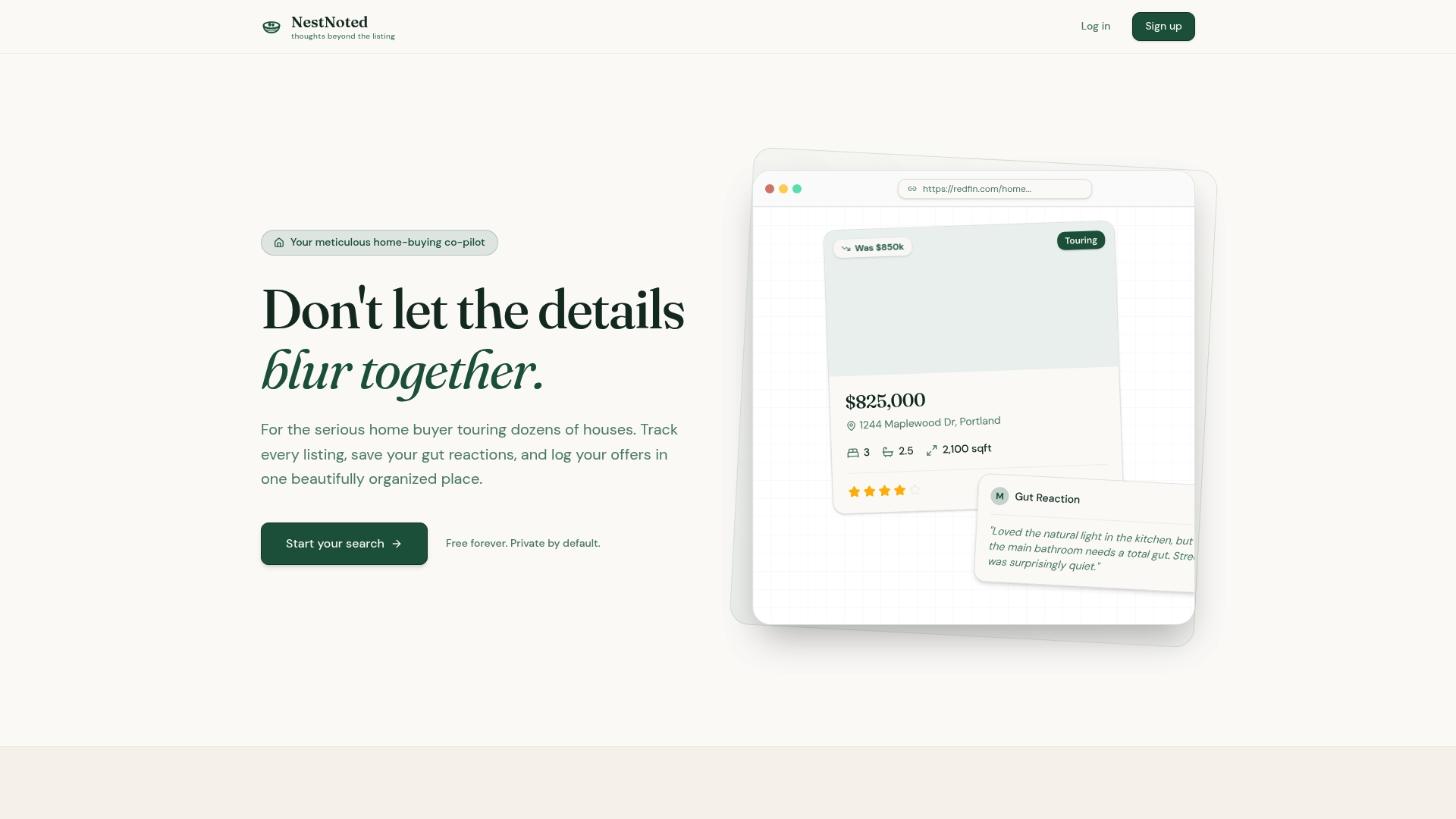
- Notes can remain private by default, with sharing controlled by invitation.
- A property pipeline can track each listing's progress from shortlist through offer stages.
- Side-by-side comparisons allow alignment of finalists on chosen criteria.
- Importing listings from major real estate sites can reduce manual entry.
- Alerts can notify of price or status changes automatically.
- Collaboration features can allow inviting agents or partners to specific properties rather than an entire workspace.
If the workflow in this guide sounds like what your search needs, start a workspace at NestNoted and set up your first few listings before your next tour.
Sources
FAQ
What is a home buying workspace exactly?
A home buying workspace is a private digital tool where you track listings, log tour impressions, compare finalists, and record offer activity in one place. It is distinct from a spreadsheet or messaging thread because it is built around privacy, structured fields, and collaboration with an agent or partner.
How long should I expect to use one during my search?
Plan on using it for the length of your active search, which runs a median of about 10 weeks according to NAR's 2025 data. Most of the value comes from consistent use across every tour, not from a single intensive setup session.
Does a workspace replace my real estate agent?
No, a workspace organizes your notes and comparisons so your agent conversations are more productive, but it does not replace licensed professionals for negotiation, inspections, or closing. Agents often spot issues buyers miss, and clear notes make that input easier to use rather than less necessary.
Can I control who sees my notes on a property?
Yes, a workspace built around privacy keeps notes private by default and only shares them when you send a specific invitation. Checking collaborator permissions before inviting anyone is a quick safeguard worth doing every time.
What does NestNoted cost to use?
NestNoted's pricing is available on request directly through its website. The core workflow features described in this guide, including private notes, pipeline stages, and side-by-side comparison, are part of its current offering.