

A property rating system is a private method for scoring, ranking, and comparing homes you've toured, so you choose based on evidence instead of whichever house you saw most recently. Score immediately after each tour, weight the factors that actually matter to you, and run the results through a weighted decision matrix. There are private tools available that build this exact workflow, replacing the spreadsheet you'd otherwise cobble together.
TL;DR:
- Weighted scoring systems prioritize home aspects that truly matter to the buyer, such as location or condition, with weights ranging from 1 to 5.
- Score homes immediately after each tour with quick notes and photo anchors, recording impressions within hours to preserve detail.
- Use a decision matrix to compare multiple homes, applying thresholds and dealbreakers to avoid rationalizing poor choices later.
- Maintain a private, honest note-taking routine to ensure objective ratings and prevent feature creep from influencing weighting.
- Tools like NestNoted automate this workflow, enabling side-by-side comparisons and AI-assisted questions during the home-buying process.
Table of Contents
- What Does a Property Rating System Actually Include?
- How Do You Build a Weighted Scoring Rubric?
- When Should You Score a Home After Touring It?
- Building a Decision Matrix to Compare Scored Homes
- The Before, During, and After Workflow for Every Showing
- Why Privacy Changes How Honestly You Rate a Home
- What Buyers Get Wrong About Rating Systems
- How NestNoted Puts This System Into Practice
- Sources
What Does a Property Rating System Actually Include?
A workable system has six moving parts, and skipping any one of them is why most buyers' notes turn into a jumbled mess by the fifth showing.
- Scoring dimensions: the categories you judge every house against, such as location, layout, condition, price relative to comps, and outdoor space (see AAS Home Buyers | Sell Your House Fast Nationwide).
- A numeric scale: usually 1 to 5, simple enough to fill in on your phone while standing in a driveway.
- Weights: a multiplier that tells you which dimensions matter more to your specific search.
- Quick notes: a sentence or two capturing the thing a number can't, like "kitchen faces a busy road."
- Photo anchors: images tagged to the exact note or score they support, so a photo of a cracked driveway sits next to your "condition: 2" score instead of floating in a generic camera roll.
- Timestamps: proof of when you scored the house, which matters because scoring immediately after a tour preserves detail that fades within hours.
Here's a quick example: a typical home might score 4 on location, 3 on layout, 2 on condition, 4 on price versus comps, and 3 on amenities. Unweighted, that's a mid-range total score. Nothing here resembles an appraiser's condition code or an insurer's risk classification. This is your private read on whether a house fits your life, which is a different question than whether it meets a lender's or insurer's standards.
How Do You Build a Weighted Scoring Rubric?
A rubric only works if the weights reflect what you'd actually regret ignoring, not what sounds responsible on paper. Follow these steps before your first tour.
- Pick 5 to 7 dimensions. Start with location, layout, condition, price versus comps, outdoor space or lot, and amenities or commute time. More than seven and you'll abandon the system by week two.
- Assign each dimension a weight from 1 to 5. A weight of 5 means "this can sink an otherwise great house." A weight of 1 means "nice, but I won't lose sleep over it."
- Choose your scale and stick to it. A 1 to 5 scale per dimension keeps entries fast and comparisons clean across dozens of properties.
- Multiply score by weight for each dimension, then add them up. That total is your comparable number across every house you've toured.
- Set a walk-away threshold now, before you fall for anything. Decide the total score below which you won't make an offer, no matter how charming the crown molding is.
Weight sets vary sharply by buyer type. A budget-first buyer might weight price versus comps at 5 and amenities at 2. A location-first buyer flips that, often putting commute or school district at 5 and condition at 3, since cosmetic issues are fixable and a location is not. A renovation-ready buyer might weight condition at just 1, treating a dated kitchen as an opportunity rather than a defect, while pushing layout and lot size to 5.
Realtor.com recommends building a master list of must-haves versus nice-to-haves before you ever schedule a showing, which is essentially the weighting exercise above, done on paper first.
Pro Tip: Write your weights down before your first tour and don't touch them for at least two weeks. Adjusting weights mid-search after falling for one house is how buyers talk themselves into ignoring their own dealbreakers.
When Should You Score a Home After Touring It?
Score it in the car, in the driveway, or on the sidewalk outside, but score it before you drive to the next showing. Waiting until that evening means you're rating a memory, not a house, and memories flatten details fast. Practitioner guidance is consistent on this point: the window for accurate scoring closes within hours, not days.
A 30 to 60 second voice note captures more than most people write in five minutes of typing. Try this structure out loud: property address, one-sentence gut reaction, your single biggest hesitation, and one line comparing it to the last house you saw. Then run through your rubric out loud, dimension by dimension, assigning a number to each.
Your quick scoring checklist on the drive away should hit:
- Say the address and today's date out loud first.
- Give a one-line emotional reaction before you second-guess it.
- Score each rubric dimension, 1 to 5, no explanations yet.
- Name your single biggest concern about the house.
- Tag two or three photos to the specific notes they support, not just "kitchen" or "backyard."
Tagging photos this way turns your camera roll into evidence instead of a scrolling blur of granite countertops that all start to look the same by house number twelve.
Building a Decision Matrix to Compare Scored Homes
Once you've scored four or five homes, list them as rows and your weighted dimensions as columns, then total each row. This is the decision matrix method: list factors, assign importance, score each option, sum the weighted results. The house with the highest total isn't automatically the winner, but it's your starting point for a real conversation instead of a coin flip.
Close scores need rules, not vibes. Try these:
- Apply a 5 percent threshold rule. If two homes land within 5 percent of each other's total, treat the tie by focusing only on your top two weighted dimensions rather than reweighing the entire rubric after the fact.
- Check non-negotiables first. If one home fails a dealbreaker regardless of its total score, it's out, no matter how close the math looks.
- Schedule a second visit when the gap is genuinely close. Use your first-visit scores to build a targeted follow-up checklist: recheck the dimension where the scores differed most, not everything all over again.
Reweighing your whole rubric after you've already fallen for a house is how buyers rationalize a bad decision after the fact. The matrix exists specifically to stop that.
The Before, During, and After Workflow for Every Showing
Consistency beats intensity. The same three-phase routine, run on every single showing, is what makes forty toured homes comparable instead of forty disconnected impressions.
- Before: Pre-fill the property address, your top three priorities for this specific house, your price cap, and two or three recent comps. Zillow notes that private tours let you focus and inspect more closely than open houses do, so use that quiet time well.
- During: Take photo anchors as you walk, record a 30-second voice note before leaving the driveway, and jot one number per rubric dimension while it's fresh.
- After: Score immediately, write a tight three-line recap covering reaction, hesitation, and comparison edge against your last showing, then schedule any follow-ups, like pulling updated comps or drafting inspection questions.
That three-line recap format, built around reaction, comparison edge, and next step, does more work than a page of loose bullet points because it forces you to name the one thing that actually moved your opinion.
Pro Tip: Keep a running list of "comps I checked" alongside your scores. Six weeks in, you'll forget which listings you already ruled out on price, and re-touring a home you rejected in March wastes a Saturday.
Why Privacy Changes How Honestly You Rate a Home

Notes you know nobody else will see are notes you'll actually be honest in. Write "the in-laws would hate this layout" or "smells like the last owners had eight cats" in a shared document, and you'll soften it. Keep it private by default, and you'll write what you really think, which is the only version of the note that's useful six weeks later.
Buyers and agents still need to collaborate without losing that candor. The patterns that work:
- Private notes stay private until you choose to share them.
- Shared workspaces let an agent see your scores on request, not by default.
- Version history shows how a score changed as you learned more about a property.
NestNoted structures this exact split: your notes and ratings stay confidential unless you invite your agent in, which keeps your honest first impression intact instead of diplomatically edited for an audience.
What Buyers Get Wrong About Rating Systems
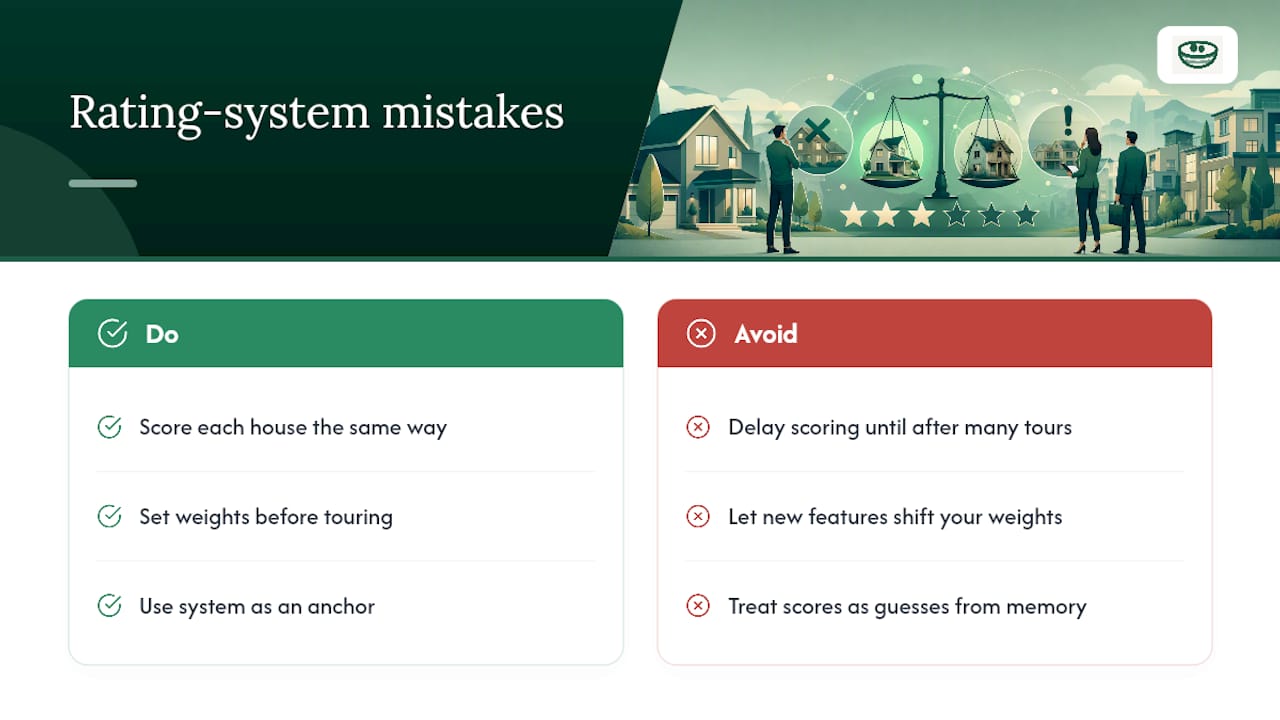
Buyers treat rating systems as a formality they'll get to eventually, usually after they've already toured a dozen homes from memory. By then the numbers are guesses dressed up as data. Score the first house you see the same way you'll score the fortieth, or the whole comparison falls apart.
The other trap is feature creep. A house with a wine cellar you didn't ask for can quietly shift your weights until price and location stop mattering. A rating system built before you started touring is the anchor that stops that drift, not a mood board you adjust to fit whatever you saw last weekend.
— Antony
How NestNoted Puts This System Into Practice
Some apps are built around the workflow this guide describes, including private ratings and notes on every dimension you decide matters, side-by-side comparisons that do the weighted math for you, and an AI assistant you can ask direct questions like "which house scored highest on commute time?"

Getting started takes three steps: create an account, import listings you're already tracking from sites like Zillow or Redfin, and apply a rubric template to your first toured home. From there, every showing feeds the same comparison, so house number thirty is judged by the same standard as house number one. If you're currently juggling screenshots, texts to your agent, and a half-finished spreadsheet, try the AI assistant on your next batch of tours and see how much faster a real answer comes back than scrolling your camera roll.
Sources
For deeper reading on timing and scoring accuracy, see Opendoor's house tour guide and Realtor.com's note-taking tips. For ready-to-use templates, check NestNoted's home decision matrix and property viewing checklist.
- What to look for on a house tour — Opendoor
- How to Compare Houses After Showings — ShowingRecap
- How to choose between two houses — StaMatrix