

The fastest way to remember houses you've toured is a private, repeatable routine: capture the high-signal facts and gut reactions the moment you walk out, score the house on a simple scorecard, and review everything within an hour while the details are still sharp. A tool like NestNoted can run this whole loop for you privately. Skip the notepad. Record a 30 to 60 second voice note before you get back in the car.
TL;DR:
- Capturing a voice note immediately after each showing about strengths, hesitations, comparisons, and next steps prevents memory blurring and saves hours of re-evaluation later.
- Taking objective details such as address, price, condition issues, and dealbreakers in the driveway ensures accurate comparisons and fixed estimates for repairs.
- Using a weighted scorecard helps quantify impressions across categories like fit, condition, value, and emotional response, reducing decision fatigue.
- Consistently photographing and narrating a short video during each tour creates a matched visual record, simplifying follow-up reviews.
- Reviewing notes twice—within an hour and two to three days later—sharpens decisions and avoids cognitive drift based on vivid but incomplete memories.
Table of Contents
- How to Remember Houses You Toured Without Losing the Details
- What Should You Capture Immediately After a Showing?
- Building a Rating Scorecard That Actually Compares Homes
- Capturing Photos, Video, and Voice Notes Without Slowing Down the Tour
- Turning Captures Into Decisions After the Tour
- Sample Templates and Private Workflows With NestNoted
- Why Capture Habits Beat Memory Every Time
- Start Tracking Every Showing Before You Forget the First One
- Sources
- FAQ
How to Remember Houses You Toured Without Losing the Details
Buyers who tour multiple homes in a single search typically see 10 to 15 properties before they make an offer, and somewhere around house six or seven, the kitchens start blending together. That's not a memory problem you can fix by trying harder. It's a capture problem, and it has a straightforward fix.
The standard industry term for this is a "post-showing capture routine," and it works the same way whether you're the buyer or the agent walking the buyer through. The routine has three moves: capture immediately, rate immediately, review within the hour. Skip any one of those steps and the details start to blur by the time you're touring your third or fourth property that day.
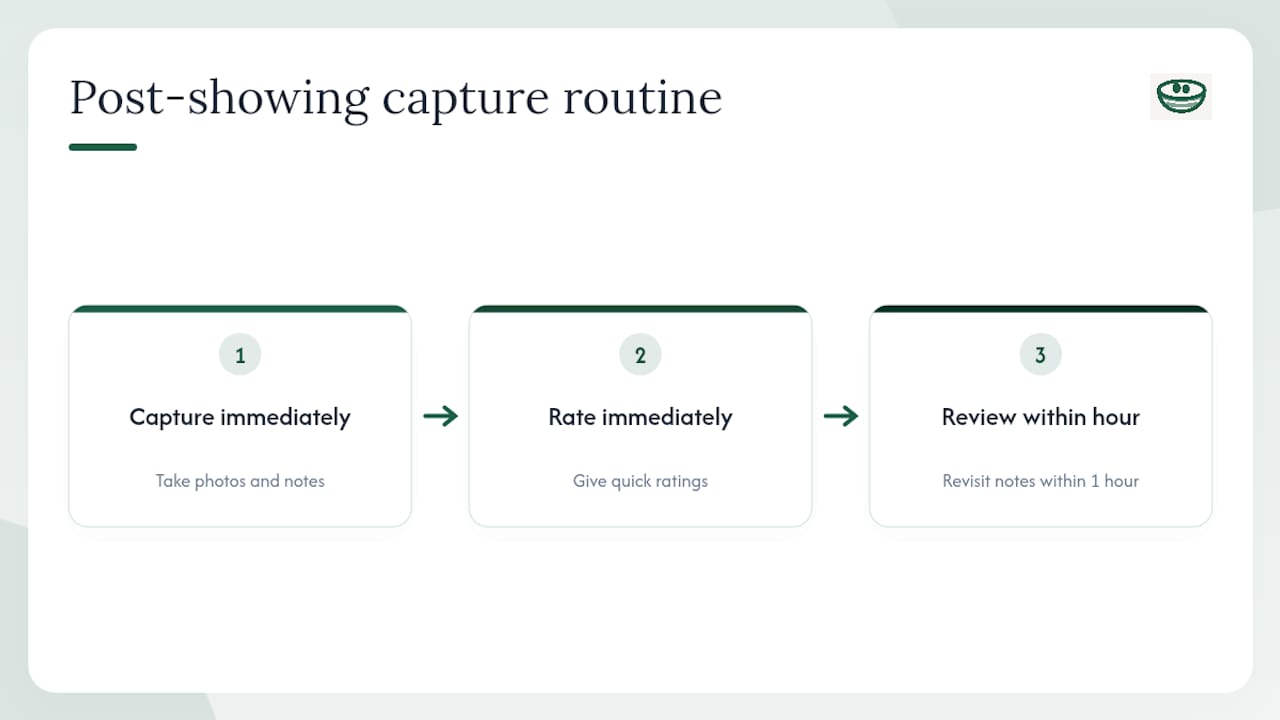
This matters more for serious buyers than casual browsers because the stakes compound. A buyer touring four homes on a Saturday and comparing them against three more from the week before isn't just forgetting paint colors. They're forgetting which house had the cracked foundation corner and which one had the noisy street. Structured capture prevents that specific kind of costly confusion.
What Should You Capture Immediately After a Showing?
The window for accurate recall closes fast. Within a day, emotional impressions fade and factual details start merging with the next house you see. Capture these four things before you leave the driveway, not after you get home:
- The strongest positive — the one feature that made you pause and reconsider the whole search.
- The biggest hesitation — whatever gave you pause, whether it's the layout, the smell, or the neighbor's fence six inches over the line.
- The comparison point — how this house stacks up against the last one you toured, in one sentence.
- The next action you own — call the inspector, ask the agent about HOA fees, check the school district boundary.
Beyond those four, log the objective facts too: exact address, list price, bed and bath count, obvious condition issues (roof age, water stains, foundation cracks), and any HOA rules that could be dealbreakers. If something is a flat no, write it down as a deal-breaker immediately, along with a rough dollar estimate for anything that needs fixing. Guessing "maybe $15,000 for a new roof" while standing in the driveway beats trying to reconstruct that estimate three weeks later.
Pro Tip: Do this capture step standing in the driveway or sitting in your car before you drive to the next showing. Once you're behind the wheel and thinking about traffic, the details start slipping.
Building a Rating Scorecard That Actually Compares Homes
A reusable one-page scorecard with numeric scores turns fuzzy impressions into something you can actually compare side by side. Without it, you're relying on vague memories of "the one with the nice backyard," which falls apart fast once you've toured a dozen homes with nice backyards.
Rate each home on a 1 to 5 scale across categories that reflect what actually matters to you:
- Fit — does the layout work for how you actually live?
- Condition — roof, HVAC, foundation, and anything visibly deferred.
- Value — price relative to comparable listings in the area.
- Location — commute, schools, walkability, noise.
- Renovation effort — what needs fixing before move-in versus what can wait.
- Emotional fit — the gut reaction, because it's real and it counts.
Not every category deserves equal weight. If schools matter more to you than kitchen finishes, multiply that score by two before totaling. A simple weighted composite score does more to cut through decision fatigue than a dozen paragraphs of notes ever will. NestNoted's home comparison chart gives you a ready-made template for this instead of building one from scratch in a spreadsheet.
Leave room on the same page for a quick first-year cost estimate (repairs, HOA dues, property tax bump) and any red flags that need follow-up. Finish scoring within the hour. Scores you assign the next morning tend to drift toward whichever house you remember most vividly, not the one that actually scored best.
Capturing Photos, Video, and Voice Notes Without Slowing Down the Tour
Media capture only works if it's fast enough that it doesn't turn every showing into a 40-minute production. The goal is consistency, not perfection.
- Shoot photos in the same order every time: front exterior, entry, living room, kitchen, primary bedroom, bathrooms, yard, then any problem areas last. When every house follows the same sequence, flipping through your camera roll later feels like flipping through a matched set instead of a jumbled mess.
- Record a 1 to 3 minute walkthrough video with one narrated line about your strongest impression, said out loud as you film. Six months from now, hearing your own voice say "the light in this kitchen is incredible" tells you more than a silent video ever could.
- Use the four-capture voice note the moment you're back in the car: strongest positive, biggest hesitation, comparison point, next action. This 30 to 60 second habit preserves the tone and urgency in your own voice, which typed notes almost always flatten out.
- Pin the address on a map as you go, and jot the drive time back to work or the kids' school. A pinned map gives you a spatial anchor that makes recall dramatically easier once you're comparing eight houses spread across three zip codes.
Pro Tip: Narrate your video like you're leaving a voicemail for your future self. "This is the one with the weird step down into the sunroom" is more useful six weeks later than any amount of silent B roll.
Turning Captures Into Decisions After the Tour
Review your notes twice, not once. The first pass happens within an hour of leaving the property, while the voice notes and photos are still fresh. This is a quick scan, not a deep analysis: confirm the scorecard is filled in and the voice note actually recorded.
The second pass happens 24 to 72 hours later, once you've seen everything on your list for that stretch. This is where side-by-side comparison earns its keep.
- Line up every house using the same scorecard and the same photo order, so you're comparing kitchen to kitchen and not kitchen to backyard.
- Sort by composite score first, then read the voice-note transcripts for the top three to catch anything the numbers missed.
- Decide next steps house by house: pull comps, book an inspection, draft an offer, or shelve it for now. A side-by-side comparison template makes this pass faster than rebuilding a spreadsheet every weekend.
- If a house clears your scorecard threshold and you're ready to move, understanding the difference between an inspection and an appraisal helps you sequence the next steps correctly.
Cap yourself at a few showings per outing. Touring more than a few in one day is how good houses start blurring into mediocre ones, and no scorecard fully undoes that kind of fatigue.
Sample Templates and Private Workflows With NestNoted
The workflow above only sticks if the tool behind it is faster than a notes app and private enough that you'll actually write down the truth. A personal property management tool can run on a simple loop: capture, tag, score, compare, share selectively.
- Capture photos, a short video, and a voice note straight from your phone during or right after the showing.
- Tag each entry by address, date, and category (kitchen, foundation, HOA, dealbreaker) so nothing gets lost in a generic camera roll. Score the house using weighted categories, saved against that address. Compare any two or more houses side by side using identical fields, optionally pulling in listing data synced from sites like Zillow and Redfin. Share selectively with your agent or partner, choosing exactly which notes go out instead of exposing your entire file.
Notes kept private by default mean you can write candid feedback without worrying it becomes public, helping produce useful notes weeks later. NestNoted's buyer feedback template and home tour checklist give you a starting structure instead of a blank page.
Why Capture Habits Beat Memory Every Time
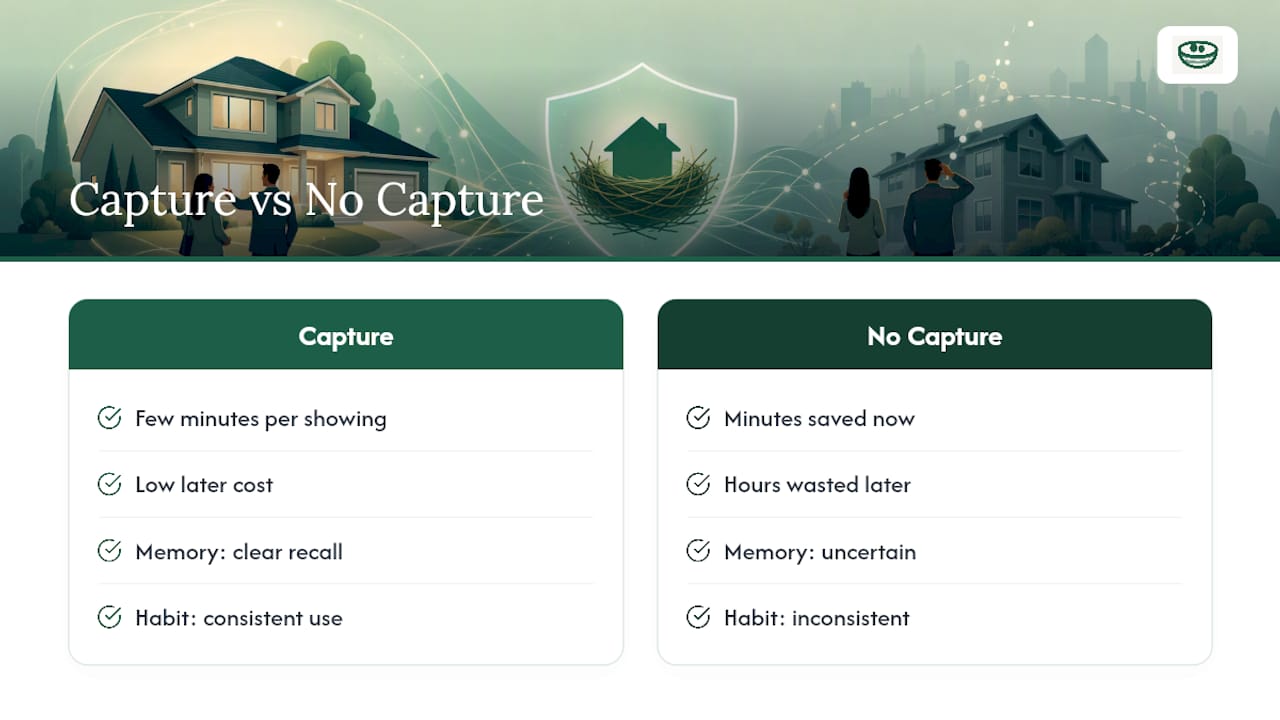
I once watched a buyer schedule a second tour of a house she'd already seen three weeks earlier, purely because she couldn't remember if the primary bedroom faced the street or the backyard. That's a wasted afternoon that a 30-second voice note would have prevented entirely.
Agents and buyers both face the same trade-off: a thorough capture routine costs a few minutes per showing, while skipping it costs hours of confusion and re-touring later. The math isn't close. Pick one system, whether it's a notes app, a paper scorecard, or NestNoted, and use it on every single showing. Consistency beats sophistication here.
— Antony
Start Tracking Every Showing Before You Forget the First One
A personal property management tool can be an alternative to juggling texts, camera rolls, and scattered spreadsheet tabs while touring dozens of homes. Each listing gets a private file for notes, tags, photo order, and a comparison-ready scorecard, with the ability to sync details from sites like Zillow and Redfin instead of retyping them. Offers, pros and cons, and price drop alerts can live in the same private workspace, shareable with your agent only when selectively shared.
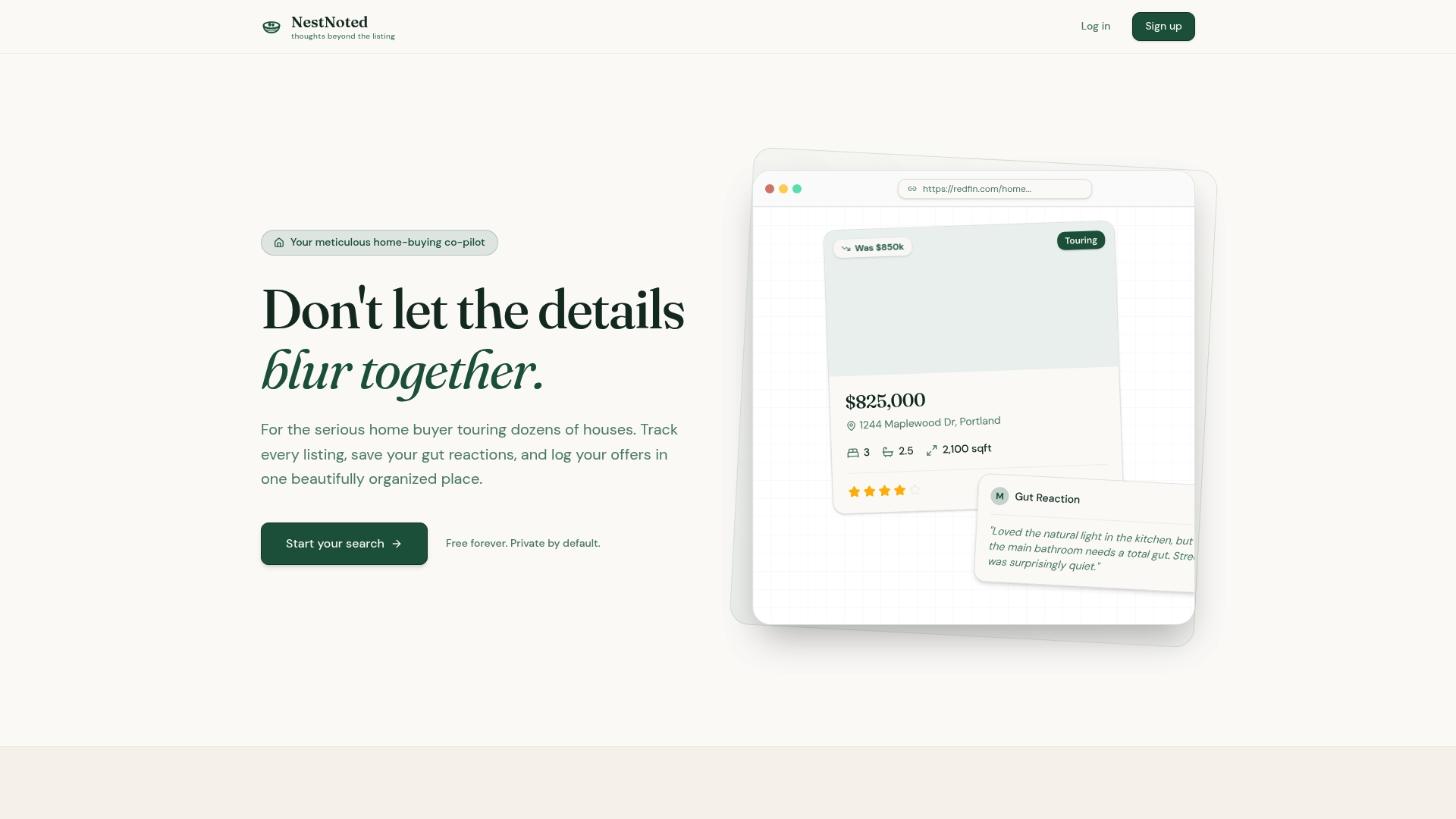
Sign up free and keep every showing private, organized, and impossible to mix up. Start your first property file at NestNoted before your next tour and you'll never have to guess which house had the good light again.
Sources
- Homebuying Step 4 - Touring Homes - Liz Walker Real Estate
- How to Remember Client Details After Showings | ShowingRecap
- House Hunting Checklist: Compare Homes Better
- Coping with homebuyers' short-term memory | Inman Real Estate News
- Touring Multiple Homes in a Day? Here’s How to Stay Organized and Clear-Headed | Real Estate Resources
FAQ
How Do I Remember Details From Houses I've Toured?
Capture a 30 to 60 second voice note covering your strongest impression, biggest hesitation, comparison point, and next action immediately after leaving each showing, then review it within the hour.
What Should I Photograph at Every Showing?
Shoot the same sequence every time: front exterior, entry, living room, kitchen, primary bedroom, bathrooms, yard, and any problem areas, so photos line up consistently when you compare houses later.
How Many Houses Should I Tour in One Day?
Cap it around three or four showings per outing; touring more than that tends to blur details and produce lower-quality decisions once you sit down to compare.
Is NestNoted Free to Use for Tracking Toured Homes?
NestNoted currently offers its core features, including private notes, tags, and side-by-side comparisons, free with account registration.
When Should I Compare Homes After Touring Them?
Do a quick review within an hour of leaving each showing, then a deeper side-by-side comparison 24 to 72 hours later once you've seen everything on that day's list.