

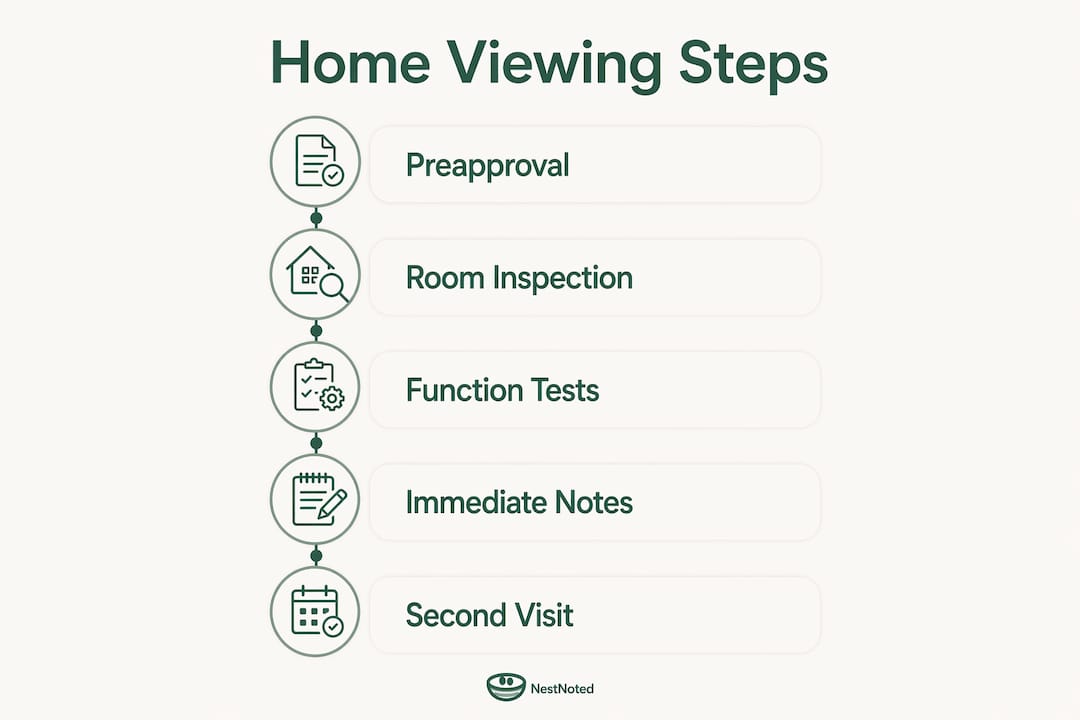
Focus first on three things the moment you walk in: confirm your mortgage preapproval matches the asking price, ask the seller's agent for the age of the HVAC, roof, and water heater and run quick function tests before you spend another minute on decor. Record everything immediately. Details blur fast when you're touring multiple homes in a weekend.
Do this in your first five minutes:
- Confirm your preapproval ceiling covers this home's list price before you invest emotional energy
- Ask the agent: "How old is the roof, HVAC, and water heater?" Write the answers down
- Run one faucet, flush one toilet, flip a light switch, and plug your phone charger into an outlet
- Take wide-angle photos of every room plus close-ups of anything unusual
- Request seller disclosures and any recent permit records on the spot
Table of Contents
- What does the best home viewing checklist cover room by room?
- What should you ask about big-ticket systems?
- What red flags should stop you in your tracks?
- How do you run quick function tests during a showing?
- How should you prepare before a showing?
- How Nestnoted keeps your viewing notes organized
- When should you visit a neighborhood to check traffic and parking?
- Key Takeaways
- The habit most buyers skip
- Nestnoted helps you move from viewing to offer with confidence
- Useful sources
What does the best home viewing checklist cover room by room?
A room-by-room approach keeps you from getting distracted by staging and missing the things that actually cost money.
Exterior
| Area | What to check | Quick score (1–5) |
|---|---|---|
| Roof | Missing shingles, sagging sections, heavy moss growth | |
| Gutters | Clogs, rust, separation from fascia | |
| Siding/brick | Cracks wider than a coin, bulging, damp patches | |
| Grading/drainage | Ground slopes away from foundation | |
| Driveway | Cracks, drainage, parking capacity | |
| Fencing | Condition, property line clarity | |
| Curb appeal | Overall maintenance standard |
Interior room-by-room prompts
- Living areas: Uneven floors, ceiling stains, fresh paint patches over problem spots, outlet count and placement
- Kitchen: Cabinet interiors for moisture or pests, under-sink plumbing, appliance operation, counter space and layout
- Bathrooms: Mold at grout lines and ceiling corners, extractor fan operation, shower pressure, toilet flush, caulk seals around tub
- Bedrooms: Closet depth and storage volume, natural light at this time of day, window condition, room dimensions for your furniture
- Basement/crawlspace: Musty odor, standing water, visible cracks in foundation walls, insulation condition
- Attic: Daylight visible through roof deck, insulation depth, signs of moisture or pest activity
Measurement prompts: Ceiling height in main living areas, closet depth and width, kitchen counter run length, doorway widths for moving large furniture. Jot these in a notes column next to each room score.
What should you ask about big-ticket systems?
The age and maintenance history of the HVAC, water heater, and roof are the three numbers that most directly predict your first-year repair costs. Ask for all three before you leave.
Questions to ask on-site:
- HVAC: Age, last service date, filter change frequency, known issues, warranty status and transferability
- Water heater: Age, fuel type, capacity (gallons), last flush or anode rod replacement
- Roof: Age, material, last repair, any active leaks or insurance claims filed
- Major appliances: Which stay with the home, age, and whether manuals or service records are available
- Electrical panel: Age, amperage, any recent upgrades or known tripping issues
- Plumbing: Material (copper, PVC, galvanized), any known leaks or slow drains
Documents to request immediately after the showing:
- Service receipts for HVAC and water heater
- Roof installation or repair invoices
- Permit records for any additions, finished basements, or structural changes
- Homeowners association rules and fee schedule if applicable
- Ask about flood zone status and whether the seller has filed any insurance claims
Pro Tip: Use system ages as a rough budget tool. A gas water heater typically lasts around a decade; a central HVAC system usually serves well for many years; an asphalt shingle roof commonly endures multiple decades. If the HVAC is 18 years old, price a replacement into your offer negotiation before you fall in love with the kitchen.
What red flags should stop you in your tracks?
Some warning signs are cosmetic. Others signal five-figure repairs. Know the difference.
The single most reliable red flag is your nose. Musty or damp odors in a basement, closet, or bathroom almost always mean active moisture intrusion. Fresh paint and plug-in air fresheners can mask the smell temporarily, but they cannot fix the source. If you smell it, treat it as a structural issue until a professional inspection proves otherwise.
Priority red flags to document immediately:
- Musty/damp odors anywhere in the home, especially in closets and below grade
- Water stains on ceilings, walls, or around windows — brown rings indicate past or ongoing leaks
- Diagonal cracks running from corners of door frames or windows, which suggest foundation movement rather than normal settling
- Sagging roofline visible from the street, indicating structural failure in the roof deck or rafters
- Active leaks under sinks, around toilets, or at the base of the water heater
- DIY electrical or plumbing without visible permits, especially in finished basements or added rooms
- Signs of pests: frass (sawdust-like debris near wood), mud tubes near the foundation, or droppings in cabinets
Staging and cosmetic updates can mask major issues. When you see fresh paint in one isolated area, furniture placed against a specific wall, or a rug covering part of the floor, look underneath and around those spots. Real problems rarely get full renovations before a sale.
If you find two or more red flags, pause on making an offer and schedule a professional inspection first.
How do you run quick function tests during a showing?
Most showings last about half an hour to an hour. These tests fit inside that window and reveal the problems that photos never show.
- Faucets and water pressure (1–2 min per bathroom): Turn on the sink and shower simultaneously. Low pressure or a significant drop when both run points to plumbing issues.
- Hot water timing (2–3 min): Run the kitchen or master bath faucet and time how long it takes to reach hot. More than two minutes suggests a distant or undersized water heater.
- Toilet flush (30 sec each): Flush every toilet. Watch for slow drainage, running water after the tank refills, or wobble at the base.
- Electrical outlets and switches (2–3 min total): Plug your phone charger into outlets in each room. Flip every light switch. A dead outlet or a switch that controls nothing warrants a closer look at the panel.
- HVAC operation (3–5 min): If the seller permits it, switch the thermostat to heat, wait two minutes, then switch to cool. Listen for unusual sounds and feel for airflow at registers.
- Windows and exterior doors (1–2 min): Open and close every window and exterior door. Sticking, gaps at the frame, or broken locks are both security and energy concerns.
Record results immediately: a quick voice memo or typed note in your phone is faster than writing. Flag anything that warrants follow-up with an asterisk so you can ask the agent before you leave.
How should you prepare before a showing?

Efficiency at a showing starts before you arrive. Getting preapproved for a mortgage before touring homes keeps you focused on properties you can actually buy and strengthens any offer you make.
What to bring:
- Measuring tape (25-foot minimum)
- Flashlight for attics, crawlspaces, and dark corners
- Phone with storage cleared for photos and video
- Printed checklist or the Nestnoted app open and ready
- Comfortable shoes that won't damage hardwood floors
Who to bring:
Bring a second person to every showing. One person handles the conversation with the agent while the other works through the technical checklist. Your real estate agent adds market context you cannot get from a listing page, including whether the price is realistic for the neighborhood and how long the property has actually been available. For a second visit, consider bringing a contractor or inspector to get rough repair estimates on anything flagged during the first tour.
Pre-visit tasks:
- Ask the agent for disclosures and property history before you arrive
- Note the best times to observe neighborhood noise and traffic (more on this below)
- Confirm your preapproval letter is current
Pro Tip: Schedule at least two visits at different times of day. A home that feels quiet at 10 AM on a Tuesday can sit next to a school pickup route or a busy bar at 5 PM on a Friday. Light changes too — a north-facing living room that looks fine in morning sun can feel dim all afternoon.
How Nestnoted keeps your viewing notes organized
Paper checklists get lost. Spreadsheets don't attach photos. Nestnoted is built specifically for this problem.
What Nestnoted does for buyers:
- Tracks every listing privately, with notes visible only to you by default
- Syncs listing data from Zillow and Redfin so you're not re-entering addresses
- Lets you attach photos and test results directly to a property entry
- Compares homes side by side so you're not relying on memory after touring a dozen places
- Sends price-drop alerts and maintains an offer pipeline
- Includes an AI assistant that can query your own property notes
Viewing-day workflow with Nestnoted:
| Step | Action |
|---|---|
| Before you leave | Create a property entry, pull listing data, open the room-by-room checklist template |
| During the showing | Attach photos, log quick test results, tag big-ticket questions for follow-up |
| Immediately after | Add impressions while they're fresh, rate the property, note red flags |
| Next steps | Share selected notes with your agent privately, schedule a professional inspection |
Document impressions immediately after leaving a showing. Details blur quickly when you're touring multiple properties, and your notes become the foundation your inspector works from later. Nestnoted keeps all of that in one place, private by default, and shareable with your agent when you're ready.
When should you visit a neighborhood to check traffic and parking?
A single showing tells you almost nothing about what it's like to live there. Drive the route to work during actual rush hour, not at 11 AM on a Saturday. Visit on a weekday evening to see where residents park, whether street parking is genuinely available, and how loud the neighborhood gets after dark.
Check parking rules specifically: some streets have permit-only zones that don't apply to visitors during a daytime showing. If the home has a single-car garage and no driveway, that's worth stress-testing before you commit. School zones, transit stops, and commercial corridors all affect traffic patterns at specific times. A quick second visit at a different hour answers questions no disclosure form will.
Key Takeaways
A thorough home viewing combines preapproval, room-by-room inspection, quick function tests, and immediate documentation so no critical detail is lost between the showing and the offer.
| Point | Details |
|---|---|
| Preapproval first | Confirm your mortgage preapproval before touring so every home you view fits your budget. |
| Ask for system ages | Request the age of the HVAC, water heater, and roof at every showing to estimate near-term costs. |
| Run function tests | Test faucets, toilets, outlets, and HVAC during the showing to catch problems photos miss. |
| Document red flags immediately | Musty odors, water stains, and diagonal cracks warrant a professional inspection before any offer. |
| Use Nestnoted to organize | Nestnoted tracks listings, attaches photos, and compares homes side by side with notes private by default. |
The habit most buyers skip
Most buyers walk into a showing hoping to fall in love. That's understandable. But the buyers who make the best decisions treat the first visit as a data-gathering exercise and save the emotional response for after the inspection report.
The checklist matters less than the habit of using one consistently. A buyer who scores every home on the same criteria, asks the same questions at every showing, and records answers immediately will outperform a buyer who relies on memory and gut feel, even if that second buyer has more experience. The discipline of a consistent process is what separates buyers who negotiate from a position of knowledge from those who negotiate from a position of attachment.
One more thing: the second visit is not optional. Viewing a property for about 30 minutes once is not enough to make a six-figure decision. Go back at a different time of day, bring a contractor if anything was flagged, and trust what you observe over what you're told.
Nestnoted helps you move from viewing to offer with confidence
Touring homes is the easy part. Keeping track of what you saw, what you asked, and what needs follow-up across a dozen properties is where most buyers lose ground.

Nestnoted gives you a private, organized workspace to log every showing, attach photos, compare homes side by side, and share notes selectively with your agent. There are no messy spreadsheets, no lost text threads, and no "wait, which house had the old HVAC?" moments at offer time. All notes stay private by default, so you can be candid without worrying about anything reaching the seller. Start tracking your home search free at Nestnoted.com and go into your next offer with every detail documented and ready.
Useful sources
- 10 Questions to Ask When Viewing a House — Chase: supports preapproval guidance, flood zone checks, and essential questions to ask sellers and agents
- House Viewing Checklist — Which?: supports the "bring a second person" guidance and multiple-visit recommendation
- What to Look for When Viewing a House — Motto Mortgage: supports big-ticket system checks, plumbing tests, and immediate note capture
- Home Survey Checklist — uSurv: supports the red flags section, including musty odors, water stains, and structural cracks
- Key Viewing Tips for Home Buyers — Prominence Estates: supports the staging-masks-problems guidance
- Your House Viewing Checklist — HomeOwners Alliance: supports the 30-minute viewing statistic and multiple-visit advice
- Why Get Pre-Approved Before Buying a Home — Platinum Capital Advisors: supports preapproval-before-touring guidance
- Nestnoted Real Estate Listing Tracker — Nestnoted: product reference for the viewing workflow and note organization sections