

Use a Personal Kanban board, a visual board plus WIP limits, to organize every listing, tour, and offer during a house search. This method keeps property details visible instead of buried in email threads and screenshots, and it slows you down just enough to compare homes fairly instead of chasing the newest listing. The rest of this guide gives you ready-to-use columns, card fields, and scoring templates.
TL;DR:
- Limiting active touring to three or four homes ensures more consistent scoring and prevents detail mix-ups during a lengthy house search.
- Using WIP limits and clear columns helps maintain focus and track progress across stages like options, touring, offers, and negotiations over several months.
- Incorporating financing and inspection tasks into the same Kanban board avoids delays and keeps all deal components visible and accountable.
- Digital tools like NestNoted automate listing imports and private notes, allowing faster setup and easier comparison compared to manual boards or spreadsheets.
- Regularly archiving off-market listings and re-scoring homes prevents clutter and scoring drift, keeping the board an accurate reflection of your current options.
Table of Contents
- What Personal Kanban is and why it fits house hunting
- Set up a house hunting Kanban board
- Tools, templates and low-effort ways to run the board
- Using the board during tours, scoring homes, and narrowing to offers
- Tie the Kanban to financing, inspection, and timeline milestones
- Common mistakes and how to fix a stalled board
- Illustrative workflow and templates from NestNoted
- How building a board changed my house hunting approach
- Try NestNoted for a private house hunting dashboard
- Sources
- FAQ
What Personal Kanban is and why it fits house hunting
Personal Kanban runs on two rules, according to the Personal Kanban learning page: visualize your work and limit work in progress. A house search breaks both rules by default. Buyers juggle a dozen open tabs, forget which kitchen had the cracked tile, and book three tours in one afternoon because nothing shows them they are already overloaded.

A simple board fixes this. Cards move left to right across columns like Options, Touring, and Done, and a WIP limit caps how many properties you actively pursue at once. Since a house search often runs four to seven months and involves dozens of decisions, a visible board keeps that stretch from turning into a blur of half-remembered showings.
A basic structure looks like this:
- Options: every listing worth a second look, unlimited.
- To Tour: scheduled showings, capped at 4 to 5.
- Touring: homes you have visited and are still scoring.
- Offer or Negotiating: active deals, capped at 1 to 2.
- Done: closed, withdrawn, or passed on.
Set up a house hunting Kanban board
Building the board takes less than an hour, and the setup determines how useful it stays three months in.
- Create six columns: Backlog, To Tour, Touring, Offer, Negotiating, Done. Backlog holds anything you have not vetted yet; Done holds anything finished, whether closed or rejected.
- Give every card the same fields: address, listing link, photos, tour date, needs versus wants score, pros and cons, and any attached documents like a Loan Estimate or inspection quote.
- Set WIP limits per column. Cap Touring at 3 to 4 and Offer or Negotiating at 1 to 2, so you are never juggling more live deals than you can actually track.
- Write short pull policies. A card only moves into Touring once a showing is booked, and only moves into Offer once you have a signed preapproval attached.
- Add a duplicates rule. When the same listing reappears under a different agent or price, merge it into the existing card instead of starting a new one.
Pro Tip: Archive a card the day it goes off-market instead of leaving it in Backlog. A board full of dead listings hides the ones that still matter.
If you are house hunting with a partner or an agent, add a collaborator policy: who can move cards, and which notes stay private until you are ready to share them.

Tools, templates and low-effort ways to run the board
A physical board works well early in a search, when you are still exploring neighborhoods and want something you can glance at on a kitchen wall. Sticky notes with a printed photo taped to the back handle 10 to 15 listings comfortably before it gets cluttered.
Once you are touring seriously, a digital setup scales better. Three broad categories cover most buyers:
- Lightweight kanban apps built for general task management, adapted with property-specific columns.
- Spreadsheet kanban, where a tab mimics columns and rows act as cards, useful if you already track finances in a spreadsheet.
- Dedicated home search dashboards, built specifically for tracking listings, notes, and comparisons in one private place.
Each trades off differently on privacy, photo handling, and how fast you can score a new showing. A generic task app rarely handles photo galleries well, and a spreadsheet gets unwieldy past 20 rows. Whichever you choose, keep the same card checklist and scoring rubric so the board stays consistent as your list grows. A reusable home comparison chart or an open house tracker gives you a starting template instead of building one from scratch.
Using the board during tours, scoring homes, and narrowing to offers
Before a touring weekend, pull only 2 to 4 cards into Touring to respect your WIP limit, and attach a needs versus wants checklist to each one so you are scoring against the same standard every time.
- During the tour, check the same items every time: water pressure, cell signal, roof and HVAC age, street noise, and natural light in the main living areas.
- Photograph the same five spots every showing (front exterior, kitchen, primary bath, mechanicals, street view) so side-by-side comparisons are fair rather than shaped by whichever photos you happened to take.
- Score each card on a simple 1 to 5 scale across your needs list, then a separate 1 to 5 for wants, and note the total on the card.
- Move the highest scorers into Offer once financing is lined up and you have a signed preapproval to attach, and shift the card to Negotiating as soon as an offer is submitted.
Pro Tip: Score immediately after leaving the driveway. Memory fades fast, and a house you loved at 2 p.m. can blur into the one you saw at 4 p.m. if you wait until evening.
Tie the Kanban to financing, inspection, and timeline milestones
Financing and inspection tasks belong on the same board as the listings, not in a separate mental list.
- Represent preapproval and loan offers as their own cards, and use the CFPB's home loan toolkit worksheets to compare Loan Estimates from at least three lenders before picking one.
- Give inspection its own mini-flow: schedule the inspector, collect repair quotes, negotiate, and track completion as sub-tasks on the property's card, since the CFPB recommends booking an inspection as soon as an offer is accepted and choosing an inspector with a strong reputation. A ready-made inspection checklist can sit alongside the card as a reference.
- Expect the whole process to run four to seven months, and let the board's Done column remind you how far you have actually come when the search feels stalled.
- Track document gathering with a mortgage document checklist attached to the financing card, and use a buyer closing checklist as the final gate before a card moves to Done.
Common mistakes and how to fix a stalled board
Boards break down in predictable ways. Watch for these:
- Too many cards in Touring or Offer at once, which usually means the WIP limit was ignored rather than set too low.
- Inconsistent card notes, where some listings have full scoring and others have a single line, making comparison useless.
- Mixing tasks and properties on the same board, so a "call the lender" reminder sits next to a house listing and clutters both.
- Score drift, where later showings get scored more generously just because memory of the early ones has faded.
Fix a stalled board with a weekly triage: archive dead cards, re-score anything that feels off, and reset the WIP limit if you have been ignoring it. If you are sharing the board with an agent, decide up front which notes stay private and which are visible, so candid impressions do not end up in a shared thread.
Illustrative workflow and templates from NestNoted
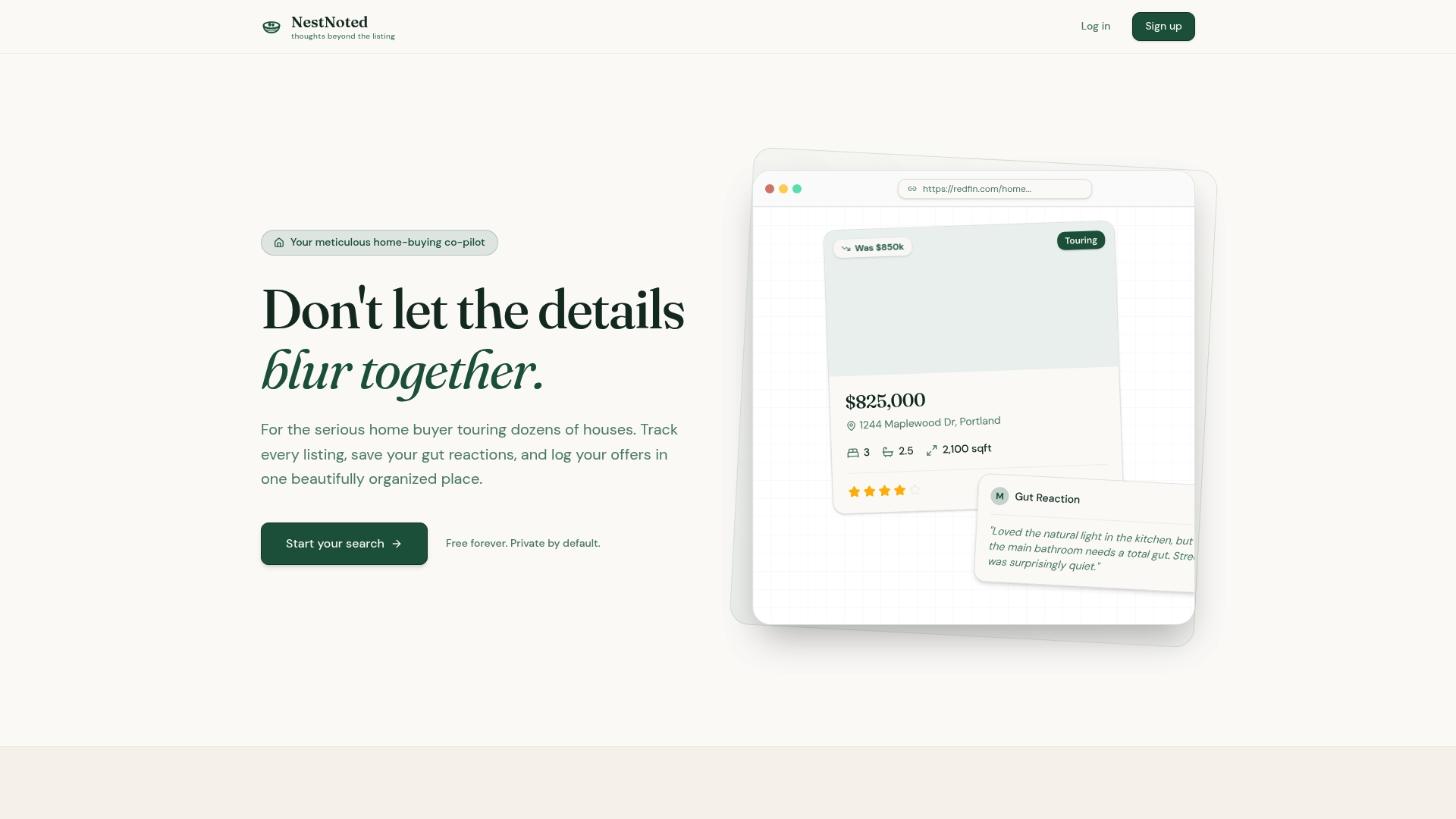
A private dashboard can run the same workflow without the manual setup. Some tools import listings automatically, keep notes private by default, and lay out side-by-side comparisons and price-drop alerts on top of the same board logic described above.
- Import a listing once and it carries photos, price history, and status automatically.
- Keep tour notes and scores private until you choose to share them with an agent or partner.
- Compare shortlisted homes side by side instead of scrolling between browser tabs.
For downloadable structure, NestNoted's home search dashboard guide and first-time homebuyer checklist translate these board steps into templates you can copy directly.
How building a board changed my house hunting approach
Capping Touring at three cards was the single change that helped most. Before that, I was scoring five houses a weekend and forgetting details by Sunday night. Try the rubric for two weekends, then adjust the WIP limit and columns to fit how you actually search.
— Antony
Try NestNoted for a private house hunting dashboard
A physical board or spreadsheet works, but rebuilding columns and card fields by hand takes time you could spend touring. NestNoted gives you that same board logic already built: private notes by default, listings imported from sites like Zillow and Redfin, side-by-side comparisons, and price-drop alerts, so you can start tracking tours and offers the same day instead of setting up a system from scratch.
Set up your first board on NestNoted and bring your next showing straight into it.
Sources
- Personal Kanban - Personal Kanban
- Your home loan toolkit
- The Home Buying Checklist: 12 Steps From Financial Prep to Move-In (2026)
- Schedule a home inspection | Consumer Financial Protection Bureau
FAQ
What is a house hunting Kanban board?
It is a visual board, physical or digital, where each property is a card that moves through columns like Backlog, Touring, Offer, and Done. It applies the Personal Kanban rules of visualizing work and limiting work in progress to a home search.
How many houses should I tour at once?
Keep active Touring cards capped at 3 to 4 so you can give each showing real attention and score it consistently. This WIP limit is a core part of the Personal Kanban method and prevents details from blurring together.
How do I track mortgage steps on the same board?
Give preapproval and loan offers their own cards, and use the CFPB's worksheets to compare Loan Estimates from multiple lenders before choosing one. Keeping financing visible on the board prevents it from stalling a deal you are otherwise ready to make.
When should I schedule a home inspection?
Schedule an independent inspection as soon as your offer is accepted, and choose an inspector with a strong reputation, as recommended by the CFPB. Track the inspection as its own card or sub-task so scheduling, quotes, and repair negotiations do not slip.
Can I run this system without a physical board?
Yes, a private dashboard like NestNoted can hold the same columns and card fields digitally, with imported listings, private notes, and side-by-side comparisons built in. It follows the same visualize-and-limit logic as a sticky-note board without the manual setup.