

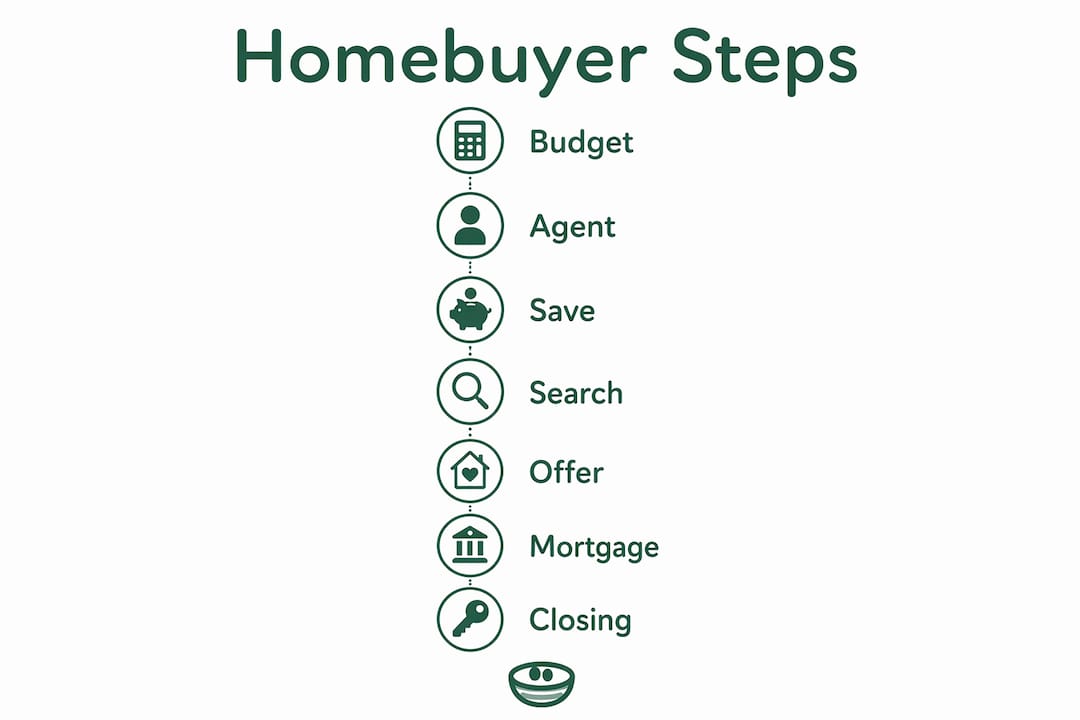
Buying your first home breaks down into eight clear phases: assess your finances, get preapproved, hire a real estate agent, save for upfront costs, search and evaluate homes, make an offer, finalize your mortgage, and close. Follow them in order and the process stops feeling like a maze.
Here is the full checklist at a glance:
- Calculate your budget and debt-to-income ratio
- Check and improve your credit score
- Get mortgage preapproved before touring homes
- Hire a buyer's agent with local market experience
- Save for your down payment and closing costs
- Define must-haves and search neighborhoods
- Tour homes and document your impressions
- Make an offer with protective contingencies
- Complete your mortgage application and underwriting
- Schedule a home inspection and appraisal
- Review all closing documents carefully
- Close, update utilities, and set up your new home
Viewing the home buying process as distinct phases helps you avoid burnout and stay organized from start to finish.
## 1. Determine your budget and explore mortgage options
Your debt-to-income ratio (DTI) is the first number to know. Add up all monthly debt payments, divide by your gross monthly income, and the result tells lenders how much additional debt you can carry. Most conventional lenders prefer a low debt-to-income ratio.
Credit score ranges directly shape the rates you qualify for. Scores above 760 are considered best and unlock the most competitive interest rates, while scores from 700–759 are good, 650–699 are fair, and anything below 650 is poor.
| Credit Range | Category | Typical Impact |
|---|---|---|
| 760 and above | Best | Lowest available rates |
| 700–759 | Good | Competitive rates |
| 650–699 | Fair | Higher rates, stricter terms |
| Below 650 | Poor | Limited options, highest rates |
Steps to assess your finances and mortgage options:
- Pull your free credit report at AnnualCreditReport.com and dispute any errors
- Calculate your DTI using current monthly debts and gross income
- Use a mortgage affordability calculator to set a realistic price range
- Compare loan types: conventional, FHA, VA, and USDA
- Ask lenders about down payment programs that allow as little as 3% down
2. Find and choose a trustworthy real estate agent
A buyer's agent costs you nothing out of pocket. The seller typically covers agent commissions, so you get professional guidance for free. That said, not every agent is equally skilled, and the difference between a mediocre and a great one shows up most during negotiations and inspections.
Interview at least two or three agents before signing a representation agreement. Ask each one how many buyers they represented in the past year, which neighborhoods they know best, and how they handle multiple-offer situations.
Agent selection criteria:
- Years of experience specifically with buyers, not just sellers
- Number of transactions closed in your target neighborhoods
- Verified reviews on Google or a real estate platform
- Responsiveness and communication style during your first call
- Willingness to explain each step rather than rush you through it
3. Save diligently for down payment and closing costs
Down payments range widely. Loan programs allow down payments as low as 3% to 10%, but a larger down payment shrinks your loan, lowers monthly payments, and lets you avoid private mortgage insurance (PMI). PMI typically adds extra cost to your monthly payment until sufficient equity is reached.

Closing costs are separate from the down payment and often catch first-time buyers off guard. They typically cover lender fees, title insurance, appraisal, and prepaid taxes.
If you are buying in Colorado, Colorado First Time Home Buyer connects buyers with down payment assistance programs and first-time homebuyer savings account guidance.
Common upfront costs and savings tips:
- Down payment size varies depending on loan type and individual circumstances
- Closing costs vary depending on the purchase price and fees involved
- Home inspection fee (paid before closing)
- Moving expenses and initial home supplies
- Emergency reserve fund for immediate repairs
Pro Tip: Open a dedicated savings account labeled "Home Purchase" and automate a fixed transfer every payday. Separating these funds from everyday spending makes the goal concrete and harder to raid.
4. Search for homes and evaluate listings effectively
Define your must-haves before you tour a single property. Bedrooms, commute distance, school district, and yard size are examples of criteria that should be non-negotiable. Nice-to-haves, like a finished basement or updated kitchen, are things you can add later or trade off for a better location.
Neighborhoods deserve as much scrutiny as the homes themselves. Visit on a weekday morning and a Saturday evening. Check planned developments, zoning changes, and flood zone maps. A home in a declining area rarely appreciates the way a modest home in a strong neighborhood does.
Home evaluation criteria:
- Structural condition: roof age, foundation, visible water damage
- System ages: HVAC, water heater, electrical panel
- Natural light, layout flow, and storage space
- Proximity to work, schools, grocery stores, and transit
- Noise levels and neighbor density at different times of day
Pro Tip: Nestnoted lets you privately log impressions, rate each property, and compare listings side by side after tours. When you have seen a dozen homes, those private notes are the only thing standing between you and a confused decision.
5. Make an offer and negotiate favorable terms
Your agent will pull comparable sales (comps) to anchor your offer price. In a competitive market, coming in at or slightly above list price with a clean offer often beats a higher price loaded with demands. In a slower market, you have room to negotiate repairs, closing cost credits, or a lower price.
Offers with protective contingencies shield buyers while still encouraging sellers to accept. An inspection contingency lets you walk away or renegotiate if the inspector finds major problems. A financing contingency protects your earnest money if your loan falls through.
Offer preparation and negotiation steps:
- Set your offer price using recent comps, not the list price alone
- Include an inspection contingency and a financing contingency
- Decide on earnest money (typically 1%–3% of purchase price)
- Specify a realistic closing date that works for both parties
- Respond to counteroffers within the timeframe your agent recommends
6. Complete your mortgage application and secure final loan approval
Preapproval is more than a formality. It gives you a verified borrowing limit, structures your search budget, and signals to sellers that you are a qualified buyer. Submit your application to your chosen lender immediately after an offer is accepted.
Documents your lender will require:
- Two years of W-2s or 1099s and federal tax returns
- Recent pay stubs (last 30 days)
- Two to three months of bank and investment account statements
- Government-issued ID and Social Security number
- Documentation of any gift funds used for the down payment
During underwriting, avoid opening new credit cards, taking on car loans, or making large unexplained deposits. Any change to your financial profile can delay or derail final approval.
7. Prepare for closing and moving into your new home
Closing day involves signing a stack of legal documents, paying remaining costs, and receiving your keys. Read every document before you sign. Your Closing Disclosure, which the lender must provide at least three business days before closing, lists every fee. Compare it line by line against your Loan Estimate.
After closing, store your closing documents including the promissory note, deed, mortgage agreement, and inspection report in a fireproof safe or a secure off-site location. You will need them for taxes, refinancing, and insurance claims.
Post-closing to-dos for your first weeks:
- Rekey all exterior locks before your first night in the home
- Locate the main water shut-off valve, electrical panel, and gas valve
- Transfer utilities into your name and confirm they are active
- Set up autopay for your mortgage to avoid any late payments
- Update your address with the USPS, DMV, employer, and bank
8. Understand costs beyond the down payment and closing
Property taxes, homeowner's insurance, and maintenance are ongoing costs that many first-time buyers underestimate. Property taxes vary by county and can be reassessed upward after a sale, sometimes meaningfully in the first year. Homeowner's insurance is required by lenders and covers the structure, but standard policies exclude flooding, so buyers in flood-prone areas need a separate policy through FEMA's National Flood Insurance Program or a private carrier.
Maintenance is the cost most buyers forget to budget for. Water heaters last 8–12 years, HVAC systems need annual servicing, and gutters need cleaning every fall. Setting aside 1%–2% of your home's value annually for maintenance gives you a realistic buffer.
9. Schedule and complete home inspections and appraisals
A home inspection is not required by lenders, but skipping it is one of the costliest mistakes a first-time buyer can make. A licensed inspector evaluates the structure, roof, electrical system, plumbing, HVAC, and more. The written report becomes your negotiating tool and your post-closing maintenance priority list.
The appraisal, ordered by your lender, confirms the home's fair market value. If the appraisal comes in below your offer price, you have three options: renegotiate the price with the seller, pay the difference in cash, or walk away using your appraisal contingency. Your agent will guide you through whichever path makes the most sense given market conditions.
10. Review and understand all documents before closing
The Closing Disclosure is the most important document you will receive before signing. It details your loan terms, monthly payment, closing costs, and cash due at closing. Federal law requires lenders to deliver it at least three business days before your closing date, giving you time to review and ask questions.
Beyond the Closing Disclosure, you will also sign the promissory note (your legal promise to repay the loan), the deed of trust or mortgage (which secures the lender's interest in the property), and the title documents confirming clear ownership. A title search conducted by the title company checks public records for any liens, claims, or easements that could affect your ownership. If anything in any document looks different from what you were quoted or promised, stop and ask before signing.
Key Takeaways
Buying your first home requires financial preparation, professional guidance, and organized tracking from preapproval through closing to avoid costly mistakes.
| Point | Details |
|---|---|
| Credit score drives your rate | Scores above 760 qualify for the best mortgage rates; below 650 limits your options significantly. |
| Down payment affects PMI | Loan programs allow down payments as low as 3%, but putting down less than 10% often triggers PMI, adding to your monthly cost until you reach sufficient equity. |
| Preapproval signals credibility | A preapproval letter gives you a verified budget and shows sellers you are a serious, qualified buyer. |
| Contingencies protect you | Include inspection and financing contingencies in every offer to preserve your right to walk away. |
| Post-closing costs add up | Budget for property taxes, homeowner's insurance, and 1%–2% of home value annually for maintenance. |