

Before you tour a single home or make an offer, pull these together: a government-issued photo ID, your Social Security card or ITIN, recent pay stubs, W-2s and signed federal tax returns from recent years, several months of bank and investment statements, a credit authorization form, and proof of your down payment source. Once you have an accepted offer, add the ratified purchase contract and any seller disclosures. The CFPB recommends using Fannie Mae Form 1003 as a baseline to make sure nothing slips through. Most lenders also want your DTI to be within acceptable limits, per Experian's guidance, so have statements for every recurring obligation ready. If your lender supports digital asset verification, they may pull bank records directly and shorten your upload list considerably.
- Government-issued photo ID (driver's license or passport)
- Social Security card or ITIN documentation
- Pay stubs from the last 30–60 days
- W-2s for the last two years
- Signed federal tax returns for the last two years
- Bank statements: two to three months, all accounts
- Investment and retirement account statements: two to three months
- Credit authorization form
- Proof of down payment and source of funds
- Ratified purchase contract (once available)
Table of Contents
- What does a complete mortgage document checklist include?
- How do DTI and credit affect your mortgage paperwork?
- What timeline and costs should you expect from preapproval to closing?
- How should you organize and securely submit your mortgage packet?
- What extra documents do special situations require?
- Key Takeaways
- Why preparedness and privacy matter more than most buyers realize
- Nestnoted keeps your mortgage paperwork private and organized
- Authoritative sources and further reading
What does a complete mortgage document checklist include?
A lender-ready packet covers six categories. Miss one and underwriting stalls.
Identity and eligibility
- Government-issued photo ID (driver's license, state ID, or passport)
- Social Security card or ITIN letter
- Proof of residency (utility bill, lease, or bank statement showing current address)
- Two-year address history
- Immigration documentation if applicable (visa, green card, work authorization)
Income and employment
Fannie Mae lists pay stubs, W-2s, and tax returns as the core income documents. Self-employed borrowers need more.
- Pay stubs from the last 30–60 days
- W-2s for the last two years
- Signed federal tax returns for the last two years (all pages)
- 1099s if you have freelance or contract income
- Year-to-date profit-and-loss statement and two years of business tax returns for self-employed borrowers
- Documentation of any other income sources (rental, alimony, Social Security)
Assets and reserves
Bankrate's preapproval checklist calls for two to three months of bank and retirement account statements. If any of your down payment is a gift, the donor must provide a signed gift letter and their own bank statement showing the funds.
- Checking and savings statements: two to three months, all pages
- Investment, IRA, 401(k), and brokerage statements: two to three months
- CD or life insurance cash-value statements if used for reserves
- Gift letter plus donor bank statement (if applicable)
- Transfer records showing funds moved to your account
Debts and credit
- Recent statements for auto loans, student loans, and credit cards (last 60 days)
- Documentation of child support or alimony you pay or receive
- Lender credit authorization form
- Any court orders related to recurring financial obligations
Property and purchase documents
- Ratified purchase contract (signed by all parties)
- Seller disclosures
- HOA or condo association documents and fee schedules (if applicable)
- Proof of earnest money deposit (canceled check or wire confirmation)
Special supporting documents
- Bankruptcy discharge papers and trustee statements
- Divorce decree (if relevant to income or obligations)
- Rental history with landlord contact information
- Source-of-funds documentation for any large recent deposits
Pro Tip: Include every page of multi-page statements, even pages marked "intentionally left blank." When printing online statements, confirm the full URL appears at the bottom of each page so lenders can verify authenticity.
How do DTI and credit affect your mortgage paperwork?
Lenders use your documents to do two things simultaneously: calculate your debt-to-income ratio and assess your credit history. Both can trigger additional paperwork requests.
Your DTI is the percentage of your gross monthly income consumed by recurring debt payments. Experian notes that lenders commonly prefer a DTI below 43%. What counts in that calculation: minimum credit card payments, auto loan payments, student loan payments, child support, and alimony. What does not count: utilities, subscriptions, or groceries. Every obligation you list needs a statement to back it up.
DTI Guidance: Experian data shows lenders typically prefer a debt-to-income ratio below 43%. Preparing statements for every recurring obligation, including child support and alimony, prevents last-minute underwriting surprises.
On the credit side, you will not submit your own credit report. The lender pulls it. But Pennymac points out that gathering documents early helps buyers surface fixable issues before final underwriting. A collection account you forgot about, a late payment from three years ago, or a balance that looks higher than expected can all trigger a letter of explanation request.
Pro Tip: Pull your free credit reports from AnnualCreditReport.com before you apply. If you spot a discrepancy, attach a brief explanation letter to your packet. A one-page, factual explanation for a one-off delinquency often satisfies an underwriter without delaying closing.
What timeline and costs should you expect from preapproval to closing?
Preapproval typically takes a few business days once your documents are submitted. Underwriting runs one to four weeks, depending on how complete your packet is and how quickly the appraisal comes back. Closing usually happens 30–45 days after an accepted offer, though loan type and lender workload both affect that window.
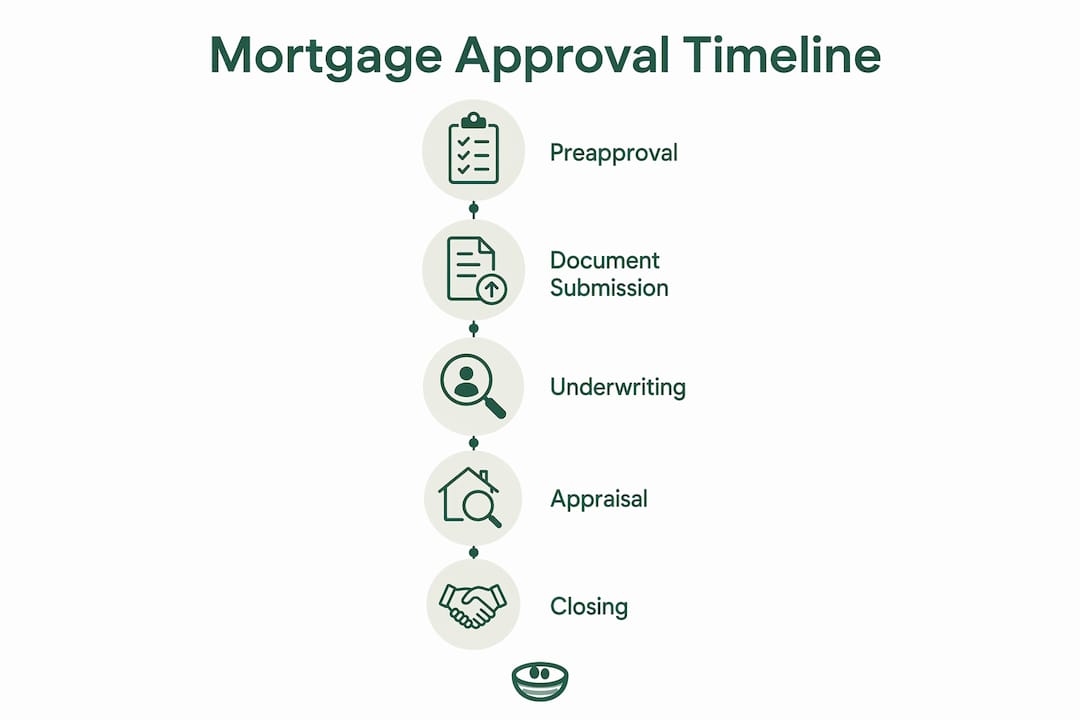
| Stage | Typical Time Range | Common Lender-Requested Fees |
|---|---|---|
| Preapproval | a few business days | Credit report fee |
| Appraisal ordered | several days after application | Appraisal fee |
| Underwriting | one to four weeks | None (internal review) |
| Closing | 30–45 days post-offer | Title search, title insurance, escrow, prepaid taxes and insurance |
Loan type changes the document load and sometimes the timeline. FHA loans require an FHA-approved appraisal and have specific condition requirements. VA loans need a Certificate of Eligibility and a VA appraisal. Jumbo loans often require more asset reserves and additional income documentation. Confirm the specifics with your loan officer before you start collecting.
A few cost items catch buyers off guard: PMI (private mortgage insurance) if your down payment is below 20%, escrow holdbacks for property condition issues, and prepaid homeowners insurance. None of these require extra documents from you, but they will appear in your Loan Estimate and Closing Disclosure, so read both carefully.
For a deeper look at submitting mortgage paperwork through lender portals, the step-by-step workflow there covers what to expect at each stage.
How should you organize and securely submit your mortgage packet?
Use a consistent folder structure and file-naming convention from day one. A pattern like YYYY-MM_DocType_AccountName (for example, 2026-03_BankStatement_Chase) makes it easy to find the right version when a lender asks for an update, which they will.
- Top-level folder:
/Mortgage_2026/ - Subfolders:
Identity/,Income/,Assets/,Debts/,Property/,Special/ - File names:
2026-03_W2_Employer_2024.pdf,2026-03_BankStatement_Chase_Checking.pdf - Version control: add
_v2when you refresh a document mid-process
For submission, use your lender's secure portal whenever possible. If the lender offers digital asset verification, take it. Fannie Mae guidance notes that digital verification lets lenders pull bank records directly, reducing the number of statements you upload manually. Encrypted email or secure upload links are acceptable alternatives; plain email attachments are not.
Keep a change log noting when you downloaded or refreshed each statement. Underwriters often ask for the most recent 30–60 days of statements repeatedly as closing approaches, and knowing exactly when you last pulled each document saves real time.

Pro Tip: Store your change log and submission notes in a private property workspace like Nestnoted. Every document update, lender request, and submission date stays in one place, private by default, and accessible when you need it.
What extra documents do special situations require?
Special circumstances require specific, additional documents. Here is what lenders ask for by scenario.
Self-employed borrowers
- Two years of personal and business tax returns (all pages)
- Year-to-date profit-and-loss statement
- Business bank statements (two to three months)
- Balance sheet and accounts receivable documentation
- Documenting income for a mortgage as a self-employed borrower involves more moving parts than a W-2 file; confirm the exact list with your loan officer early
Recent job change
- Offer letter showing position, start date, and salary
- Pay stubs showing year-to-date earnings at the new employer
- Employer contact information for verbal verification of employment
Bankruptcy or foreclosure
- Discharge papers and trustee statements
- Documentation of resolved debts
- Waiting-period documentation (FHA requires two years post-discharge; conventional loans typically require four years)
Gift funds and large deposits
- Signed donor gift letter stating the funds are not a loan
- Donor bank statements showing the source of funds
- Transfer records and proof of receipt in your account
Foreign income
- Translated and notarized income documents
- Consistent currency conversion evidence across all periods
- Discuss this with your lender before applying; requirements vary significantly
Key Takeaways
A complete, well-organized mortgage document packet assembled before you apply is the single most effective way to speed preapproval and avoid underwriting delays.
| Point | Details |
|---|---|
| Start with the BLUF packet | Collect ID, pay stubs, two years of tax returns, and two to three months of bank statements before anything else. |
| Keep DTI below 43% | Document every recurring obligation; Experian guidance shows lenders commonly prefer a debt-to-income ratio below 43%. |
| Organize with consistent naming | Use a folder structure and file-naming pattern like YYYY-MM_DocType_AccountName from day one. |
| Address credit issues early | Pull reports from AnnualCreditReport.com and attach explanation letters for any delinquencies before underwriting. |
| Use Nestnoted to stay organized | Track document submissions, lender requests, and property notes in one private workspace at no cost. |
Why preparedness and privacy matter more than most buyers realize
Most buyers treat the mortgage document process as a bureaucratic hurdle. That framing costs them. The buyers who move fastest through underwriting are the ones who assembled their packet before they found the house, not after. When a seller has two comparable offers, the one with a clean preapproval letter backed by a complete document file carries real weight.
The privacy angle is underappreciated. Your mortgage packet contains your Social Security number, two years of tax returns, full bank account histories, and details about every debt you carry. Sending that through unencrypted email or storing it in a shared folder is a genuine risk. A private workspace where notes and documents are confidential by default is not a luxury. It is the right way to handle this.
There is also a practical benefit to keeping lender interactions logged. When an underwriter asks for a document you submitted three weeks ago, or a loan officer gives you verbal guidance you later need to reference, having a private record of those exchanges protects you. Most buyers have no record at all.
Nestnoted keeps your mortgage paperwork private and organized
Assembling a mortgage packet means managing dozens of sensitive files across multiple lender requests, often over six to eight weeks. Nestnoted gives you a private workspace to centralize that work, with checklist templates for each property, a submission log for lender requests, and document storage that stays confidential by default.
Every file you upload, every note you add about a lender interaction, and every version of a document you refresh stays in one place, organized and private. There are no public-facing notes, no shared feeds, and no risk of sensitive financial details surfacing where they should not. The account is free to create, and the main features are available immediately.
If you are serious about buying and want your paperwork as organized as your property search, get started with Nestnoted today.
Authoritative sources and further reading
The sources below are the ones lenders, housing counselors, and underwriters actually reference. Use them to verify program-specific rules and download standard forms.
- CFPB: Create a Loan Application Packet — the baseline guide for assembling a complete mortgage packet, including Fannie Mae Form 1003 as a starting point
- Fannie Mae: Documents You Need to Apply for a Mortgage — the primary source for income verification requirements and digital asset verification guidance
- Experian: Documents Needed for Mortgage Preapproval — DTI thresholds and a full breakdown of income, asset, and debt documentation
- Pennymac: Pre-Approval Checklist for Homebuyers — practical preapproval guidance and why early document collection surfaces fixable issues
- Bankrate: Documents Needed for Mortgage Preapproval — standard statement periods and asset documentation requirements
- Rocket Mortgage: Mortgage Preapproval Checklist — a repeatable checklist pattern across lender types
- U.S. News: Complete Checklist of Documents Needed for a Mortgage — additional documentation for self-employed borrowers and existing property owners
- Navy Federal Credit Union: Mortgage Application Checklist — baseline requirements including two-year address history and property loan details
Confirm loan-program specifics with your loan officer. FHA, VA, conventional, and jumbo loans each carry distinct documentation requirements, and lender overlays can add to the standard list.
This article is general information, not professional financial or legal advice. Confirm current requirements with your lender, the CFPB, or a qualified housing counselor for your specific situation.