

Use Zillow for early discovery, Redfin when you're ready to tour and transact, and Nestnoted to privately centralize everything in between. That's the short answer. Here's how to put it into practice:
- Discovery phase: Zillow's massive monthly traffic and broad listing inventory make it the stronger top-of-funnel tool. Browse wide, save candidates, and check Zestimates as rough benchmarks.
- Transaction phase: Experts recommend brokerage-integrated portals for touring and offer stages. Redfin's salaried agents and direct MLS access mean status changes propagate faster and estimates run tighter.
- Private tracking: Neither portal is built for iterative offer management. Pull your shortlist into Nestnoted to keep notes, offers, and comparisons private and auditable.
TL;DR: Don't pick one portal. Use both strategically, then consolidate into a private workspace before you write a single offer.
Table of Contents
- How Zillow vs Redfin stack up for serious buyers
- How to move from portal discovery to private offer tracking
- How does coverage differ between Zillow and Redfin?
- What do customer reviews actually say about each platform?
- What extra tools does each platform offer?
- How to choose the right portal for your location and preferences
- Key Takeaways
- Nestnoted keeps your search private while portals compete for your data
How Zillow vs Redfin stack up for serious buyers
| Dimension | Nestnoted | Redfin | Zillow |
|---|---|---|---|
| Best for | Organizing discoveries, tracking offers privately | High-intent buyers touring and transacting | Top-of-funnel browsing and valuation checks |
| Data freshness | Syncs from portals; you control the record | 50% of listings updated every 2 minutes via MLS | IDX feeds; update speed varies by agent |
| Agent/contact model | No agent pressure; private by default | Salaried agents assigned; faster coordination | Pay-per-lead Premier Agents; quality varies |
| Listing breadth | Imports from any portal | MLS-direct; limited FSBO (via FSBO.com/Fizber only) | Widest inventory including FSBO uploads |
| Tour/brokerage integration | Tour notes and timelines logged privately | In-app tour scheduling; Rocket Companies mortgage stack | Connects to third-party agents; less clarity on who you're contacting |
| Search and filter features | Side-by-side comparison, priority tagging | Real-time map, deep MLS status filters | Commute time, school ratings, draw-on-map |
| Export/sync to private tracker | CSV and PDF export native | Manual copy or screenshot required | Manual copy or screenshot required |
| Fees/business model | Free with account; future premium tiers | Brokerage fees; potential 1% listing fee for sellers | Free to browse; agents pay per lead |
| Mobile app and alerts | Price-drop and status alerts | Tight, listing-focused alerts | Broad alerts; can feel promotional |
| Privacy/lead risk | Private by default; no lead generation | Single assigned agent; some pressure toward ancillary services | Contact requests routed to paying agents |
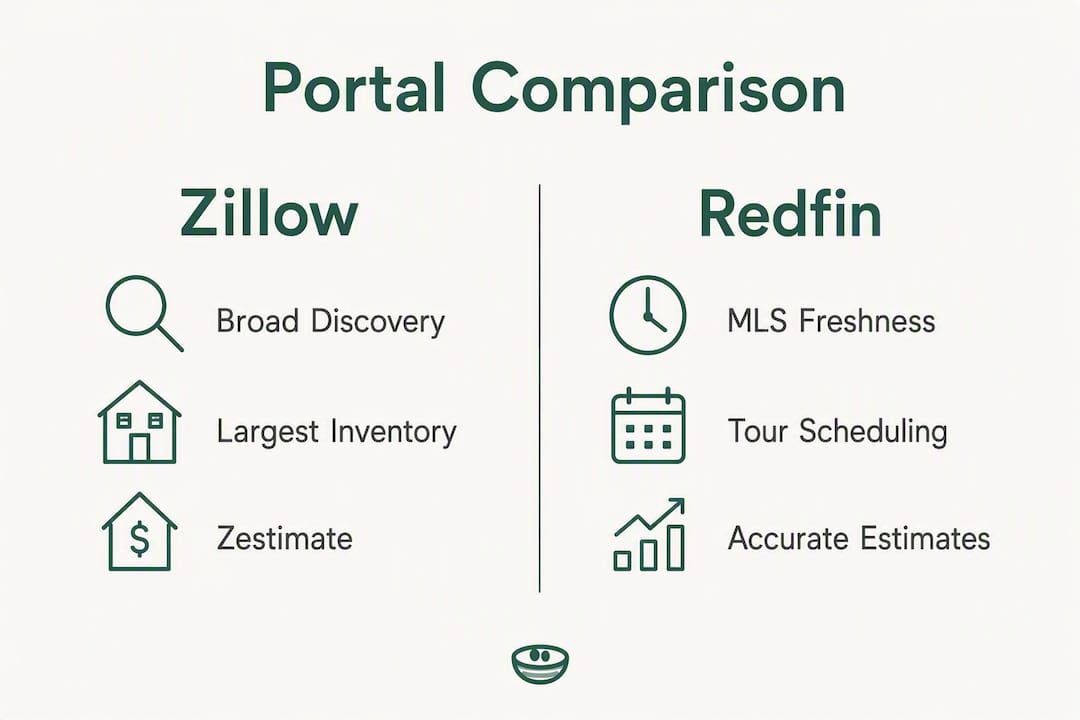
Redfin pros: Fresher MLS data, in-app tour scheduling, tighter home value estimates (~1.99% median error on active listings). Redfin cons: Thinner FSBO coverage, not available in every market, and Rocket Companies' July 2025 acquisition creates some pressure toward bundled mortgage products.
Zillow pros: Largest inventory in the U.S., FSBO-friendly, rich visual content, and the Zestimate as a quick sanity check. Zillow cons: Agents pay for leads, so follow-up quality is inconsistent. Listings can run stale on fast-moving properties.
Nestnoted pros: Privacy-by-default, versioned offer tracking, shared workspaces, and CSV/PDF export so your data is never trapped inside a portal. Nestnoted cons: Not a listing source itself; it works on top of portals, not instead of them.
Pro Tip: When you contact an agent through Zillow, you're often reaching a Premier Agent who paid for your click, not the listing agent. Check the listing agent's name separately and contact them directly if you want unfiltered information.
How to move from portal discovery to private offer tracking
- Run broad searches on Zillow. Set saved searches with your core filters (price, beds, zip codes). Let alerts surface candidates passively. Don't agonize over Zestimate accuracy at this stage.
- Verify freshness on Redfin. Before scheduling a tour, pull the address into Redfin and check the MLS status. Redfin's salaried-agent updates and direct MLS integration catch "Pending" or "Contingent" flags that lag on other feeds.
- Import into Nestnoted. Paste or import the listing metadata, attach screenshots, tag by priority round, and log the agent's contact details. Note whether the lead came through a paid placement.
- Pre-tour checklist. Before you walk in, record your property viewing notes template: condition flags, comparable sales, estimated closing timeline, and local market velocity.
- Post-tour debrief. Log impressions immediately: required repairs, seller concession signals, and your gut rating. Private notes mean candid feedback, not sanitized comments you'd share in a group chat.
- Track offers and counteroffers. Use Nestnoted's versioned offer documents to timestamp every revision. Link inspection notes and communication logs to the same property record. That audit trail matters during negotiations.
- Export before closing. Generate a CSV or PDF snapshot of your offer history. A buyer closing checklist tied to your tracker keeps nothing falling through the cracks.
Common pitfalls: Agent spam from lead-driven portals is real. Use a secondary email for portal contact forms. Stale listings are the other trap: a listing that looks active on Zillow may already be under contract. Always verify on Redfin or call the listing agent directly. Duplicate records accumulate fast when you're tracking 20+ homes across two portals. A house hunting spreadsheet can work early on, but a dedicated tracker handles versioning and collaboration that spreadsheets can't.
How does coverage differ between Zillow and Redfin?
Zillow operates nationwide without geographic gaps. Redfin describes itself as a nationwide brokerage, but some markets are listed as "out of area," meaning you'd be connected to a Partner Agent rather than a salaried Redfin employee. Premium services like Redfin Concierge are limited to major metro areas. For buyers in smaller or rural markets, Zillow's reach is a genuine advantage. Redfin's depth is strongest in high-volume metros where its agent network is dense and MLS integrations are tightest. If you're relocating to a secondary market, check Redfin's coverage map before assuming full-service access. Zillow also hosts FSBO listings directly, which matters in markets where owner-listed inventory is common. Redfin only surfaces FSBO homes listed through FSBO.com or Fizber.
What do customer reviews actually say about each platform?
User reviews in 2026 show a consistent split: Zillow earns praise for its visual experience and breadth, but draws complaints about stale listings and inconsistent agent follow-up. Redfin users tend to rate data freshness higher and appreciate the in-app tour scheduling. The friction point for Redfin is that the single-agent model, while reducing spam, can create pressure to use Redfin's mortgage and title services, especially post-Rocket acquisition. A frequent pain point across both platforms is agent spam after submitting a contact request. On Zillow, that contact triggers a paid lead handoff; on Redfin, it routes to an assigned agent who may push ancillary services. Neither platform is neutral once you raise your hand. That's precisely why serious buyers benefit from a private tracker that keeps their research separate from the portal's commercial machinery.
What extra tools does each platform offer?
Zillow's Zestimate carries a self-reported median error rate of 1.83% on active listings and 7.01% on off-market homes. Redfin's Estimate runs at approximately 2.01% on active listings and 7.73% off-market. Both are useful as rough benchmarks, not appraisals. Zillow layers in commute-time filters, school ratings, and neighborhood data that Redfin keeps more minimal. Redfin's real-time map updates instantly as listing statuses change, which is genuinely useful in fast-moving markets. On the financing side, Zillow connects buyers with third-party lenders; Redfin now routes toward Rocket Mortgage as part of the integrated stack. If you're weighing the benefits of using a broker versus going direct through a portal's lender, that distinction matters more post-acquisition. Zillow's 3D tours and HD photo galleries are richer by default; Redfin's visual presentation is more functional than immersive.

How to choose the right portal for your location and preferences
Geography is the first filter. If you're in a major metro with strong Redfin coverage, use Redfin as your primary transaction tool and Zillow for discovery. If you're in a smaller market where Redfin routes to Partner Agents, lean on Zillow for inventory and find a local MLS-connected agent independently. Personal preference matters too. If you want a visually rich browsing experience and broad FSBO access, Zillow fits. If you want tighter data and integrated tour scheduling, Redfin fits. The FTC's 2025 lawsuit against both companies over rental advertising practices is a reminder that both platforms operate with commercial incentives that don't always align with buyer interests. Maintaining your own independent record of every listing, price change, and communication is the practical response to that reality.
Key Takeaways
Zillow wins discovery; Redfin wins transaction accuracy; Nestnoted is where serious buyers keep their private, auditable record of both.
| Point | Details |
|---|---|
| Use portals by stage | Zillow for broad discovery, Redfin for MLS-fresh data and tour scheduling when you're ready to act. |
| Data accuracy gap | Redfin's Estimate carries a ~1.99% median error on active listings; Zillow's Zestimate runs ~1.83% on active listings. |
| Agent model risk | Zillow routes contacts to paying Premier Agents; Redfin assigns salaried agents who may push bundled services post-Rocket acquisition. |
| Coverage caveat | Redfin's full-service brokerage is strongest in major metros; smaller markets may get Partner Agents instead. |
| Private tracking layer | Nestnoted centralizes listings, versioned offers, and post-tour notes from both portals with privacy by default and CSV/PDF export. |
Nestnoted keeps your search private while portals compete for your data
Portals are built to generate leads. Every contact form you submit, every saved search, every alert you set feeds a commercial system designed to connect you with paying agents. Nestnoted works differently.
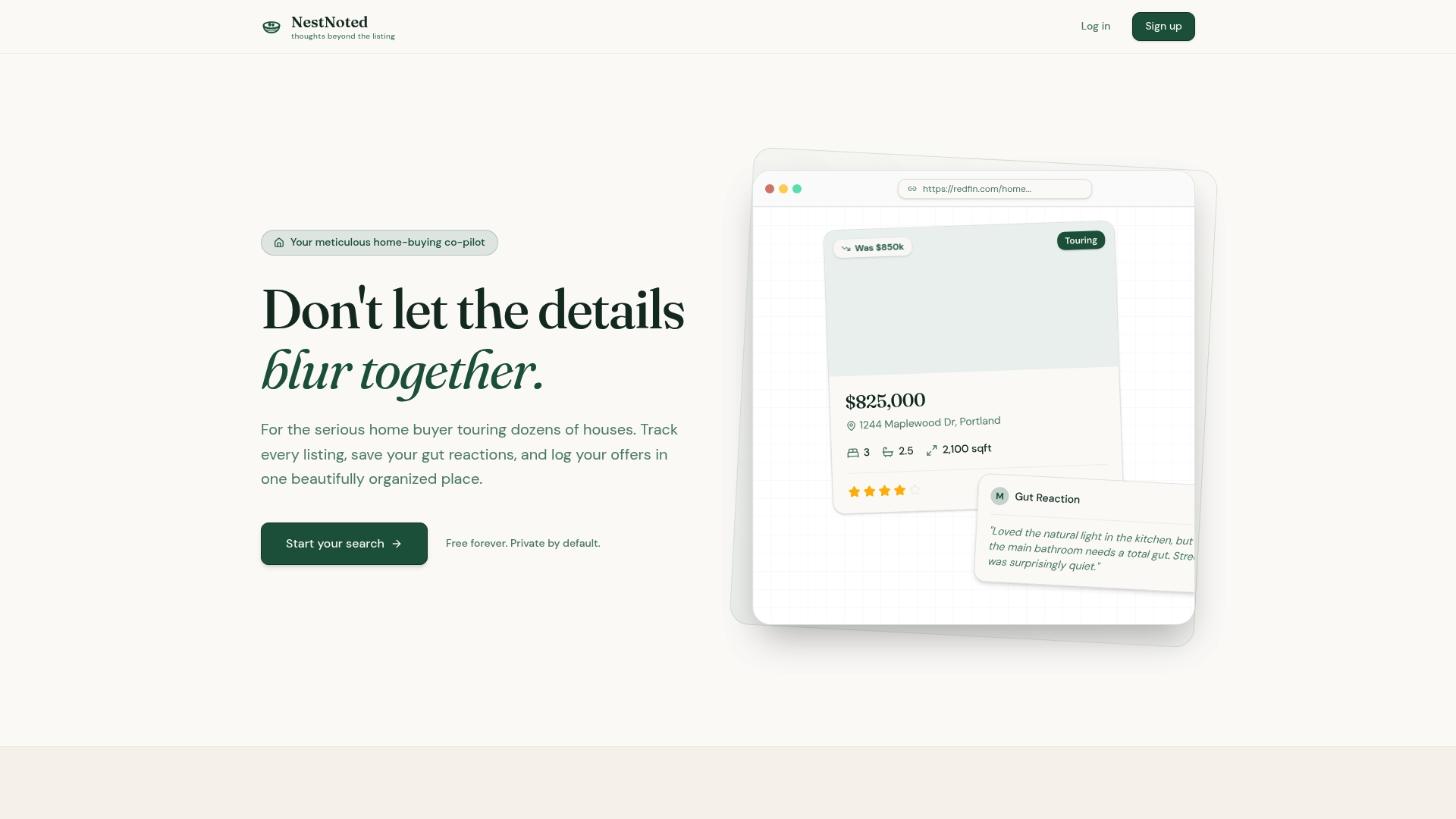
Pull listings from Zillow and Redfin into a single private workspace. Log your post-tour impressions, track every offer version with timestamps, and share your shortlist with a partner or agent without exposing your notes to the portal's algorithm. CSV and PDF export means your research travels with you, not with the platform. For buyers managing a serious search across multiple properties and rounds of offers, that independence is the point. Start organizing your search privately with Nestnoted's offer tracking and shared search features today.