

What are the best Zillow alternatives right now?
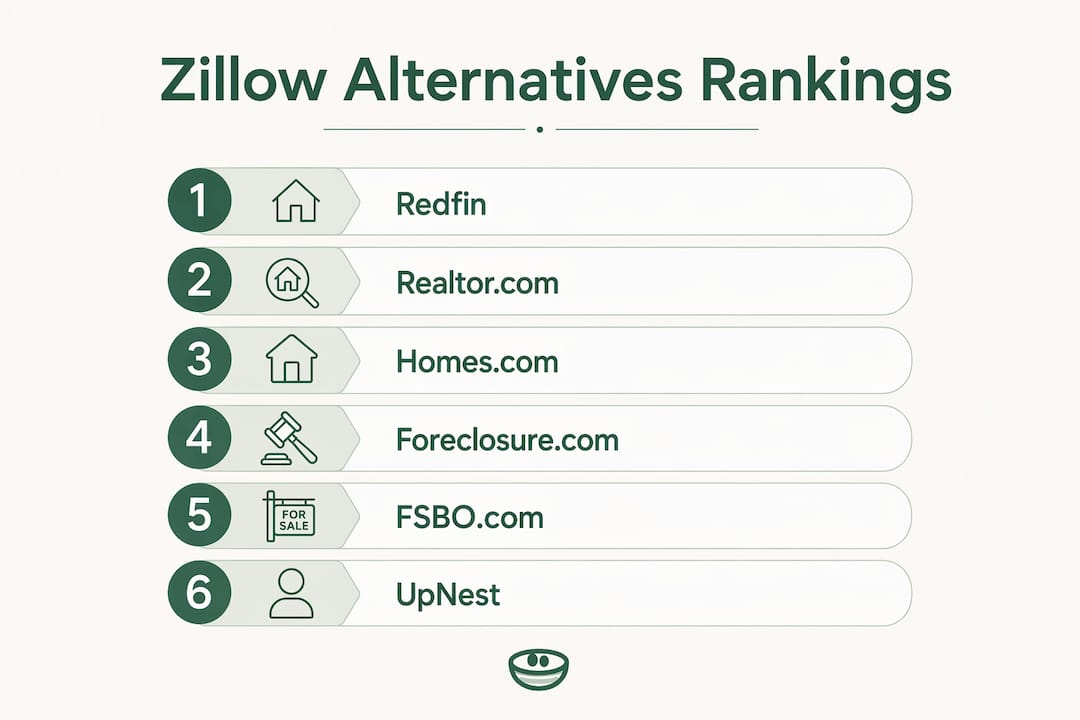
Redfin, Realtor.com, and Homes.com are the strongest all-around Zillow alternatives for most buyers and sellers in 2026. Foreclosure.com leads for investors, FSBO.com suits owners selling without an agent, and UpNest works best when you want competing agent proposals before committing to anyone.
Each platform solves a specific problem Zillow does not. Realtor.com updates listings every 15 minutes via direct MLS partnerships, while Zillow's data can lag 24–48 hours behind local MLS feeds. That gap matters when a hot listing goes under contract before you even see it.
| Platform | Best for | Key features | Geographic coverage | User experience | Pricing |
|---|---|---|---|---|---|
| Redfin | Fee-conscious buyers and sellers | Integrated brokerage, real-time MLS data, commission rebates | Nationwide | Clean app, real-time updates | Listing fee from 1%–3% |
| Realtor.com | Data accuracy, current listings | 15-min MLS updates, mortgage tools, neighborhood ratings | Nationwide | Professional, agent-focused | Free; paid agent tiers |
| Homes.com | Buyer education and market research | Neighborhood insights, school ratings, agent visibility | Nationwide | Intuitive, buyer-friendly | Free |
| Foreclosure.com | Investors seeking distressed deals | Foreclosures, preforeclosures, auctions, tax liens | Nationwide | Functional, data-dense | $39.80/month after free trial |
| FSBO.com | Owners selling without an agent | Auto-generated contracts, MLS syndication, AI description writer | Nationwide | Simple, seller-focused | Free to $399 one-time |
| UpNest | Finding and comparing local agents | Free agent proposals, commission transparency, agent reviews | Nationwide | Straightforward matching | Free for buyers and sellers |
How does each platform actually compare?
Redfin: lower fees, real brokerage
Redfin operates as a licensed real estate brokerage, not just a listing portal. That distinction matters because Redfin agents are salaried employees, which changes the incentive structure compared to commission-only agents. Sellers who also buy through Redfin within 365 days can qualify for a 1% listing fee; standard listing fees run 2.0%–3.0% depending on services selected. The platform also offers an Early Access feature that surfaces listings before they hit the broader market.

Realtor.com: the accuracy benchmark
Realtor.com pulls data directly from MLS databases every 15 minutes, making it the go-to for buyers who have lost deals because a listing showed as available when it was already gone. The platform is operated by Move, Inc. and carries the endorsement of the National Association of Realtors. Tools like a mortgage calculator, refinance calculator, and rent-vs-buy calculator are built in, not bolted on as afterthoughts.
Homes.com: built for the research phase
Homes.com attracted over 83 million unique visitors by mid-2026, which reflects how many buyers use it specifically for neighborhood research rather than just scrolling listings. School ratings powered by GreatSchools, points of interest, and environmental data sit alongside standard listing details. Serious buyers leverage its neighborhood insights to conduct deeper due diligence before ever contacting an agent.

Foreclosure.com: the distressed-property specialist
No other platform comes close to Foreclosure.com's depth on distressed inventory. It lists foreclosures, preforeclosures, short sales, sheriff sales, bankruptcies, tax liens, and as-is deals, often before those properties reach mainstream portals. The $39.80 monthly subscription (after a seven-day free trial) is the trade-off for that early access. For investors who follow the "you make money when you buy" principle, the subscription pays for itself quickly on a single good deal.
FSBO.com: sell it yourself, with real tools
FSBO.com gives homeowners three tiers: a free Starter plan (30 days, one photo), a $99 Plus plan (180 days, ten photos), and a $399 MLS plan that includes full MLS syndication and unlimited photos. The MLS plan syndicates to Zillow and Realtor.com, so sellers get broad buyer exposure without paying a listing agent. Auto-generated contracts and an AI-powered description writer handle the paperwork side, with offer negotiation tools coming soon.
UpNest: agent comparison done right
UpNest flips the typical agent-search process. Instead of you hunting for agents, local agents compete for your business by submitting proposals that include their commission rates, specialties, and reviews. There is no commitment required to receive proposals, and the service is free for buyers and sellers. For anyone who finds the standard agent-selection process opaque, UpNest's commission transparency is a practical fix.
How to choose the right Zillow alternative for your goals
The platform that fits you depends almost entirely on what stage of the process you are in and what problem you are trying to solve.
Data accuracy vs. discovery: If you need listings the moment they hit the market, Realtor.com's 15-minute MLS updates beat Zillow's 24–48 hour lag. If you are still in the research phase, Homes.com's neighborhood tools serve that need better than a raw listing feed.
Cost of selling: FSBO.com offers an MLS plan that provides full market exposure for a flat fee. Redfin's 1%–3% listing fee undercuts the traditional 2.5%–3% seller's agent commission, but you stay within a full-service brokerage relationship.
Investment focus: Foreclosure.com is the only platform on this list built specifically for distressed properties. If you are not looking for foreclosures or pre-foreclosures, the subscription adds no value.
Agent selection: UpNest is the right tool when you want to compare agents before picking one, not after. The proposal model gives you leverage in a conversation that usually favors the agent.
- Prioritize MLS-direct platforms (Realtor.com, Redfin) when speed and accuracy are non-negotiable.
- Use FSBO.com or UpNest when your primary goal is controlling commission costs.
- Choose Foreclosure.com only if distressed or below-market properties are your target.
- Lean on Homes.com during the research phase before you are ready to make offers.
Pro Tip: Before committing to any platform, run the same property search on two or three sites simultaneously. The listing that appears on Realtor.com but not yet on Zillow tells you everything about which feed is faster in your specific market.
Why do buyers and sellers leave Zillow?
Zillow's scale is also its weakness. With over 200 million monthly visits, the platform optimizes for consumer traffic, not professional accuracy or seller control.
Listing data latency is the most concrete issue. Zillow's listings update 24–48 hours behind local MLS data, which means buyers sometimes pursue homes that are already under contract. That is not a minor inconvenience in a competitive market.
Zestimate accuracy is a persistent frustration. The algorithmic valuations can be off by 20% or more in volatile or unique-property markets, which creates unrealistic expectations for both buyers and sellers.
Lead sharing drives agents away. Exclusive lead platforms convert at 8%–15%, while Zillow's shared leads convert at roughly 1%–3%. When the same buyer inquiry goes to multiple competing agents, everyone's follow-up effort drops.
- Listing data lags 24–48 hours behind MLS in many markets.
- Zestimates carry meaningful error margins in fast-moving or unusual property markets.
- Shared agent leads reduce conversion and increase marketing noise for buyers.
- Limited tools for transaction management, FSBO sellers, or niche property types like foreclosures.
Specialized platforms address each of these gaps directly. Realtor.com solves the data latency problem. Foreclosure.com fills the niche inventory gap. FSBO.com gives sellers the control Zillow's model does not offer.
Nestnoted helps you manage what search portals cannot
All six platforms above are excellent for finding properties. None of them help you remember what you actually thought about the 14th house you toured, or compare it side-by-side with the 8th.

That is the gap Nestnoted fills. It is a private property tracking tool built for serious home buyers who are deep in the process and need to organize their thinking, not find more listings. You log notes, impressions, and offers on each property you tour. Everything stays private by default, so your candid observations never reach sellers or agents unless you choose to share them. A built-in AI assistant lets you query your own notes ("which house had the updated kitchen and the small backyard?") without scrolling through a spreadsheet. Nestnoted also syncs data from Zillow and Redfin, so you are not re-entering details manually. The core features are free with account registration.
Key Takeaways
Realtor.com's 15-minute MLS updates and Redfin's reduced commission model make them the strongest all-around Zillow alternatives for buyers and sellers who prioritize accuracy and cost control in 2026.
| Point | Details |
|---|---|
| Data accuracy gap | Realtor.com updates every 15 minutes; Zillow lags 24–48 hours behind local MLS feeds. |
| Lead conversion difference | Exclusive platforms convert leads at 8%–15% vs. Zillow's shared-lead rate of 1%–3%. |
| Selling without an agent | FSBO.com's $399 MLS plan gives full market exposure for a flat one-time fee. |
| Investor-specific inventory | Foreclosure.com is the only featured platform built exclusively for distressed properties. |
| Nestnoted for active buyers | Nestnoted privately tracks listings, notes, and offers across platforms, free with registration. |