

Use a dedicated offer tracking template, or a private tool to centralize every offer's price, deposit, contingencies, and deadlines in one place. Download the structure below, or import listings directly, then log each offer's core terms as soon as you make it. The sections that follow walk through field definitions, deadline tracking, cash-to-close math, and two filled examples.
TL;DR:
- Convert each contingency into a date from its contract trigger, then check the soonest deadline daily; a missed deadline can put earnest money at risk.
- Calculate cash to close by adding down payment, closing costs, and prepaid items, then subtracting earnest money paid; verify the total against lender documents.
- Lenders must provide a Loan Estimate within three business days of application and a Closing Disclosure at least three business days before closing; compare both.
- Compare offers by price, financing, contingencies, closing timeline, and earnest money, since sellers may weigh the full package rather than choosing the highest bid.
- Add each counteroffer as a new timestamped entry instead of editing prior terms, preserving a clear record of what changed and when.
Table of Contents
- What a Downloadable Offer Tracking Template Should Include
- What Each Field Means and Why It Matters
- How to Use the Template From Tour to Close
- Tracking Contingency Deadlines Without Losing Earnest Money
- How to Estimate Cash to Close
- Two Filled Examples: Cash Buyer vs. Financed Buyer
- Why Disciplined, Private Tracking Changes Negotiation Outcomes
- Try NestNoted Instead of a Manual Spreadsheet
- FAQ
- Sources
What a Downloadable Offer Tracking Template Should Include
A usable template separates each offer into distinct, scannable sections rather than one long row of numbers. We build ours around eight tabs that mirror the real negotiation process, from first walkthrough to closing paperwork.
- Offer summary: address, offer price, date submitted, and current status.
- Financials: earnest money amount, loan type, down payment, and estimated cash to close.
- Contingencies and deadlines: inspection, financing, appraisal, and sale-of-home windows with specific dates.
- Inspection and repair estimates: itemized repair quotes with links to vendor documents.
- Negotiation log: timestamped rows for every counteroffer and term change.
- Communication log: who said what, and when, between buyer, agent, and seller's side.
- Private scorecard: a confidential rating field for gut impressions that never needs to go public.
- Attachments: Loan Estimate, proof of funds, and inspection reports.
| Tab | Primary purpose | Typical format |
|---|---|---|
| Offer summary | Quick status check across properties | Spreadsheet row or app card |
| Financials | Track deposit and cash to close | Calculated fields |
| Contingencies | Countdown to each deadline | Date fields with alerts |
| Negotiation log | Audit trail of counteroffers | Timestamped entries |
You can build this in a spreadsheet or use NestNoted's private 5 Point Scorecard to import listings automatically and keep every note confidential by default.
What Each Field Means and Why It Matters
Consistent entries are what make offer comparisons useful later, especially once you are juggling three or four live negotiations. Each field exists to answer a specific question a buyer or agent will ask under time pressure.
- Offer basics: address, list price, offer price, and the date submitted, so you can see the gap between ask and offer at a glance.
- Escrow holder details: name of the title company or attorney holding earnest money, since earnest money is typically 1% to 10% of the purchase price and held in escrow until closing.
- Financing terms: loan type, lender name, and a note confirming proof of funds or pre-approval was attached.
- Contingency descriptions: plain-language notes on what each contingency actually requires, plus a status field (open, satisfied, waived).
- Closing timeline: target closing date and any seller-requested rent-back period.
- Seller concessions: closing cost credits, repair credits, or included appliances.
- Special inclusions: anything unusual the seller agreed to leave behind or remove.
Logging the escrow holder matters because missed contingency deadlines can forfeit earnest money if a buyer waives a protection without realizing it. A clear financing note also helps your agent respond fast when a seller asks for updated proof of funds mid-negotiation.
How to Use the Template From Tour to Close
A template only works if you fill it in at the same points in the process every time, rather than after the fact when details get fuzzy.
- Set up the entry before you tour. Create a new property row, pull in listing details, and start a baseline private scorecard.
- Capture impressions on the spot. Note condition issues, estimated repair costs, and photos right after the walkthrough, while details are fresh.
- Populate the offer row when you submit. Fill in offer price, earnest money, financing terms, and attach the Loan Estimate and proof of funds.
- Set contingency countdowns immediately. Convert each contract deadline into a specific calendar date tied to the acceptance date.
- Log every counteroffer with a timestamp. Add a new row rather than editing the old one, so the history stays intact.
Pro Tip: Update the status field the same day a counteroffer arrives, not at the end of the week, so your agent is always working from the current terms.
This sequence works whether you are tracking one offer or five. Buyers touring remotely can use a post-tour checklist to make sure the first two steps happen before memory fades.
Tracking Contingency Deadlines Without Losing Earnest Money
Contingencies exist to protect your deposit, but only if you track them as active dates rather than static text in a contract.
- Inspection contingency: count days from the acceptance date, not the date you signed, unless the contract specifies otherwise.
- Financing contingency: tied to loan approval timing, usually the longest window and the one most likely to need an extension.
- Appraisal contingency: often runs parallel to financing and depends on lender scheduling.
- Sale-of-home contingency: tracks against the buyer's own property closing, adding a second timeline to watch.
Common contingency clauses protect earnest money when met, but missing a deadline or waiving a contingency without satisfying it risks forfeiting the deposit. Convert each clause into a calendar action by identifying the trigger event, then applying the contract's business-day count. Keep a single "next deadline" field that always shows the soonest upcoming date across all contingencies, and check it daily as closing approaches. As a deadline nears, order the inspection, request an extension in writing, or notify your lender so nothing lapses by default.
How to Estimate Cash to Close
Your offer price is never the full amount due at closing. Estimated Cash to Close combines the down payment, closing costs, and prepaid items, minus any earnest money already paid, and the Consumer Financial Protection Bureau treats this figure as the number to reconcile against your lender's paperwork.

Lenders must provide a Loan Estimate within three business days of your application, and a Closing Disclosure at least three business days before closing, giving you two fixed checkpoints to verify the math.
Attach both the Loan Estimate and the Closing Disclosure to the template so you can compare the two line by line.
Two Filled Examples: Cash Buyer vs. Financed Buyer
How you fill in the template shifts depending on how you are buying.
- Cash buyer, quick close: prioritize the closing date field and skip financing contingency entirely; the earnest money field and inspection contingency carry the most weight since there is no loan timeline to track.
- Financed buyer, competitive market: log an escalation clause cap, track financing and appraisal contingencies closely, and keep earnest money higher to signal seriousness to the seller.
- Decision logic either way: sellers often weigh contingencies, closing timeline, and earnest money alongside price, so the template should surface those fields next to price rather than ranking offers by price alone.
A side-by-side view like this is also where a private comparison method helps, since it separates subjective scorecard notes from the hard financial terms.
Why Disciplined, Private Tracking Changes Negotiation Outcomes

The biggest mistake we see is treating offer tracking as paperwork instead of strategy. A buyer who logs every counteroffer with a timestamp walks into the next conversation knowing exactly what was on the table and when it changed, which is leverage most people give away by relying on memory or a text thread.
Keeping notes private matters just as much. A candid repair estimate or a blunt scorecard rating only stays useful if you can write it down honestly, without worrying who else might read it.
— Antony
Try NestNoted Instead of a Manual Spreadsheet
We built this tool so you never have to choose between a thorough template and a fast workflow. Every property you tour gets a private 5 Point Scorecard, a timestamped negotiation log, and an auto-imported listing feed from major sites, so you are not retyping details you already saw on Zillow or Redfin.
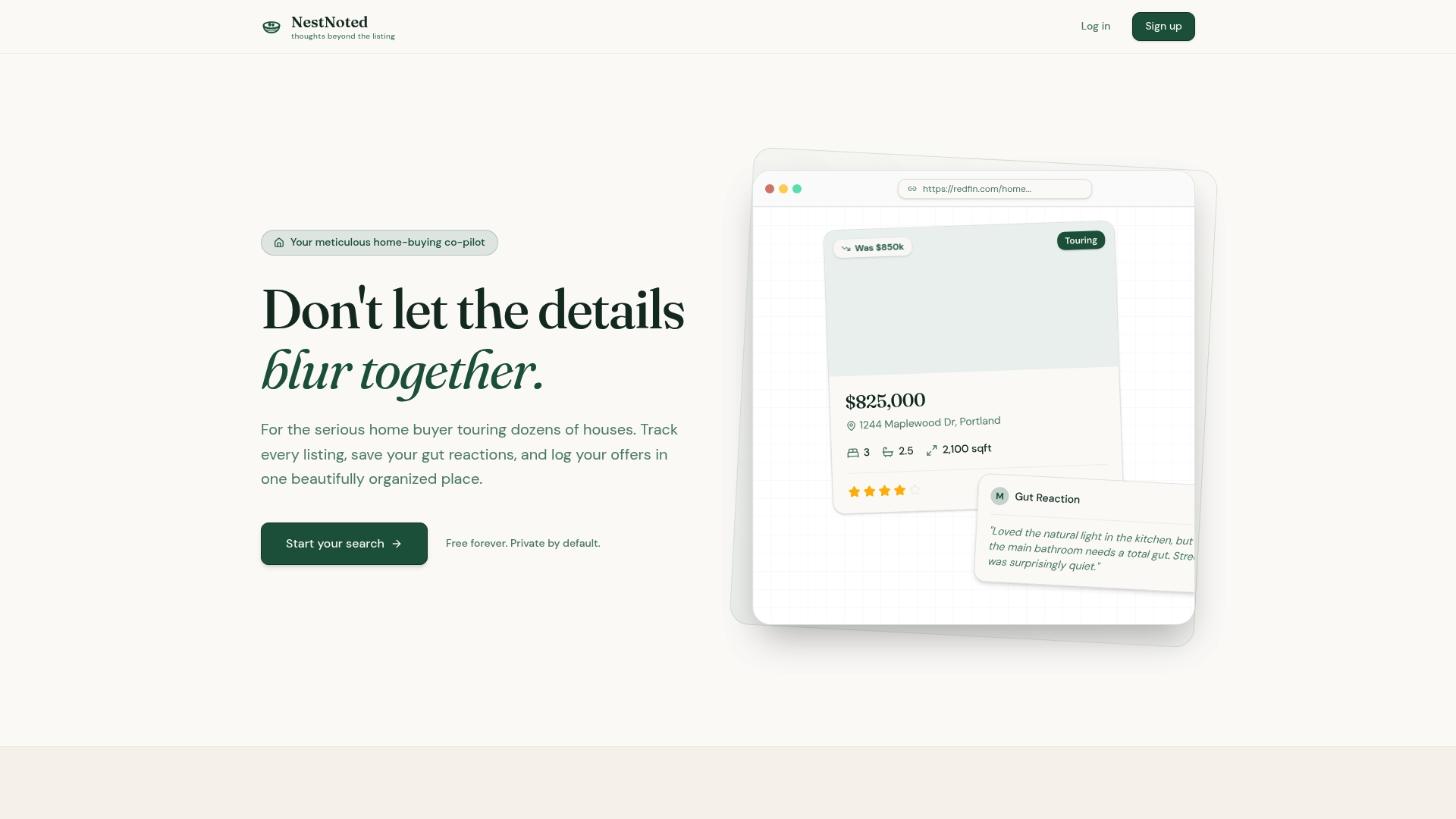
- Import listings automatically instead of building rows by hand.
- Keep every scorecard and note private by default, visible only to authorized people.
- Share a workspace with collaborators so everyone sees the same current status.
- Track contingency countdowns and cash-to-close figures in one view instead of several tabs.
If you want help reconciling loan terms while you compare offers, an EMD funding and escrow walkthrough or a mortgage comparison calculator can run alongside your tracking workspace. Start a free NestNoted account and bring your current offers into one private view today.
FAQ
What fields belong in an offer tracking template?
At minimum, include offer price, earnest money amount, financing terms, contingency status, closing date, seller concessions, and estimated cash to close. A negotiation log and a private scorecard round out the structure for comparing multiple offers.
How do I calculate estimated cash to close?
Add your down payment, closing costs, and prepaid items, then subtract any earnest money already paid. The CFPB recommends checking this figure against your Loan Estimate and Closing Disclosure as those documents arrive.
How much earnest money should I offer?
Earnest money deposits typically run 1% to 10% of the purchase price, held in escrow until closing. The right amount depends on your market and how competitive the offer needs to be.
How do I compare multiple offers fairly?
Look beyond price at financing terms, contingencies, closing timeline, and earnest money, since sellers often weigh these factors together rather than picking the highest number alone. A side-by-side template makes these differences easy to spot.
Can I keep my offer notes private from other buyers?
Yes. A tool like NestNoted keeps scorecards and notes private by default, so you can write candid impressions without them becoming visible to sellers, agents, or other buyers.