

The strongest offer rarely wins on price alone. It wins on net proceeds and certainty to close, and the only way to see that clearly is to pull price, financing strength, contingencies, earnest money, appraisal-gap terms, and closing timeline out of each contract and line them up side by side. Once those terms sit in matching columns, a quick spreadsheet score tells you which offer actually deserves the win, not just which one looks biggest.
TL;DR:
- Matching all offer terms side by side helps determine which deal is truly stronger, focusing on net proceeds and certainty to close rather than price alone.
- Key factors to compare include net to seller after credits, earnest money strength, financing quality, appraisal-gap clauses, inspection rights, and closing timelines.
- Contracts with early non-refundable earnest money, uncapped appraisal gaps, vague proof of funds, or short contingency periods pose higher fall-through risks.
- Successful negotiations often involve adjusting clauses such as capping appraisal gaps or improving contract deadlines rather than simply increasing price.
- Using a private, organized comparison system helps track offer details, verify evidence, and prevent losing leverage before making a final recommendation.
Table of Contents
- How Do You Compare Offer Terms Across Different Contracts?
- Building a Spreadsheet to Score Competing Offers
- What Contract Terms Signal Higher Fall-Through Risk?
- Running the Comparison as a Private Workflow
- Final Checklist Before Advising Acceptance
- What Buyers Get Wrong About Offer Comparison
- Track Every Offer Without Losing the Details
- Sources
How Do You Compare Offer Terms Across Different Contracts?
Every purchase contract buries its terms in slightly different language, which is exactly why a side-by-side extraction matters before you try to rank anything. Pull these fields verbatim from each offer, using the same order every time:
- Offer price and credits. Note the headline price, then subtract any seller credits or concessions listed as dollar amounts. That gives you a real net figure, not a marketing number.
- Earnest money. Record the deposit amount, the deadline for delivering it, and the exact conditions under which it becomes non-refundable to keep your earnest money safe. Deposits typically run 1 to 3% of the purchase price, and a buyer offering less than that range on a competitive property is signaling weaker commitment. NestNoted's guide on earnest money vs down payment breaks down how that deposit interacts with the rest of the purchase.
- Financing details. Cash or loan, lender name, and whether the buyer has a preapproval letter or a fully underwritten approval. A cash buyer needs to show proof of funds, ideally a recent bank statement or cashier's check confirmation, not just a claim from their agent.
- Appraisal clause. Confirm whether the clause exists at all, and if it does, whether it includes a gap provision with a specific dollar cap. Uncapped gap coverage is a very different risk profile than a $15,000 ceiling.
- Inspection clause. Check the scope of inspection rights, the buyer's termination window, and any repair-cost caps or thresholds written into the contract.
- Title, closing costs, and timeline. Review title insurance responsibilities, who pays which closing costs, the proposed closing date, and any possession or rent-back terms attached to it.
Contingency windows vary by category. Inspection periods usually run 7 to 15 days, appraisal contingencies 14 to 21 days, financing 30 to 60 days, and title review 14 to 30 days, according to contract clause guidance from ReviewMyContract. A financing contingency that expires in 10 days on a conventional loan is either a red flag or a sign the buyer has already been fully underwritten.
Building a Spreadsheet to Score Competing Offers
Once the fields are extracted, the next step is converting them into a single comparison table. A multiple-offer comparison spreadsheet works best with these columns:
- Offer price
- Seller credits or concessions
- Estimated net to seller (price minus credits)
- Earnest money strength (scored 1 to 5)
- Financing strength (scored 1 to 5)
- Appraisal protection (scored 1 to 5)
- Inspection exposure (scored 1 to 5)
- Timeline fit (scored 1 to 5)
- Total weighted score
Weight net-to-seller heaviest, since that's the number that actually lands in the seller's pocket. Give financing strength and appraisal protection the next-highest weight, since those two factors predict whether the deal survives underwriting and valuation. Timeline fit and earnest money strength matter, but they rarely make or break a closing the way financing and appraisal certainty do.
Turning contract language into a number is the tricky part. An appraisal-gap clause capped at $15,000 might earn full points up to that cap and a partial score beyond it. A preapproval letter with no underwriting detail scores lower than a written statement confirming the loan has cleared underwriting. Vague language such as "buyer has sufficient funds" without a bank statement attached should score near the bottom, regardless of what the agent says verbally.
Pro Tip: Weight documented commitments over verbal assurances every time. An underwriting-status letter or a photographed cashier's check outranks an agent's phone call, no matter how confident that agent sounds.
Practitioners who use this scoring approach consistently find that weighting net-to-seller and certainty-to-close above headline price produces fewer fall-throughs than picking the biggest number on the page.
What Contract Terms Signal Higher Fall-Through Risk?
Some clauses look fine on a first read and turn into problems three weeks later. Watch for these patterns:
- Earnest money that goes non-refundable too early, before inspection or financing contingencies have been satisfied.
- An uncapped appraisal-gap clause. Buyers who agree to cover any gap with no ceiling sometimes discover they can't actually fund the difference.
- "As-is" language paired with no seller disclosure. That combination often hides a problem the buyer hasn't priced in.
- Contingency windows shorter than the market norm, like a 3-day inspection period on a property with known deferred maintenance.
- Vague proof-of-funds language with no bank statement, verification letter, or lender contact attached.
When a strong offer has a weak spot, negotiate the specific clause rather than the whole contract. Ask for a capped appraisal-gap instead of an open-ended one. Request an underwriting-status letter from the lender rather than accepting a generic preapproval. Consider shifting the point where earnest money becomes non-refundable to just after inspection contingencies are removed, which protects the buyer while still showing commitment. Adjusting the closing date, or offering a short rent-back to the seller, can sometimes beat raising price outright, because it improves the seller's actual net-to-seller math without costing the buyer more cash at closing. A capped appraisal-gap clause is the most common middle ground for buyers who want to stay competitive without unlimited exposure. Roughly 81% of purchase contracts include at least one contingency, though about 20% of buyers waive inspection or appraisal protection in hot markets, a trade-off that raises fall-through risk even when it wins the bid.
Home-sale contingencies and kick-out clauses deserve separate handling. An offer contingent on the buyer selling their current home is structurally weaker no matter how strong the price looks, because a kick-out clause lets the seller keep marketing the property and accept a cleaner offer if one appears.
Running the Comparison as a Private Workflow
A spreadsheet only works if the underlying documents are attached and current, which is where a structured tracking workflow saves time under deadline pressure.
- Step 1: Scan or photograph each signed offer and save one canonical row per property, with the original contract attached.
- Step 2: Fill in the comparison columns and score each field, noting the actual evidence behind each score (underwriting letter, proof-of-funds document, inspection terms).
- Step 3: Record the seller's stated priorities and timeline needs, then flag which negotiation levers you plan to use.
- Step 4: Share the comparison privately with the buyer or the agent team and export a recommendation. Keeping the analysis private matters here. A negotiation strategy that leaks to a competing buyer or a listing agent can cost leverage instantly.
Final Checklist Before Advising Acceptance
Run this sequence before recommending acceptance or submitting a highest-and-best response:
- Confirm lender underwriting status, or verify cashier's check details for cash offers.
- Check that the appraisal-gap cap is explicit and within the buyer's actual funding capacity.
- Verify earnest money refund triggers and the exact timing of each deadline.
- Confirm inspection, title, and closing deadlines are realistic given the transaction's complexity.
- Recalculate net-to-seller after every credit and seller-paid item is subtracted.
What Buyers Get Wrong About Offer Comparison
The most common mistake is letting headline price override financing and appraisal certainty, and it happens even among experienced agents working under deadline pressure. A seller comparing three offers will often gravitate toward the highest number without checking whether that buyer's financing has cleared underwriting.
One pattern shows up repeatedly: a lower-priced offer with a fully underwritten loan and a capped, adequately funded appraisal-gap closes on schedule, while a higher offer with a shaky preapproval and no appraisal protection reopens negotiations after the inspection or falls apart entirely when the appraisal comes in low. Price got the seller's attention. Certainty got the deal closed. Keeping every offer's terms organized in one place, rather than scattered across texts and printed contracts, is what makes that kind of comparison possible in the first place.
— Antony
Track Every Offer Without Losing the Details
Comparing offer terms gets messy fast when the details live in five different email threads and a stack of PDFs. There are tools offering buyers and agents private workspaces to track every listing and offer, attach the actual contract documents, and build side-by-side comparisons without exposing notes or negotiation strategy to anyone outside the team.
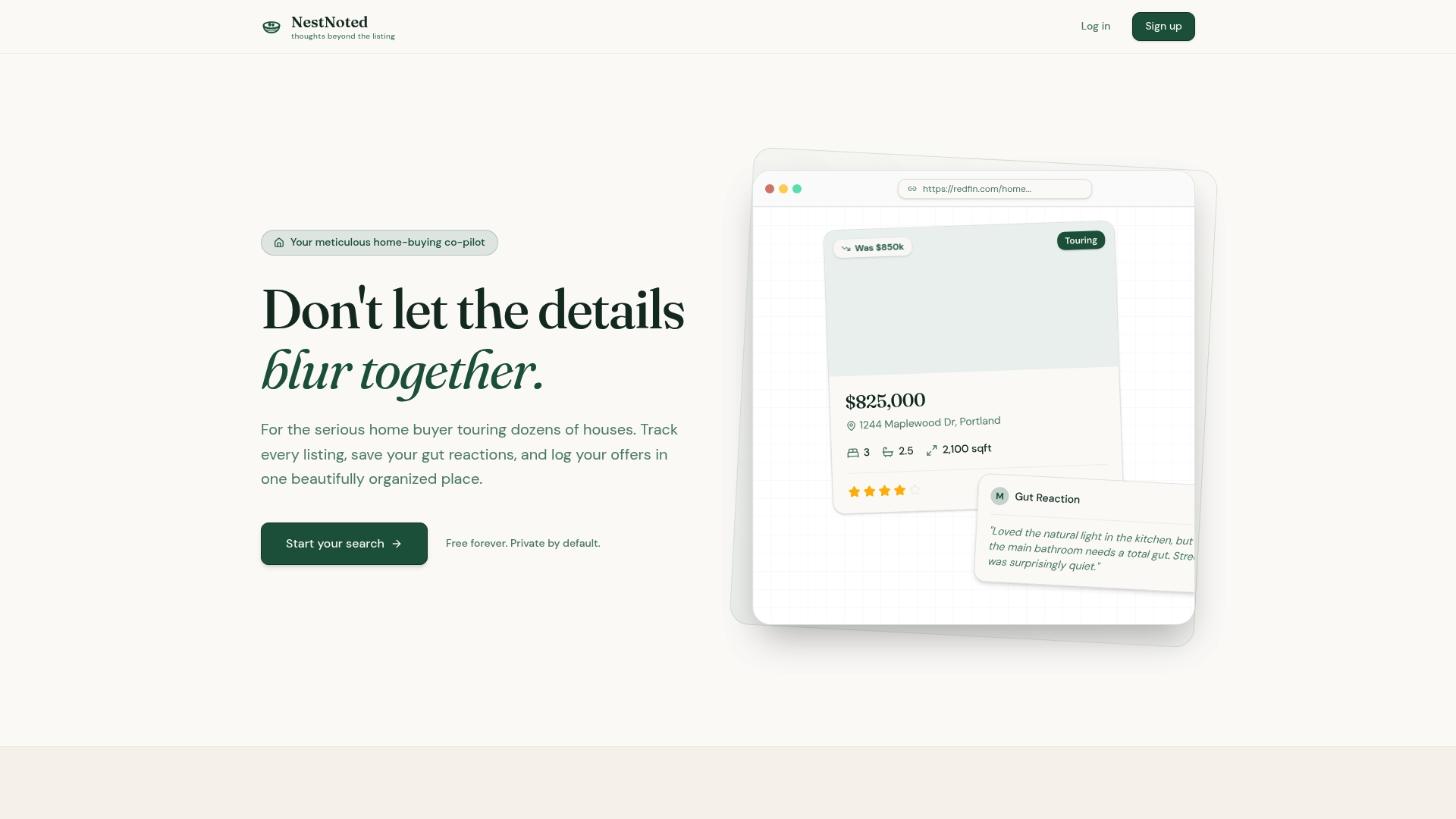
Because everything stays private by default, you can score a shaky financing letter or flag a red flag clause honestly, without worrying who else might see it. That candor is what makes the comparison useful instead of diplomatic. Agents managing several active offers at once can build a shared workspace with clients, keep every scored comparison current as new offers arrive, and export a clear recommendation when it's time to decide. If you're weighing competing offers on a property right now, visit NestNoted and set up your first comparison before your next deadline hits.
Sources
- Consumer Guide: Navigating Multiple Offers | NAR
- Multiple offers house comparison spreadsheet | Foroes
- Real estate contingencies: what to include, waive, or negotiate | EffectiveAgents
- Real Estate Contract Guide: Clauses, Red Flags & Negotiation (2026) | ReviewMyContract