

The fastest way to avoid a blown deadline is to enter every contract date into a shared system the same day the contract is executed, then run a 5/3/1 day reminder cascade with a clear escalation path. Manual calendars alone miss deadlines far more often than automated systems. Your three real options are a manual spreadsheet or calendar, CRM-native reminders, or full transaction automation, each suited to a different transaction volume.
TL;DR:
- Enter all contingency deadlines into a shared system immediately after contract signing, as delays in logging increase the risk of missed deadlines.
- Automating reminders to escalate at five, three, and one day before each deadline significantly reduces missed compliance, especially for high-volume transactions.
- Manual tracking misses about 8.2 deadlines per 100 deals, while full automation drops that rate below 1, making it essential for agents closing more than 10 deals a month.
- Relying on single notifications is a common mistake; using multiple reminders and confirmation checks improves deadline adherence and transaction safety.
- Setting up a private, integrated workspace with automatic date calculations and responsible party assignments helps manage deadlines more accurately than separate tools or manual methods.
Table of Contents
- Checklist: The Contract Dates Every Agent and Buyer Must Track
- Manual, CRM, or Automation: Which Method Actually Works?
- The Reminder Schedule and Escalation Workflow You Should Use
- Tools and Setup: What to Look for in Calendars, CRMs, and Reminder Systems
- A Private Buyer Tracking Workflow in Practice
- Where Most Agents Actually Go Wrong
- Try a Private Property Tracking Workspace
- Sources
- FAQ
Checklist: The Contract Dates Every Agent and Buyer Must Track
Every contingency clock starts on the same trigger: the accepted-offer or mutual acceptance date written into the contract. Count calendar days forward from that date (unless your contract specifies business days), and enter every deadline the same afternoon the contract goes fully executed. Waiting even 24 hours to log dates is where most tracking failures start.
Here's what belongs on the list within hours of signing:
- Inspection contingency, typically 7 to 10 days from acceptance. Schedule the inspector immediately and set reminders around the response deadline, not just the inspection date.
- Financing contingency, typically 21 to 30 days; for detailed guidance, see our mortgage contingency explained resource. Track lender milestones like loan application submission, appraisal order, and the loan commitment date, since the CFPB's mortgage process outline shows how many steps sit between application and final approval.
- Appraisal contingency, typically 14 to 21 days. Confirm the appraisal order date and flag it separately from the financing deadline, since a low appraisal can trigger renegotiation on its own timeline.
- Title and HOA document review, typically 5 to 10 days. Someone has to actually read the HOA docs and title report, not just receive them.
- Closing and final walkthrough, usually set independently in the contract. Confirm funding is scheduled to land before the walkthrough and closing date.
If a contingency deadline passes without written objection or extension, it's often treated as waived, meaning the buyer loses the right to cancel or renegotiate on that basis.
Manual, CRM, or Automation: Which Method Actually Works?
The performance gap between these three approaches is bigger than most agents assume. A 2024 transaction coordination benchmark found manual tracking misses roughly 8.2 deadlines per 100 transactions, CRM-native reminders drop that to 3.1, and full automation gets it down to 0.7. Time spent per transaction tells a similar story: 2.4 hours manually, 1.1 hours with CRM reminders, and 0.4 hours with automation.
| Method | Missed-deadline rate (per 100) | TC time per transaction | Monthly cost | Best for |
|---|---|---|---|---|
| Manual spreadsheet/calendar | 8.2 | 2.4 hours | $0 | 1 to 4 transactions/month |
| CRM-native reminders | 3.1 | 1.1 hours | $50 | 5 to 10 transactions/month |
| Full transaction automation | 0.7 | 0.4 hours | $200 | 10+ transactions/month |
A few things drive those numbers:
- Manual tracking fails when someone forgets to open the calendar, or when a shared spreadsheet gets edited by two people at once and a date gets overwritten.
- CRM-native reminders fail less often but still rely on someone manually entering each date correctly on day one, since most CRMs don't calculate contingency dates from the contract automatically.
- Full automation fails mainly at setup, meaning a misconfigured template or wrong effective date poisons every downstream reminder, so the setup step deserves more scrutiny than the ongoing use.
If you're closing one to four deals a month, a well-maintained shared calendar with strict same-day entry can work fine. Once you cross five transactions, the time savings from CRM reminders start paying for themselves. Past ten transactions monthly, the 0.7 missed-deadline rate from automation isn't a luxury. It's the difference between a manageable pipeline and a liability exposure.
The Reminder Schedule and Escalation Workflow You Should Use
Set three reminders for every contingency deadline: 5 days out, 3 days out, and 1 day out. Multiple lead-time reminders consistently outperform a single calendar alert, especially for deadlines tied to financing, where lenders can slip without warning.
- Send the 5-day reminder by push notification or email. This is a heads-up, not an alarm.
- Send the 3-day reminder by email, copying anyone else responsible for that task (lender, inspector, title company contact).
- Send the 24-hour reminder by SMS for anything client-facing. Texts get opened faster than email, and a missed contingency isn't the moment to find out someone doesn't check their inbox.
- Escalate if there's no confirmation within 4 to 6 hours of the 24-hour reminder. That means a direct call or SMS to the transaction coordinator, team lead, or client, not another automated nudge.
Pro Tip: Write your 24-hour reminder with a next step baked in, not just a warning. "Inspection response due tomorrow by 5 PM. Reply CONFIRMED once you've sent it to the listing agent" gets action; "Reminder: deadline tomorrow" gets ignored.
Tools and Setup: What to Look for in Calendars, CRMs, and Reminder Systems
Whatever system you use, it needs an accepted-offer date field that auto-calculates every contingency deadline from that single anchor point, per the counting method C.A.R.'s risk management guidance recommends for measuring contract time periods.
Beyond that, look for:
- Contingency type fields that separate inspection, financing, appraisal, and title deadlines instead of lumping them into one generic "deadline" tag.
- Multiple reminder lead-times configurable per deadline, not a single fixed alert.
- SMS support, since text reminders outperform push and email for anything truly time-sensitive.
- Escalation logging so a missed confirmation automatically flags a supervisor or backup contact.
- A confirmation audit trail, which matters for E&O risk management as much as it matters for staying organized, since automated workflows create a documented record that manual tracking rarely produces.
For integration, your calendar, CRM, transaction management platform, and SMS gateway should all point back to the same contract record, so a date change in one place updates everywhere else automatically. From signed contract to fully protected deadlines, setup should take under 30 minutes if the template is built correctly.
Buyers shouldn't rely entirely on their agent's system either. Setting a personal reminder three days before each deadline as a backup costs nothing and catches the rare case where an agent juggling a dozen files misses one.
A Private Buyer Tracking Workflow in Practice
A workflow that holds up under a busy season looks like this. At contract execution, enter the accepted-offer date and every contingency type into a private workspace the same day, before anything else gets scheduled.
- Configure 5/3/1 day reminders for each deadline and assign a responsible party to every single one, not just "the file."
- Mirror the 24-hour reminder to the client by SMS so nobody's waiting on an email that lands in spam.
- Log every remediation step (extension requests, renegotiation notes) and upload the actual contingency removal form the moment it's signed, not days later.
- Keep the workspace private by default so notes on a property stay candid rather than filtered for an audience.
Antony has written more on adapting this kind of workflow to real transactions in 12 deal breakers for busy home buyers, which walks through how a private tracking habit changes what buyers actually notice during a tour.
Where Most Agents Actually Go Wrong
Relying on a single notification is the most common failure I see, and it's an easy habit to break. Enter every date the same day the contract is signed, require confirmation logging from whoever owns each task, and reserve SMS for the deadlines that genuinely can't slip. Ask clients to confirm receipt. It takes thirty seconds and closes the biggest gap in most systems.
— Antony
Try a Private Property Tracking Workspace
If you've been juggling brokerage transaction software for deadlines and a separate notebook for everything else you actually noticed on a showing, that gap is exactly where a private property tracking workspace fits. Such a workspace is built for the buyer's side of the process: track listings, log pros and cons, compare properties side by side, and keep notes on every home confidential by default, so feedback stays honest instead of polished for an audience.
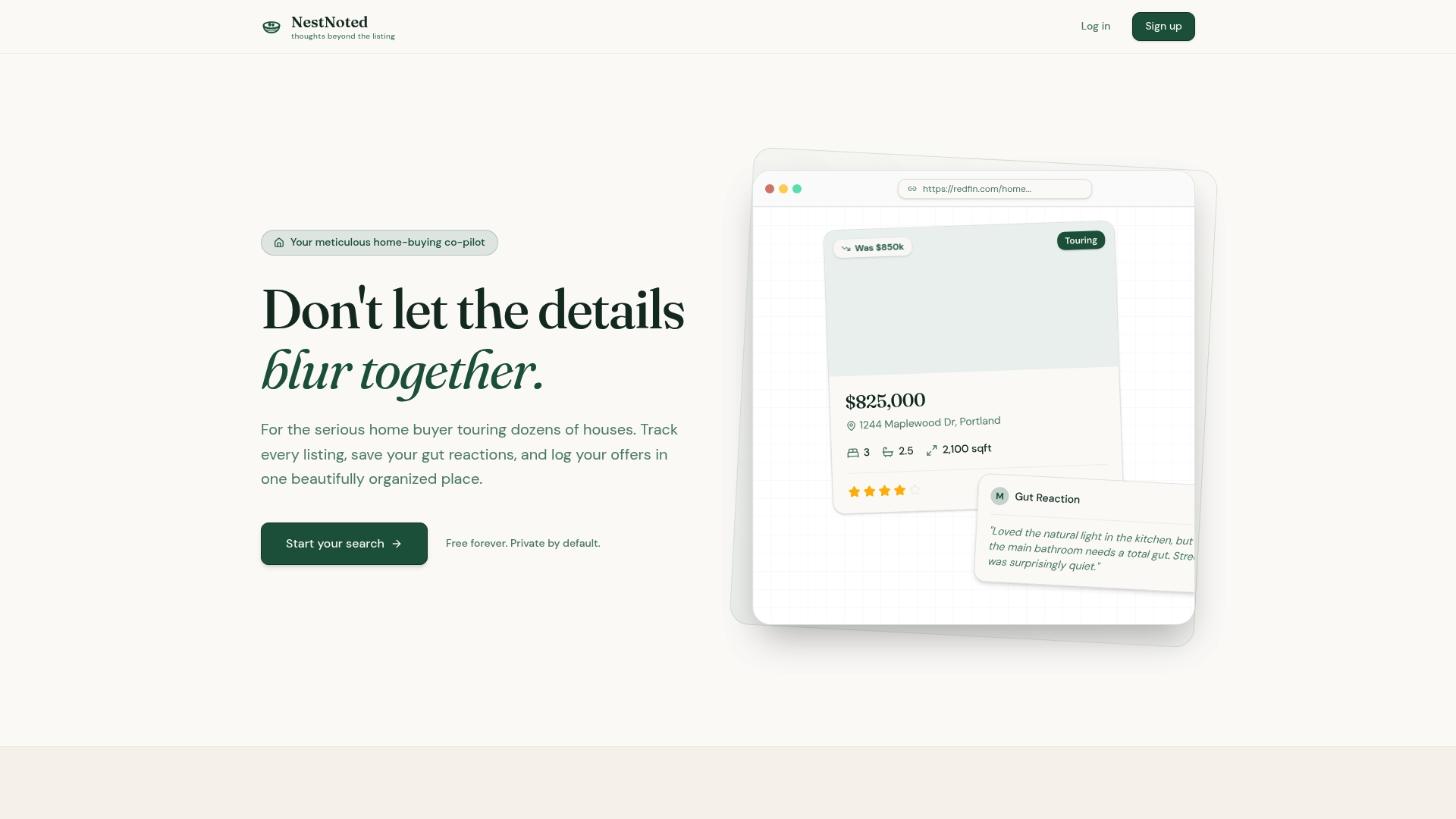
Nestnoted isn't a replacement for your brokerage's contingency tracking or your agent's CRM. It runs alongside it, syncing data from platforms like Zillow and Redfin, sending price drop alerts, and giving buyers and agents a shared workspace to compare notes on the properties still in play. If you're touring more than a couple of homes a month and the details are starting to blur together, create a free Nestnoted account and set up your first property pipeline before your next showing.
Sources
- Contingency Deadlines vs Manual Tracking 2026 | US Tech Automations
- Home buying contingencies guide (2026) | HomeCostLab
- What are the steps involved in getting a mortgage? | CFPB
FAQ
What happens if a buyer misses a contingency deadline?
The contingency is typically treated as waived once its deadline passes without written objection or an agreed extension, meaning the buyer loses the right to cancel or renegotiate on that basis and can risk their earnest money if they try to back out afterward.
How likely is a contingent offer to fall through?
There's no single universal failure rate since it depends heavily on financing strength, inspection findings, and local market conditions, but missed or mishandled deadlines are a common, avoidable cause when deals do collapse.
Can I extend my mortgage contingency deadline?
Yes, most contracts allow a mutual written extension if both parties agree before the deadline passes. Ask your lender for a written timeline update as soon as you sense a delay, using CFPB's mortgage process steps to gauge whether the slowdown is normal or a red flag.
What is the deadline for a mortgage contingency?
Financing contingencies typically run 21 to 30 days from the accepted-offer date, though the exact window is set in the contract itself and should be confirmed against your specific agreement rather than assumed.