

Earnest money tracking means confirming, in writing, that the escrow holder actually received the buyer's deposit, then filing that proof before the contract deadline passes. The date that counts is the escrow receipt date, not the day the buyer sent the wire or dropped off the check. Do this one thing well, and most earnest money disputes never happen: get a timestamped receipt attached to the transaction file, whether you track it on a spreadsheet, inside a transaction platform, or through automation that watches the escrow inbox for you.
TL;DR:
- Proper tracking of earnest money requires securing a timestamped receipt from the escrow holder that matches the actual receipt date, not just the wire transfer or check delivery date.
- Using automated systems that poll escrow portals and parse receipts offers the most reliable audit trail, but manual tracking with reminders can suffice for fewer than four transactions monthly.
- A defensible receipt must include the exact amount received, the escrow holder's identity, and the official receipt date on letterhead to stand up in disputes.
- Deadlines are determined by the escrow holder’s receipt date, making prompt follow-up essential if funds are delayed or held up by banking processes or courier issues.
- Consolidating offers, receipts, and deadlines in a single, private digital workspace reduces errors and makes audit and dispute resolution much easier.
Table of Contents
- What Earnest Money Is and Who Holds It
- How Do Earnest Money Deadlines and Receipt Windows Work?
- Refunds, Forfeiture, and What Documentation Decides
- Three Proven Tracking Approaches and Which Teams They Fit
- A Step-by-Step Checklist From Acceptance to Closing
- What a Defensible Receipt Actually Needs to Show
- What to Look for in Earnest Money Tracking Tools
- A Broker's View on Rolling Out Better Tracking
- Keep Every Offer, Receipt, and Deadline in One Private Place
- Resources for Verifying Your State's Rules
- Sources
- FAQ
What Earnest Money Is and Who Holds It
Earnest money is the buyer's good faith deposit, paid shortly after a purchase agreement is signed, that signals serious intent to close. It gets applied toward the down payment or closing costs at settlement, so it is not an extra cost on top of the purchase price. If you want a full breakdown of how it differs from the down payment itself, earnest money and down payments serve different roles in the closing math even though buyers often confuse the two.
Amounts vary by market and price point, but 1% to 2% of the purchase price is the common range, according to Rocket Mortgage's earnest money guidance. On a $400,000 home, 1% works out to $4,000. In competitive markets, sellers sometimes expect closer to 2% or more to make an offer stand out against multiple bids.
The deposit never sits with the buyer or seller directly. A neutral third party holds it until closing or a contractually defined release event. That holder is typically one of the following:
- A title company running an escrow account
- A real estate brokerage's trust account
- A closing attorney's escrow account, common in attorney-closing states
The identity of the holder matters more than most buyers realize. It determines whose letterhead should appear on the receipt, who to call if a deposit goes missing, and who legally controls disbursement when a deal falls apart.
How Do Earnest Money Deadlines and Receipt Windows Work?
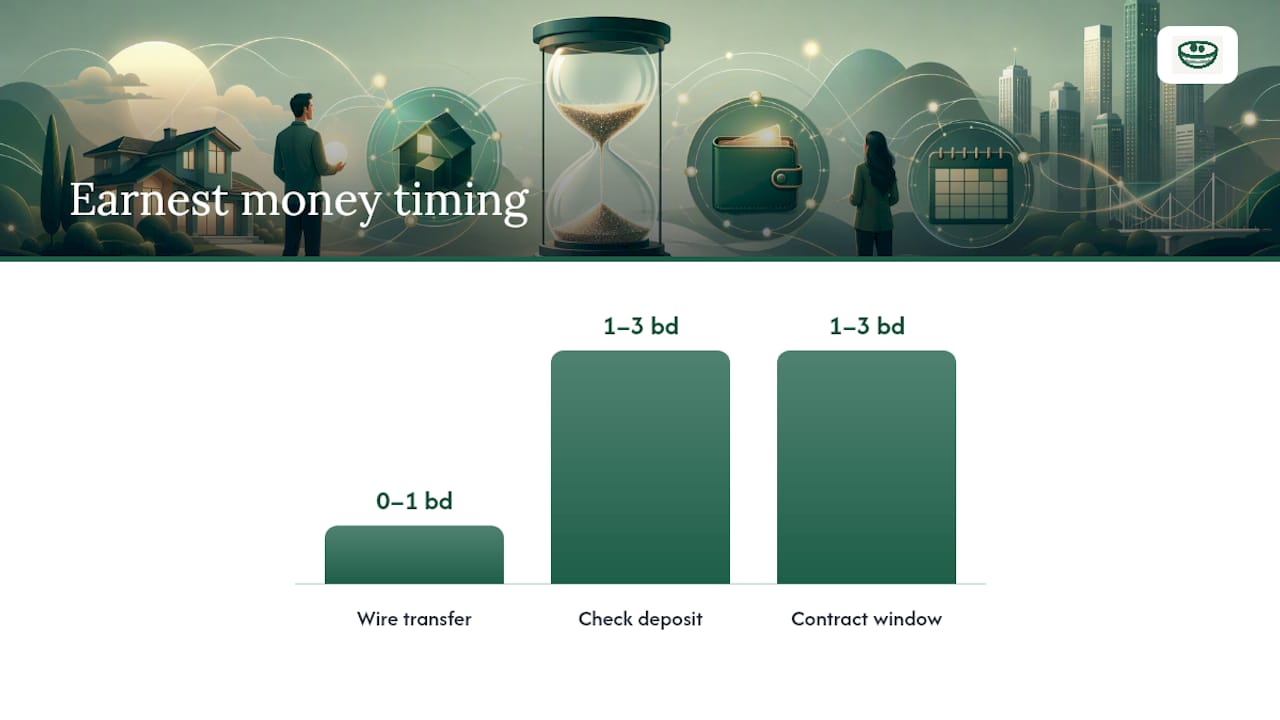
Every purchase agreement sets a window, usually one to three business days after the contract's effective date, for the buyer to deliver earnest money. The effective date itself can be tricky. It is typically the date of final signature or mutual acceptance, not the date an offer was first submitted, and most contracts count only business days toward the deadline.
How the money moves changes how fast it counts as received. Here's the sequence that matters for tracking purposes:
- Wire transfer initiated. Funds sent by wire usually post to the escrow account the same business day or the next one, depending on the sending bank's cutoff time.
- Check delivered. A check handed to the title company or attorney still needs to clear or at least be logged and deposited, which commonly takes one to three business days before it shows as received funds.
- Escrow issues confirmation. The holder generates a receipt only after funds are actually in hand, not when the buyer claims to have sent them.
- Receipt gets filed. This confirmation, not the wire confirmation from the buyer's bank, is the document that satisfies the contract deadline.
That last point trips up more transactions than anything else. The NAR's guidance on earnest money makes clear that a deadline is measured against the escrow holder's receipt, not the buyer's send date. If a wire gets held up by a bank's compliance review or a check arrives after courier delays, the burden falls on the buyer's side to prove good faith effort and to press the escrow holder for confirmation immediately, not after the deadline has already lapsed.
Refunds, Forfeiture, and What Documentation Decides
Earnest money disputes almost always come down to paperwork, not intent. Whoever has the cleaner file usually wins the disagreement, or avoids one entirely.
Refunds happen most often when a buyer exercises a contingency written into the contract. An inspection contingency lets a buyer walk away and recover the deposit if a home inspection turns up problems, provided the buyer's agent documents the objection and cancellation within the contract's stated window. A financing contingency works similarly. If a lender denies the loan, the buyer typically needs a formal denial letter, not just a verbal statement, to support a refund claim.
Forfeiture works in the opposite direction. If a buyer breaches the contract, for example by missing a deadline without an approved extension or backing out for a reason the contract doesn't cover, the seller may be entitled to keep the deposit. The exact language in the purchase agreement controls this outcome, and generic assumptions about "standard practice" do not hold up if the contract says otherwise.
To protect either side, the file needs:
- The signed contract with contingency deadlines highlighted
- Written notices of contingency removal or objection, timestamped
- Lender denial letters or inspection reports where applicable
- The original escrow receipt showing funds were received on time
Missing any one of these turns a straightforward refund into a drawn-out dispute.
Three Proven Tracking Approaches and Which Teams They Fit
Agents and buyers generally land on one of three tracking methods, and the right one depends almost entirely on transaction volume.
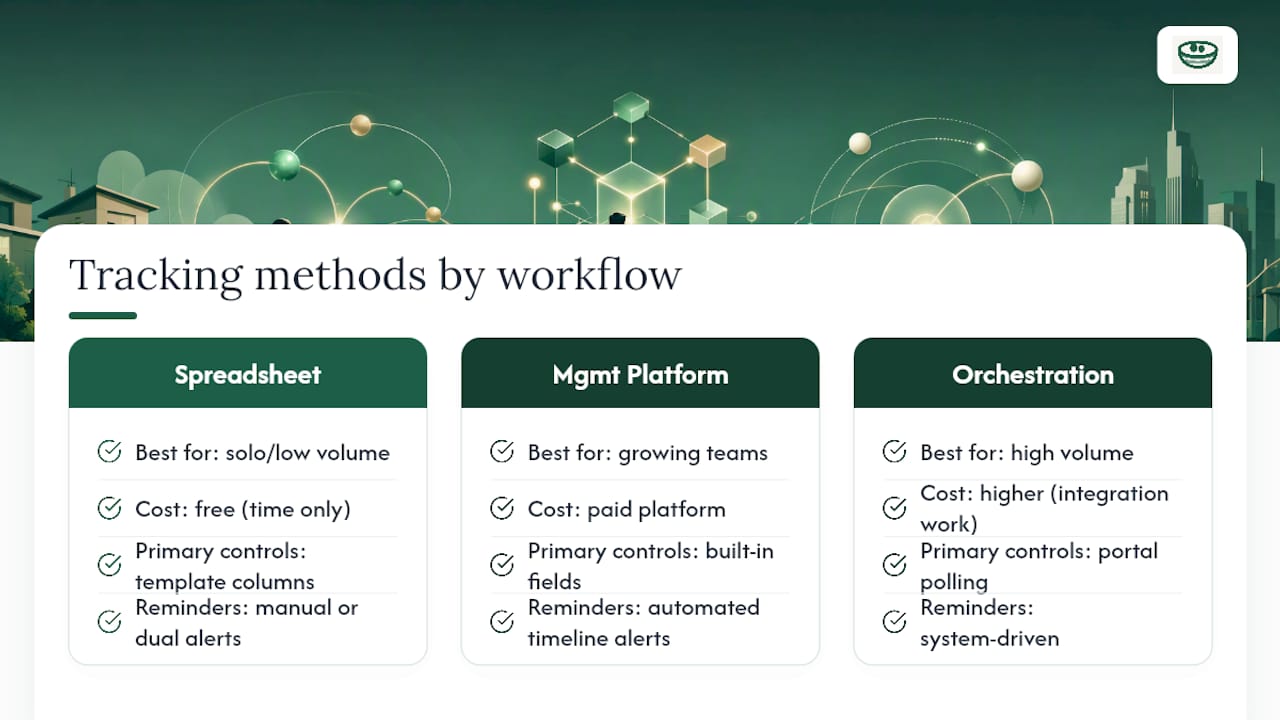
Spreadsheet and manual tracking works for solo agents or buyers handling a handful of deals at once. It costs nothing beyond time, and a well built template with columns for contract date, deadline, escrow holder, and receipt status can catch most problems. The failure mode is human error: a missed calendar reminder, a receipt saved to the wrong folder, or a deadline miscounted because someone forgot to exclude a weekend. Research comparing tracking methods found that teams handling fewer than about four transactions a month can manage fine with disciplined spreadsheets and dual reminders, but the margin for error shrinks fast as volume grows.
Transaction management platforms add structure. Most include built-in fields for earnest money amount, due date, and status, plus automated reminders tied to the contract timeline. The gap is that these platforms track that a task exists, not that the escrow holder actually has the money. Someone still has to log in, check for the receipt, and mark it confirmed.
Orchestration automation goes a step further by polling escrow portals or inboxes directly, parsing incoming receipt PDFs, and flagging exceptions when a deadline approaches with no confirmation on file. This method requires more setup and sometimes integration work with a title company's portal, but it produces the most reliable audit trail because the system, not a person's memory, is watching the clock.
Pro Tip: Whichever method you use, log the escrow receipt date as a separate field from the deadline date. If they ever diverge, that gap is exactly what an auditor, broker, or opposing attorney will ask about first.
A Step-by-Step Checklist From Acceptance to Closing
Missed earnest money deadlines rarely happen because someone didn't care. They happen because no one owned the task clearly enough. This sequence closes that gap.
- Pull the earnest money clause the day the contract is signed. Screenshot or save the specific page showing the deposit amount, deadline, and holder. Don't rely on memory of "standard terms."
- Create a tracked task immediately, assigned to one named person, with the escrow deadline as the due date and at least one reminder set 24 to 48 hours ahead of it.
- Contact the escrow holder to confirm intake instructions before funds move. Wire instructions in particular should be verified by phone, never by email alone, given how common wire fraud has become in real estate closings.
- Request a written receipt on official letterhead once funds are delivered. Verify it shows the correct amount, the escrow file number, and the actual receipt date.
- Attach the receipt to the transaction file and notify the client that the deposit has been confirmed. Close the task only after this step, not after the wire was sent.
- Escalate immediately if no receipt arrives within the expected window: call the escrow office directly, loop in the broker if the office is unresponsive, and document every follow-up attempt with a timestamp in case the deadline becomes contested later.
Pro Tip: Build the escalation step into your process before you need it. Waiting until a deadline has already passed to figure out who to call is how a fixable delay turns into a forfeited deposit.
Keeping the repair estimates, inspection notes, and other offer documents in the same organized place makes this checklist easier to run consistently. Buyers who track repair estimates and offer attachments in one file tend to catch discrepancies faster than those juggling separate email threads and paper folders.
What a Defensible Receipt Actually Needs to Show
A bank confirmation showing money left the buyer's account is not proof the escrow holder received it. Only the escrow holder's own written receipt satisfies that requirement, and it needs three specific fields to hold up under scrutiny.
- Amount received, stated as the confirmed figure, not the amount the buyer claims to have sent.
- Escrow holder identity, including the company name and license or file number where applicable.
- Receipt date, printed on official letterhead rather than a forwarded email screenshot.
Industry checklists built around NAR's documentation standards treat these three fields as non-negotiable for errors and omissions protection. If a dispute ever reaches a broker review or a claim, the agent who has this receipt on file is in a completely different position than the one who has only a wire confirmation number.
Store the receipt as a PDF attached directly to the transaction record, named consistently (something like [address]_EMD_receipt_[date]), and keep it under your brokerage's standard document retention policy. A folder full of inconsistently named screenshots is nearly as bad as no file at all when someone needs to find the receipt fast.
What to Look for in Earnest Money Tracking Tools
Not every digital tool that touches earnest money actually solves the receipt problem. Some products, like Earnnest's digital deposit platform, handle the payment and receipt generation directly, giving both sides a dashboard to confirm funds moved and landed. Whether you use a dedicated payment tool or a broader transaction platform, the same feature checklist applies.
Look for:
- Escrow portal integration or polling, so the system checks for receipts rather than waiting for a human to remember
- Receipt parsing, ideally with optical character recognition, that pulls the amount, date, and holder name automatically
- Timestamped audit logs that can't be edited after the fact
- Secure document storage that meets your brokerage's compliance standards
- Clear visibility into refund and return status when a contingency gets exercised
Red flags include vendors that only confirm "payment sent" without a corresponding "payment received" event, audit logs that can be quietly edited, and no visible refund workflow. If a platform can't show you the exact date escrow confirmed receipt, it isn't solving the actual problem.
A Broker's View on Rolling Out Better Tracking
Brokers who try to fix earnest money tracking across an entire office at once usually stall out. The better path starts narrow: pick the single workflow from contract acceptance to receipt confirmation, assign clear ownership, and require a human sign-off before any task closes.
Run it on five to ten transactions before declaring victory. Track one number: how many deadlines got missed or nearly missed. That figure tells you more than any process document ever will, and it usually exposes exactly where the template needs tightening, whether that's the reminder timing, the escalation contact, or the file naming convention.
Set a clear threshold for when a broker needs to step in personally, such as any receipt still unconfirmed 24 hours past deadline. Vague escalation rules are why deposits go missing for days before anyone notices.
— Antony
Keep Every Offer, Receipt, and Deadline in One Private Place
Juggling earnest money deadlines across three or four active offers gets messy fast, especially when the details live scattered across email threads, text messages, and a half-updated spreadsheet. A suitable property management tool can provide buyers and agents with a single private workspace to log offers, attach receipts and inspection documents, and set reminders tied to real deadlines, without turning every property into a public group chat.

Because notes stay private by default, buyers can track honest impressions and offer details without worrying about anything leaking to a seller's agent, while collaborating agents still see the shared file when it matters. If you're managing more than one active offer right now, start organizing your properties on NestNoted and see how much easier the deadline math gets when everything lives in one place.
Resources for Verifying Your State's Rules
Earnest money rules carry real regional variation, so confirm specifics against a primary source before relying on general guidance.
- NAR's overview of earnest money refunds and regulations covers common refund and forfeiture scenarios nationally.
- Wells Fargo's earnest money explainer walks through how deposits get applied at closing from a lender's perspective.
- State statutes, such as Ohio's real estate licensing code on trust funds, show how individual states codify escrow handling. Check your own state's equivalent section before assuming a rule applies everywhere.
- Legal guidance on common real estate transaction hurdles covers procedural pitfalls that often intersect with earnest money timing.
Sources
- Earnest Money in Real Estate: Refunds, Returns and Regulations
- Earnest money: What is it and how much is enough?
- Earnest Money Receipts: 3 Tracking Methods Compared 2026
FAQ
How long does it take to receive earnest money?
Wire transfers usually post to the escrow account quickly, often the same business day or the next. Checks typically take longer to clear, sometimes a few business days before they are logged as received.
How much is earnest money on a $400,000 house?
Earnest money generally ranges from 1% to 2% of the purchase price, so on a $400,000 home it often falls around $4,000 or more, with higher amounts sometimes seen in competitive markets.
Where is earnest money sent?
It goes to a neutral third party, usually a title company's escrow account, a brokerage trust account, or a closing attorney's escrow account, never directly to the buyer or seller.
How long can a realtor hold earnest money?
A real estate agent generally should not hold earnest money personally for longer than the timeframe specified in the contract, and most brokerages route it directly into a trust or escrow account rather than holding it in-house at all.