

Appraisal gap coverage is a buyer's written promise to pay the difference, up to a stated dollar limit, when a home appraises below the contract price. The single most important thing to understand: your lender will not finance that gap. The mortgage is calculated on the appraised value, not what you agreed to pay, so every dollar of coverage comes out of your pocket at closing.
- The gap is the difference between contract price and appraised value.
- Coverage commits you to bridging some or all of that gap in cash.
- A cap limits your maximum exposure; without one, your liability is unlimited.
- Lenders treat the shortfall as buyer cash, separate from your down payment.
Pro Tip: Before you include any coverage language in an offer, confirm with your lender exactly how much additional cash you can bring to closing without jeopardizing your loan approval.
Table of Contents
- How appraisal gap coverage differs from an appraisal contingency
- Who pays the shortfall and what the numbers actually look like
- How to write a coverage clause that limits your exposure
- When coverage makes sense and when it's a trap
- A privacy-first workflow for tracking appraisal risk across multiple offers
- Pre-offer checklist: confirm before you commit to coverage
- Common mistakes that turn coverage into a financial trap
- Key Takeaways
- The case for capping first and competing second
- Nestnoted helps you track appraisal risk privately, offer by offer
- Useful sources and further reading
How appraisal gap coverage differs from an appraisal contingency
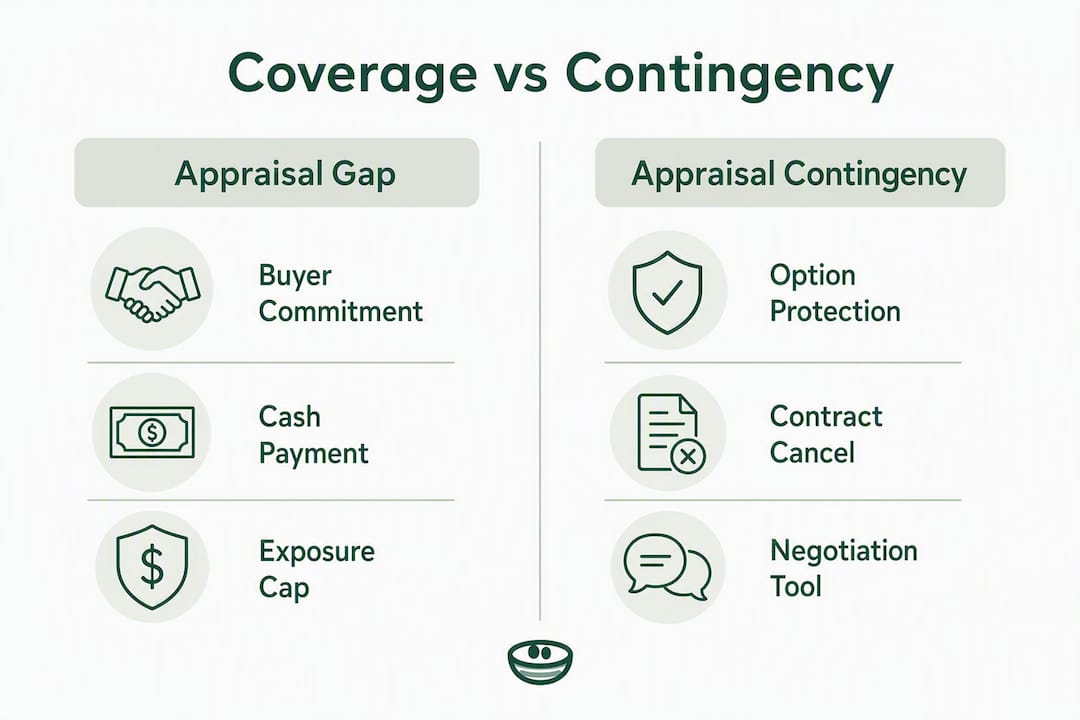
Buyers and agents commonly conflate these two terms, but they do opposite things legally.
| Feature | Appraisal Gap Coverage | Appraisal Contingency |
|---|---|---|
| What it is | Buyer's cash commitment to cover a shortfall | Buyer's right to renegotiate or exit |
| Effect on seller | Signals financial strength | Signals buyer caution |
| Buyer protection | Low (buyer pays) | High (buyer can walk) |
| Common in | Competitive, low-inventory markets | Balanced or buyer-friendly markets |
| Can they coexist? | Yes, as a hybrid clause | Yes, as a hybrid clause |
A contingency protects your options. Coverage communicates commitment. The hybrid approach, where you cap coverage at a fixed dollar amount and retain the right to exit if the gap exceeds that cap, gives you both a competitive edge and a safety valve. Capping specifies buyer exposure and preserves negotiating leverage when the shortfall is larger than anticipated.
Clear, dollar-capped language matters because vague coverage clauses can expose you to unlimited liability. "Buyer agrees to cover any appraisal gap" with no cap is a blank check.
Who pays the shortfall and what the numbers actually look like

The lender's math is straightforward and unforgiving. Say you offer a price on a home with a standard down payment. The home appraises for less than that offer.
| Scenario | Contract Price | Appraised Value | Loan (%) | Down Payment | Gap You Pay |
|---|---|---|---|---|---|
| No gap | The offered price | Equal to offer | Standard loan amount | Standard down payment | None |
| Some gap | The offered price | Lower than offer | Lower loan amount | Standard down payment | Difference in cash |
| Larger gap | The offered price | Even lower appraisal | Reduced loan amount | Standard down payment | Larger cash difference |
Your down payment stays the same percentage of the appraised value, not the contract price. The gap is a third bucket of cash entirely. In the $25,000 example, you close with $125,000 out of pocket instead of $100,000.
The ripple effects go further. A lower loan amount can push your loan-to-value ratio into PMI territory if you were counting on a clean 20% down. Your cash reserves shrink, which some lenders verify at closing. Buyers often mistakenly assume lenders will cover the gap; in most cases the entire shortfall must be paid in cash.
Home appraisals can come in below the contract price, especially in competitive markets where prices rise faster than appraiser comps can follow.
How to write a coverage clause that limits your exposure
Coverage clauses can be capped at a dollar amount or percentage and can coexist with appraisal contingencies. Here are the four main structures:
- Dollar cap: "Buyer agrees to cover up to $15,000 of any appraisal shortfall."
- Percentage cap: "Buyer agrees to cover up to 3% of the purchase price in appraisal gap."
- Cap plus contingency: Buyer covers up to $X; if the gap exceeds $X, buyer may renegotiate or exit.
- Escrow timing clause: Specifies when gap funds must be deposited (e.g., within 5 business days of the appraisal report).
A sample clause worth modeling:
Each element earns its place. The dollar cap defines your maximum exposure. The cash-at-closing language tells the lender exactly what to expect. The termination right protects your deposit if the gap blows past your limit.
Pro Tip: Attach a proof-of-funds letter and your preapproval to every offer that includes coverage language. Sellers and listing agents take capped coverage far more seriously when they can see the cash actually exists.
When coverage makes sense and when it's a trap
Coverage is a competitive tool, not a default. Use it when the conditions support it.
Situations that favor including coverage:
- You are in a hot seller's market with multiple competing offers.
- Recent comparable sales are strong and within 2%–3% of your offer price.
- You have liquid reserves well above your down payment and closing costs.
- The property is conventional and not unique enough to attract a wide appraisal range.
Situations to avoid it:
- Comps are thin, dated, or significantly below your offer price.
- The market is volatile and prices have shifted sharply in recent months.
- Your cash reserves are tight; covering the gap would drain your emergency fund.
- You are using an FHA, VA, or USDA loan, where program-level appraisal rules add complexity and limit your options.
Pro Tip: Set your coverage cap as a hard dollar amount tied to an affordability threshold, not a round number that sounds competitive. If covering $20,000 would leave you with less than two months of mortgage reserves, your real cap is lower.
A privacy-first workflow for tracking appraisal risk across multiple offers
When you are managing several offers at once, appraisal risk compounds fast. Organized documentation of comparable sales and appraiser-facing facts reduces the chance of a surprise shortfall.
Here is a repeatable workflow:
- Capture comps before the offer. Pull at least three recent closed sales within one mile, same bed/bath count, within the past 90 days.
- Assign a confidence score. Rate each property 1–5 on comp strength. A score below 3 means thin support; lower your cap or keep the contingency.
- Log per-offer coverage fields. For each property, record your proposed cap, the comp-supported value, and the gap between them.
- Note lender and appraiser details privately. Which lender, which appraisal management company, and any known local appraiser tendencies.
- Track days on market and price-per-square-foot. These two figures are what appraisers weight most heavily.
- Document seller concessions and recent repairs. Appraisers adjust for both; knowing them in advance sharpens your estimate.
Fields to track in your private tool for each property:
- Comp-supported value (your estimate)
- Contract price and proposed coverage cap
- Price per square foot vs. neighborhood average
- Days on market at offer
- Seller concessions (if disclosed)
- Preapproval letter version and lender contact
- Proof-of-funds balance and date
Nestnoted is built for exactly this kind of private, per-offer documentation. You can store comps, log offer details with custom cap fields, attach proof-of-funds documents, and share a workspace with your agent, all without any of it becoming public. A home comparison chart built inside a private tool like Nestnoted lets you standardize your cap-setting logic across every offer instead of recalculating from scratch each time.
Pro Tip: Write a one-line "coverage rationale" note for each offer explaining why you chose that cap. When you revisit the decision two weeks later, that note is worth more than any spreadsheet.
Pre-offer checklist: confirm before you commit to coverage
Run through this before submitting any offer that includes a coverage clause.
- Confirm with your lender that a low appraisal will not trigger a loan denial or require a new preapproval.
- Verify your liquid cash balance covers your down payment, closing costs, AND your maximum coverage cap simultaneously.
- Pull and review at least three recent comps; note the gap between the strongest comp and your offer price.
- Set your cap at or below the difference between your offer price and the strongest comp.
- Assemble proof-of-funds documentation dated within 30 days.
- Confirm your lender's documentation requirements for gap coverage (some require a signed addendum).
- Agree with your agent on a fallback negotiation plan if the appraisal comes in below your cap.
Checklist items to record privately before submitting:
- Maximum coverage cap (dollar amount)
- Maximum coverage as a percentage of purchase price
- Comp-supported value and source
- Lender confirmation (name, date, method)
- Proof-of-funds document version and balance
- Fallback plan (renegotiate price, request reconsideration of value, or exit)
Check loan program-specific appraisal rules before finalizing your approach, since FHA and VA loans carry distinct appraisal requirements that can affect your options.
Buyers who can't easily produce additional cash at closing should not include coverage language in any offer, regardless of how competitive the market feels.
Common mistakes that turn coverage into a financial trap
Uncapped coverage. The most dangerous clause is one with no dollar limit. Waiving contingencies or offering uncapped coverage puts your earnest money and closing funds at risk if the gap is larger than expected. Fix: always name a dollar cap.
Assuming the lender will finance the gap. They won't. The mortgage is based on appraised value, full stop. Fix: confirm your cash position before signing.
Waiving the contingency without sufficient reserves. A coverage clause without a contingency backstop means you either close or forfeit your deposit. Fix: keep the contingency unless your reserves can absorb the worst-case gap.
Vague escrow timing. No deadline for depositing gap funds creates disputes at closing. Fix: specify the number of business days after the appraisal report.
Conflicting contingency language. A contract that includes both a coverage clause and a standard appraisal contingency with no clear hierarchy creates ambiguity about which controls. Fix: state explicitly which provision governs if they conflict.
"Buyer agrees to cover any difference between appraised value and purchase price" with no cap, no timing, and no exit right is the single most dangerous sentence in a competitive-market offer. One word change, adding "up to $[X]," transforms it from unlimited liability to a defined, manageable commitment.
Key Takeaways
Appraisal gap coverage is only as safe as the dollar cap you put on it; without a written limit and confirmed cash reserves, it is an open-ended financial commitment your lender will not share.
| Point | Details |
|---|---|
| Lenders finance appraised value only | Any gap between contract price and appraisal must be paid in buyer cash at closing. |
| Always cap your exposure | Name a specific dollar amount in the clause; uncapped coverage is unlimited liability. |
| Keep cash reserves above the cap | Your down payment, closing costs, and coverage cap must all be covered simultaneously. |
| Track comps before every offer | Strong recent comps reduce gap risk; thin comps mean a lower cap or a retained contingency. |
| Nestnoted for per-offer tracking | Log coverage caps, comps, and proof-of-funds privately per property to standardize decisions across multiple offers. |
The case for capping first and competing second
The conventional wisdom in a hot market is to lead with your strongest offer and worry about the appraisal later. That logic costs buyers real money. The gap between what you offered and what the appraiser finds is not a negotiating footnote; it is a cash demand that arrives at closing with no flexibility from your lender.
What changes buyer outcomes is not the size of the coverage commitment but the quality of the information behind it. Buyers who walk into an offer knowing their comp-supported value, their lender's exact cash requirements, and their own hard cap make better decisions than buyers who guess at a round number to sound competitive. Private notes, tracked consistently across every property you tour, are what make that discipline possible. The buyers who get surprised at closing are almost always the ones who set their cap based on emotion rather than documented evidence.
Appraisal contingencies are not a sign of weakness. They are a sign that you understand the contract you are signing. Keep one whenever your reserves are thin, your comps are soft, or the market is moving faster than appraisers can follow.
Nestnoted helps you track appraisal risk privately, offer by offer
Serious buyers managing multiple offers need more than a spreadsheet. Nestnoted's offer-tracking features let you log a coverage cap, attach proof-of-funds documents, store comps, and share a private workspace with your agent, all in one place and visible only to you.

Every offer gets its own record: the comp-supported value, your proposed cap, lender contact details, and your fallback plan. Nothing is public. Nothing gets lost in a text thread. Nestnoted does not provide legal advice or lending decisions, but it gives you the organized, private documentation that makes every coverage decision traceable and defensible. Sign up free at Nestnoted and start tracking your next offer with the detail it deserves.
Useful sources and further reading
The sources below informed this article. Consult them directly for lender-specific or program-specific detail, and confirm any clause language with your agent and lender before signing.
| Source | Best for |
|---|---|
| Zillow: What Is an Appraisal Gap? | Definition, buyer options, and lender cash rules |
| Rocket Mortgage: Appraisal Gap | Lender mechanics and contingency waiver risks |
| NerdWallet: Appraisal Gap | Clause structures, cap options, and comp documentation |
| SoFi: What Is an Appraisal Gap? | Coverage vs. contingency distinction |
| Platinum Capital: USDA vs FHA vs Conventional | Program-level appraisal and underwriting rules |
- For FHA, VA, or USDA loan-specific appraisal rules, contact your loan officer directly; program requirements affect how gaps are handled at underwriting.
- Always have your agent review coverage clause language before submitting; state contract forms vary and may require specific addenda.
- This article is general information, not legal or financial advice. Confirm current rules and clause language with a licensed real estate attorney or your lender.