

A deal breaker is any finding that puts your safety at risk, signals active structural or water damage, makes a home uninsurable or unlendable, or drags repair costs high enough to break your purchase math. When you spot one, stop making personal commitments to the house, activate your inspection contingency, and either order the specialist report you need or walk if the danger is immediate.
TL;DR:
- Active foundation movement, ongoing water intrusion, and uninsurable electrical systems are the most urgent deal breakers that directly threaten safety or insurability.
- Roof leaks, sewer line collapse, and major HVAC failures often require significant repairs and should be carefully evaluated against repair cost estimates.
- Personal factors like zoning restrictions, unpermitted work, or neighborhood changes can also serve as deal breakers, even if they don't show up in inspections.
- Regularly updating and reviewing your deal breakers list during the search helps adapt to new information and avoid emotional or impulsive decisions.
- Using a private, organized record system for inspection notes, photos, and quotes ensures consistency and clarity across multiple property viewings.
Table of Contents
- What Counts as a Deal Breaker on a Deal Breakers List
- The Five-Axis Rubric: Walk, Negotiate, or Proceed
- Tracking Deal Breakers Without Losing Your Mind
- What a Deal Breakers List Actually Does for You
- Building Your Own List Around What You Actually Care About
- Deal Breakers Differ by Property Type
- Deal Breakers That Have Nothing to Do With the Inspection
- Keep the List Alive Through the Whole Search, Not Just at the Start
- An Editor's Take on Staying Disciplined Through the Search
- Keep Every Property's Deal Breakers in One Private Place
- Sources
What Counts as a Deal Breaker on a Deal Breakers List
Not every flaw belongs on a deal breakers list. A dated kitchen or a roof with a few years left doesn't qualify. The purpose of this list is narrower: it exists to catch the handful of conditions that change whether you should buy the house at all, not the hundred small things you'd fix eventually anyway.
Home inspections turn up problems in 86% of properties, and buyers who negotiate on inspection findings knock an average of $14,000 off the sale price. That means almost every home you tour will generate some kind of inspection note. Your job is separating routine maintenance items from the small set of conditions serious enough to threaten your health, your loan, or your insurability. Below is the working list Nestnoted users flag most often when comparing properties across a busy touring season, ranked roughly by urgency and frequency.
1. Active foundation movement. Fresh cracks wider than a quarter inch, doors that newly stick, floors that slope where they didn't before. These differ from old, stable settlement cracks that have been painted over for a decade. Active movement means the problem is still happening.
2. Ongoing water intrusion. A damp basement corner during a rainstorm is different from a water stain that's been there since the Clinton administration. Chronic leaks, widespread rot, and visible mold growth on tour are deal breakers; a single old stain with no odor and dry drywall usually isn't.
3. Uninsurable electrical systems. Knob-and-tube wiring, aluminum branch circuits, and outdated panels are common triggers for insurer refusal. Electrical defects show up in roughly 18.7% of inspections, and some insurers simply won't write a policy until the panel is replaced.
4. A roof at the end of its life with active leaks. Roof issues appear in about 19.7% of inspection reports. A roof that's merely old is a negotiating point. A roof that's old and actively leaking into the attic is a different category entirely.
5. Sewer line collapse. Tree roots, bellied pipe, or a fully collapsed clay line under the yard won't show up on a walkthrough. If the home is more than 40 years old and has mature trees near the main line, a camera inspection is worth the money before you get attached to the house.
6. Major HVAC failure or obsolete refrigerant systems. A system running on discontinued refrigerant that needs full replacement changes your first-year budget significantly.
7. Active termite or pest structural damage. Treatment kills the bugs. It doesn't always restore the wood, and insurers sometimes flag a history of infestation regardless of remediation.
8. Severe mold contamination. Isolated bathroom mold from a leaky supply line is fixable. Mold running through wall cavities or HVAC ductwork is a habitability issue.
9. Banned or failing plumbing materials. Polybutylene pipe and lead supply lines are known failure points that many inspectors flag automatically, especially paired with any active leak.
10. Unpermitted structural work. A converted garage, a bumped-out addition, or a load-bearing wall removed without a permit can be uninsurable and unfinanceable until it's brought up to code, retroactively permitted, or reversed.
11. HOA financial trouble. Pending special assessments, reserve shortfalls, or active litigation against the association can add thousands to your annual cost with zero warning.
12. Lender or insurer blockers. Certain findings, particularly around foundations and electrical panels, tend to trigger FHA and VA minimum property standard conditions that conventional loans might not require. Know your loan type before you decide how scared to be.
Pro Tip: A general home inspection runs about $343 on average, but a targeted sewer camera or structural engineer report often costs less than one month of the repair you're trying to rule out. Spend the extra money before you spend the down payment.
Realtor.com's own reporting notes that some apparent deal breakers are actually "deals in disguise": an older roof, a dated kitchen, even some water staining can be perfectly acceptable once quantified and priced into your offer. The list above is about severity and activity, not age or appearance.
The Five-Axis Rubric: Walk, Negotiate, or Proceed
Once an inspection flags something serious, you need a repeatable way to decide, not a gut reaction in the parking lot. Run every finding through five axes, in this order.
- Active versus historic. Is the damage still happening, or did it happen once and stop? Active problems carry ongoing risk; historic ones are often just a repair line item.
- Repair-cost band. Get real numbers, not guesses.
- Seller posture. A seller who offers to fund a structural engineer visit or hands over old repair invoices is cooperating. One who stonewalls or refuses further access is telling you something.
- Lender and insurer constraints. Confirm whether your loan type (particularly FHA or VA financing) will hard-block on this finding regardless of what you're willing to accept.
- Timing and contingency window. How many days are left on your inspection contingency, and is that enough time to get a specialist out?
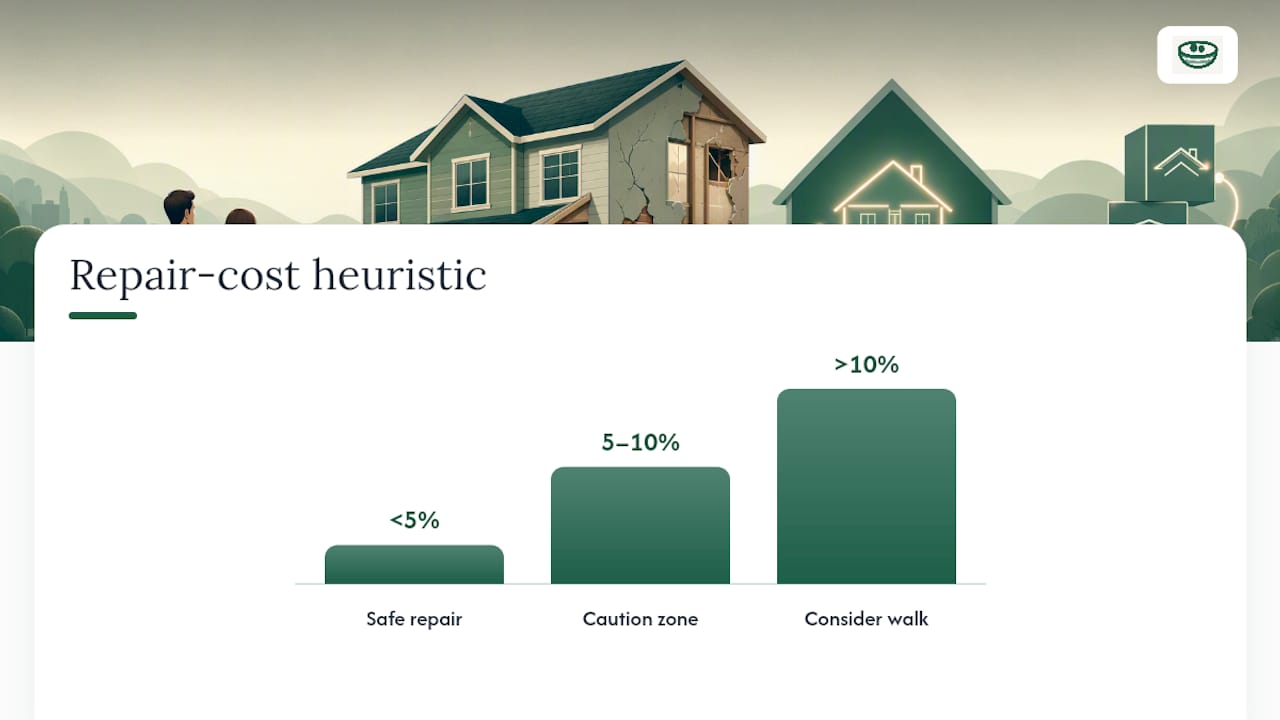
The cost heuristic that matters most: when repair estimates approach 5 to 10% of the purchase price, the math usually favors walking unless the seller absorbs most of the cost. Get two or three independent quotes and negotiate off the median, not the scariest number you got.
When a finding is serious but ambiguous, escalate before you decide anything. Order the structural engineer, the sewer camera, or the pest structural report, and push the seller to fund it or extend your contingency window to accommodate it.
Negotiation typically moves through a ladder: a completed repair by a seller-approved contractor, an escrow holdback, a closing credit based on median quotes, a price reduction, or a walk. Work through them in that order; you'll rarely need to reach the bottom.
Pro Tip: Photograph everything the moment you notice it, and attach your inspector's exact language to your notes. Memory fades fast when you've toured fifteen houses in three weekends, and vague recollection is worthless when you're trying to negotiate.
Tracking Deal Breakers Without Losing Your Mind
Touring a dozen properties a month means a dozen sets of inspection notes, repair quotes, and gut reactions all competing for the same mental space. A structured record, whether it's a private app or your own repair estimate tracker, beats trying to remember which house had the sketchy panel and which one had the sewer issue.
Here's how a workflow inside Nestnoted typically looks during an active search:
- Log the finding the moment you see it: severity rating, a photo, the inspector's exact note, an estimated repair band, and your next action (specialist call, negotiate, or walk).
- Tag each property by repair-cost band, lender risk, and seller posture so fifteen homes become comparable instead of a blur.
- Keep notes private by default, which matters when you want to write "this basement smells like a swamp" without worrying anyone else will see it.
- Share select findings with your agent when it's time to brief them, rather than exposing your entire private log.
| What you're solving | Nestnoted workflow field |
|---|---|
| Forgetting which house had which issue | Per-property notes with photo and inspector quote attached |
| Comparing repair risk across homes | Tags for cost band, lender risk, seller posture |
| Writing honest reactions without exposure | Private-by-default notes |
| Getting your agent up to speed fast | Shareable summary instead of raw notes |
For the tour itself, pair this with a property viewing checklist so you're capturing the same fields every time, whether it's your third house or your thirtieth.
What a Deal Breakers List Actually Does for You
A deal breakers list is a short, private record of the specific conditions that would end your interest in a property regardless of price, location, or how much you loved the kitchen. It's not a wish list, and it's not the same as your "nice to have" features. Its entire job is to draw a hard line between "fixable and negotiable" and "walk away, full stop," so you're not relitigating the same emotional decision at every single showing.
Without one, buyers touring multiple homes tend to fall into two traps. Either they get talked out of a real problem because they've fallen for the house, or they panic over something minor because it's the first flaw they've seen that week. A written list, decided before you're standing in someone's kitchen picturing your furniture in it, keeps both instincts in check.
The list also serves a second purpose: it's evidence. When you're negotiating repairs or a price reduction, having documented, consistent criteria for what you consider unacceptable makes your position look reasoned rather than reactive. Agents notice the difference, and so do listing agents on the other side of the table.
Keep it short. A deal breakers list with 30 items on it isn't a filter anymore, it's just anxiety in bullet-point form. The strongest lists have somewhere between eight and fifteen entries, almost all of them tied to safety, structural integrity, insurability, or financing risk.
Building Your Own List Around What You Actually Care About
The checklist earlier in this guide is a strong default, but your personal version should flex based on your specific situation. A cash buyer with a big renovation budget can tolerate findings that would sink a buyer stretched thin on an FHA loan. A buyer with small children weighs lead paint and staircase safety differently than a retiree buying a single-story home.
Start by ranking your own non-negotiables against three questions: What could hurt someone in my household? What could I not afford to fix even with financing help? What would make my lender or insurer say no regardless of my own comfort level? Anything that hits all three questions belongs at the top of your list.
Loan type matters more than most buyers realize here. If you're financing with FHA or VA loans, certain conditions, peeling exterior paint on pre-1978 homes, missing handrails, exposed wiring, become hard stops regardless of your own risk tolerance, because the loan itself won't close until they're fixed. A cash buyer facing the identical house has more room to negotiate around the same issue.
Your list should also reflect what you're personally willing to manage after closing. Some buyers happily take on a fixer with cosmetic issues but draw a hard line at anything structural. Others are the opposite: they'll tolerate an ugly kitchen forever but won't touch a house with any history of water in the basement. Neither instinct is wrong. Write yours down before you start touring, not after you've fallen for the wrong house.
Deal Breakers Differ by Property Type
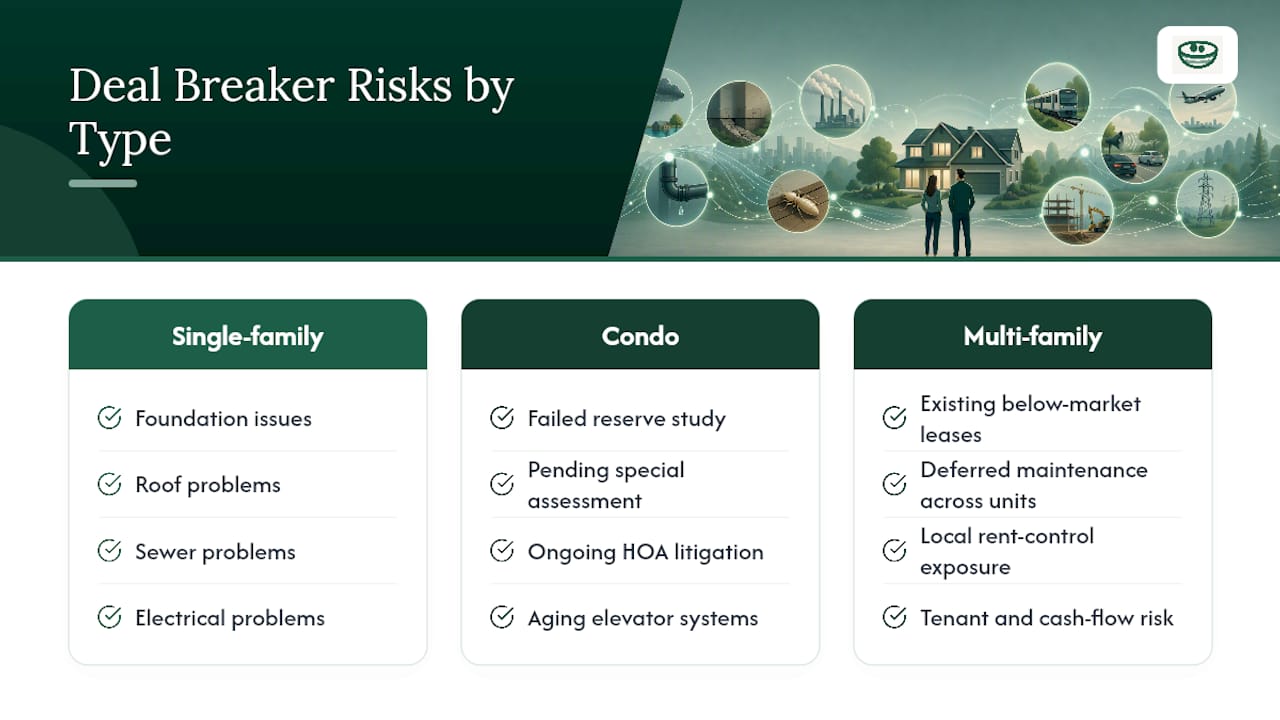
A single-family home, a condo, and a multi-family property carry different risk profiles, and a generic checklist misses the ones specific to each.
For single-family homes, the checklist covered earlier applies almost in full: foundation, roof, sewer, electrical, HVAC. You own everything, so every system is your problem, and every deal breaker on the earlier list carries full weight.
Condos shift the calculus toward the HOA and the building envelope. A structurally sound unit can still be a deal breaker if the building has a failed reserve study, a pending special assessment, or ongoing litigation against the association. Aging elevator systems, a roof or facade the HOA has deferred maintaining, and any sign the building is under-insured all belong on a condo-specific list, because you don't control the fix even though you'll pay for it.
Multi-family properties add tenant and cash-flow risk on top of the physical building. Existing leases below market rent, deferred maintenance across multiple units, and local rent-control exposure can all break the deal even when the structure itself is fine. A single bad unit is a repair line item; a building full of neglected units with sitting tenants is a different kind of problem.
Whatever the property type, tag it in your notes so you're not comparing a condo's HOA risk against a single-family home's foundation risk as if they're the same category of concern.
Deal Breakers That Have Nothing to Do With the Inspection
Some of the strongest reasons to walk away from a property never show up on an inspector's report at all. Zoning is the biggest one: a home that looks like a straightforward single-family purchase but sits on a lot zoned for eventual multi-family redevelopment can change your neighborhood's character in five years in ways you never agreed to.
Permit history matters just as much as the physical work itself. A gorgeous finished basement or a bumped-out kitchen addition built without permits can turn into a financing problem, an insurance problem, or a resale problem down the line, even if the workmanship looks solid. Pull permit records before you fall in love with the square footage.
Neighborhood-level factors round out this category: a flight path that wasn't obvious during a weekday tour, a planned commercial development two lots over, or a school district boundary that's up for redistricting. None of these will appear in an inspection report, and none of them are fixable after closing. If any of these would genuinely change your decision, they belong on your list with the same weight as a cracked foundation.
Keep the List Alive Through the Whole Search, Not Just at the Start
A deal breakers list written once and never touched again stops being useful by house number six. Revisit it after every serious showing, not just the ones where something went wrong, because your priorities shift as you see more inventory and get a real feel for what's actually available in your price range.
Update it in three moments specifically: right after your first few tours, when you discover a concern you hadn't thought to write down; right after your first inspection, when a real report shows you what "active" versus "historic" actually looks like in person; and right before you write an offer on a property you're serious about, as a final gut check against the list you built with a clear head weeks earlier.
Keep a version history if you can, even an informal one. Buyers touring for two or three months often find their list gets stricter on physical issues and looser on cosmetic ones as they see more homes and calibrate their expectations. That's a normal, healthy shift, not a sign you did it wrong the first time. What matters is that the list stays a living document you actually check against every serious contender, rather than a piece of paper you wrote once in week one and forgot about by week eight.
An Editor's Take on Staying Disciplined Through the Search
Keep enough in reserve to cover a real repair after closing, and don't buy a house that would wipe out that cushion on day one. That single rule of thumb prevents more regret than any inspection checklist ever will.
The buyers who call their agent six months later, upset about a foundation issue "they kind of knew about but really wanted the house," almost always ignored an active sign because the kitchen was perfect. Trust the specialist report over the feeling in your chest.
Use your checklist the same way on house two as you do on house twenty, and treat your contingency window as a deadline, not a suggestion. Decisiveness during that window is worth more than another week of hoping the problem looks smaller tomorrow.
— Antony
Keep Every Property's Deal Breakers in One Private Place
Comparing a dozen inspection reports from memory is how good houses get confused with bad ones and good red flags get forgotten by the third showing that week. Nestnoted gives serious buyers a private workspace built for exactly this problem.

Inside Nestnoted, you can log a deal breaker the moment you spot it, attach the inspection report or photo, and tag the property by repair-cost band and seller posture so every home you've toured sits in one comparable view instead of scattered texts and screenshots. Price-drop alerts flag when a stalled listing suddenly gets more attractive, and side-by-side comparisons make it obvious which properties actually cleared your list and which only looked good in person. Because notes stay private by default, you can write down exactly what you think, sewer smell and all, without worrying a seller's agent will ever see it.
If you're touring multiple properties this season and tired of losing track of which house had which problem, start organizing your search with Nestnoted and keep your deal breakers list where you'll actually use it.
Sources
- Common home inspection problems that make buyers walk away - AZ Big Media
- Is foundation movement a deal breaker? A buyer's five-axis rubric - InspectionTriage