

Before your first real meeting, your agent needs four things from you: your role (buyer or seller), your hard budget or target price, your timeline with a firm latest date, and your top three non-negotiables. Everything else builds on those four. Here is a copy-ready script you can send right now by text or email:
"Hi [Agent name], I'm looking to [buy/sell] in [area]. My budget/target price is [amount], I need to be [in/out] by [date], and my three must-haves are [X, Y, Z]. I prefer [text/email/calls] and I'm reachable [hours]. Let's set up a time to talk."
That one message gives a competent agent enough to start pulling comps, checking inventory, or preparing a market analysis before you even sit down together.
- Your role: buyer or seller
- Hard budget (buyers) or target net proceeds (sellers)
- Ideal close date and absolute latest date
- Top three non-negotiables (school district, garage, no HOA, etc.)
- Preferred contact method and available hours
- Financing status: preapproval letter in hand, prequalification only, or cash
Key Takeaways
Briefing your Realtor effectively comes down to sharing the right information with your own agent, withholding sensitive details from the other side, and documenting every agreement in writing from the first meeting forward.
| Point | Details |
|---|---|
| Lead with four core facts | Share your role, budget or target price, firm timeline, and top three non-negotiables before anything else. |
| Verify before you sign | Check your agent's license on the state real estate commission site and use NMLS Consumer Access for any recommended lender. |
| Protect your leverage | Never disclose your maximum budget, bank balance, or hard deadline to anyone except your own agent. |
| Put agreements in writing | Confirm communication norms, response times, and decision authority in a written agreement at the first meeting. |
| Nestnoted organizes your brief | Use Nestnoted to attach documents, import listings, and share a private one-page brief with your agent in one place. |
Table of Contents
- What to prepare before you brief your Realtor
- Exactly what details your Realtor needs — buyer vs. seller checklist
- Questions to ask your Realtor in the first meeting
- How to agree on communication norms and timelines
- Red flags to watch for and the ethics your Realtor must follow
- Ready-to-use templates for briefing your agent
- How to organize and share your briefing
- The part most people skip — and why it costs them
- Nestnoted keeps your briefing organized and private
- Sources
What to prepare before you brief your Realtor
Walking into a first agent meeting without documents is like showing up to a job interview without a resume. You can still have the conversation, but you're working harder than you need to.
Documents buyers should bring
- Preapproval letter (not just prequalification — sellers and their agents treat these very differently)
- Government-issued ID
- Proof of funds for the down payment and closing costs, especially if you're paying cash or bridging with a gift
- Contact info for your loan officer so the agent can coordinate timing directly
First-time buyer checklists should include questions about appraisals and code of ethics, and connecting your mortgage loan officer with your Realtor early prevents last-minute financing surprises.
Documents sellers should gather
- Deed or title information (confirm you know who is on title)
- Recent utility bills (12 months is ideal for buyers doing due diligence)
- Property tax parcel number and most recent tax bill
- List of improvements with approximate dates and costs
- HOA documents if applicable, including current dues and any pending assessments
Build your needs vs. wants list
Write down your top three absolute requirements separately from your wish list. "Three bedrooms in the Lincoln Park zip code with a garage" is a need. "Exposed brick and a clawfoot tub" is a want. Agents work faster when they know which items are deal-breakers and which are bonuses.

Pro Tip: Pull three to five example listings from Zillow or Redfin that show what you like, even if they're already sold. Screenshots or saved links give an agent a visual shorthand that a written description rarely matches. You can import and organize those listings in Nestnoted before the meeting so you have them in one place.
To verify an agent's license before you commit, look up your state's real estate commission website. Every licensed agent in the U.S. has a public record there. Ask for two or three references from clients who bought or sold in your target neighborhood within the last 12 months, then ask those references one specific question: "Did the agent tell you anything you didn't want to hear, and were they right?"
Exactly what details your Realtor needs — buyer vs. seller checklist
The information a buyer's agent needs and the information a listing agent needs overlap less than most people expect. Getting specific on both sides prevents the agent from making assumptions that cost you money.
Buyer details to share
- Financing status: Preapproval is not the same as prequalification. Tell your agent which you have, the lender's name, and the approved loan amount. If you're using a VA or FHA loan, say so upfront — it affects which offers sellers will consider.
- Target neighborhoods and commute constraints: Give a radius or a list of zip codes. If your commute to a specific office or school is a hard constraint, state the maximum acceptable drive time.
- Property type and size: Single-family, condo, townhouse, multi-unit. Minimum beds and baths. Any accessibility requirements.
- Flexibility on closing: Can you close in 21 days or do you need 60? This affects how competitive your offer looks.
- Contingency priorities: Which contingencies are non-negotiable for you (inspection, financing, appraisal) and which could you waive in a competitive situation?
Buyers should avoid disclosing their maximum budget, bank balances, or personal pressure timelines to anyone other than their own agent, because those details reduce negotiation leverage the moment they reach the other side.
Seller details to share
- Desired net proceeds: Not just your asking price, but what you actually need to walk away with after commission, closing costs, and any repairs.
- Minimum acceptable price: Share this with your agent in confidence. It shapes how they handle lowball offers and counteroffers.
- Required closing window: Do you need to close before a school year starts? Are you buying simultaneously and need a coordinated closing date?
- Staging and repair status: What's done, what's in progress, and what you're not willing to fix. Agents need this to set buyer expectations and price accordingly.
- Access constraints: Pets, tenants, work schedules, or security systems that affect when showings can happen.
What to withhold
Your agent needs to know your real ceiling and your real deadline. The listing agent on the other side does not. Keep absolute maximum budget, personal financial pressure, and hard move-out deadlines between you and your own agent only. State deadlines as preferences in negotiations, not ultimatums.
Questions to ask your Realtor in the first meeting
Most buyers and sellers ask too few questions in the first meeting. The agent is also interviewing you, but you're the one hiring. Treat it that way.
High-priority vetting questions
Asking specific vetting questions reveals whether an agent is data-driven or sales-driven, and that distinction shows up directly in price and timing outcomes:
- "What is your list-to-sale price ratio in this zip code recently?"
- "How many active clients are you currently representing?"
- "Tell me about a deal that nearly fell apart and how you saved it."
- "Do you practice dual agency, and what is your policy on it?"
Contract and commission questions
- What is your commission rate, and how is it split?
- Is the listing agreement exclusive? For how long?
- What are the cancellation terms if I'm not satisfied?
- Are there any fees beyond commission (photography, staging, admin fees)?
Operational questions
Agents' communication practices and reporting frequency directly affect how smoothly a transaction runs. Ask:
- Who will be my day-to-day contact — you or a team member?
- How quickly do you respond to texts and emails during active negotiations?
- How will you report showing feedback to me, and how often?
- How do you present and walk me through an offer?
On trust and transparency
This matters because undisclosed referral relationships can steer you toward vendors who serve the agent's interests rather than yours. The NAR Code of Ethics requires disclosure of material conflicts, but asking directly is faster than waiting for a disclosure form.
How to agree on communication norms and timelines
Setting clear communication expectations at the start, including channel, frequency, and response times, removes ambiguity when negotiations move fast. Put this in writing at the first meeting.
Short communication agreement (copy and share)
- Preferred channel: Text for quick updates, email for documents and written confirmations
- Response time, urgent items: Within 2 hours during business hours (9 AM–7 PM local time)
- Response time, non-urgent items: Within 24 hours
- Active hours: Monday through Saturday, 8 AM–8 PM; Sunday by appointment
- Decision authority: Only [your name] can authorize offers and counteroffers; agent may not proceed without explicit sign-off
- Reporting: Written showing feedback within 24 hours of each showing; weekly market update every Friday
Transaction timeline table
Fill in your personal target dates and share this table with your agent at the first meeting. Any milestone where your date is tighter than the typical window needs to be flagged explicitly so the agent can plan around it.

Document every agreement in writing. A follow-up email after a verbal conversation ("Just confirming we agreed to X") creates a paper trail without feeling adversarial.
Red flags to watch for and the ethics your Realtor must follow
A few behaviors signal that an agent may not be working in your best interest. Recognizing them early saves you from a bad contract.
Common red flags:
- Evasive or vague answers when you ask about fees or commission splits
- No recent local comparable sales (comps) to support their pricing recommendation
- Refusing to put commitments in writing or delaying the written agreement
- Declining to provide client references from the past 12 months
- Pressuring you to disclose your ceiling price or urgency before you've signed anything
Ethical and legal constraints agents must follow:
Agents who hold the REALTOR® designation are bound by the NAR Code of Ethics, which includes fiduciary duties to act in your interest, disclose conflicts, and avoid steering. Steering — directing buyers toward or away from neighborhoods based on protected characteristics — is illegal under the Fair Housing Act regardless of whether the agent holds a REALTOR® designation.
How to verify credentials:
- Look up your agent's license on your state real estate commission website. Every state maintains a public registry.
- Use NMLS Consumer Access to verify any lender your agent recommends, including checking for disciplinary history.
- For transactions involving brokered financial products, BrokerCheck from FINRA surfaces registered brokers' records and disclosures.
Pro Tip: Before signing an exclusive listing or buyer-representation agreement, ask for one recent transaction reference and look up that property's sale in public records or the MLS. If the agent's claimed list-to-sale ratio doesn't match what you find, that's a concrete data point, not just a gut feeling.
Ready-to-use templates for briefing your agent
Buyer briefing email
Subject: Buyer briefing — [Your name] — [Target area]
Hi [Agent name],
I wanted to send you a quick overview before we meet so you can hit the ground running.
My situation:
- Budget: Up to $[amount] (preapproval attached)
- Target area: [Neighborhoods or zip codes]
- Timeline: Under contract by [date], close by [date]
- Property type: [Single-family / condo / townhouse], [X] beds, [X] baths minimum
- Must-haves: [List your top 3]
- Flexible on: [List 2–3 wants, not needs]
Financing: [Lender name], loan officer [name and phone]. Preapproval letter attached.
Preferred contact: [Text / email / calls], available [hours].
I've attached a few example listings that show the style and layout I'm looking for. Looking forward to connecting.
[Your name]
Seller briefing email
Subject: Seller briefing — [Your address] — [Your name]
Hi [Agent name],
Here's a quick overview of my situation ahead of our meeting.
Property: [Address], [beds/baths], [year built], [approximate sq ft] Target list price: $[amount] Minimum net proceeds needed: $[amount] after commission and closing costs Staging status: [Fully staged / partially staged / as-is] Repairs completed: [Brief list] Preferred showing hours: [Days and times] Required close by: [Date]
I'd like to review your pricing strategy, recent comps, and your marketing plan at our meeting. Please bring your list-to-sale price data for this zip code.
[Your name]
Quick phone and text scripts
Buyer (text): "Hi [Agent], I'm pre-approved for $[amount], targeting [area], need to close by [date]. Three must-haves: [X, Y, Z]. Can we talk [day/time]?"
Seller (text): "Hi [Agent], I'm selling [address], targeting $[price], need to close by [date]. Staging is [status]. When can we meet?"
For a complete first-time homebuyer checklist that covers every document and question from preapproval through closing, that resource walks through each step in sequence.
How to organize and share your briefing
A brief that lives in three different email threads and a notes app is not a brief. It's noise. The goal is one place, one version, always current.
Three-step workflow
Step 1: Gather. Collect your documents (preapproval, ID, proof of funds or deed), your needs vs. wants list, and five to ten example listings or photos that show what you're looking for. For sellers, add your improvement list and utility bills.
Step 2: Build a one-page brief. One document, three sections: must-haves and deal-breakers, timeline with hard dates, and financing or pricing status. Keep it to a single page. Agents read dozens of these.
Step 3: Share in one place. Email it as a PDF attachment, or use a shared folder. If you're using Nestnoted, you can attach documents and photos directly to your property workspace and share it with your agent in a few clicks using the documents and photos feature.
File naming and photo tips
Name files clearly: Smith_Preapproval_March2026.pdf, not scan001.pdf. For photos, label by address or feature: 123Main_kitchen.jpg. Agents forward these to other parties; a clear file name prevents confusion downstream.
Privacy note
Share your full brief only with your own agent. Your maximum budget, hard deadline, and personal financial situation should never appear in an email that could be forwarded to a listing agent or seller. Keep those details in a private note, not in the shared document. Nestnoted's private notes feature keeps your candid impressions and sensitive figures confidential by default, separate from anything you choose to share.
Pro Tip: Version your brief with a date in the file name. When your timeline or budget shifts, update the document and resend. Your agent should always be working from the most current version, and a dated file makes it obvious which one that is.
The part most people skip — and why it costs them
The briefing conversation is where most buyers and sellers leave money on the table, and it's usually not because they gave too much information. It's because they gave the wrong information to the wrong person at the wrong time.
Buyers routinely tell their agent they "need to be in by September" without specifying whether that's a preference or a hard deadline tied to a lease expiration. Sellers mention they're "flexible on price" without clarifying that flexibility has a floor. Both of those gaps get exploited in negotiation, not by bad agents, but by the other side's agent doing their job.
The checklist approach works because it forces specificity before emotion takes over. Once you're in love with a house or anxious about a slow market, your judgment about what to share shifts. Getting the brief written before you tour a single property or take a single offer call means your agent has your real priorities on record, not the version of your priorities that exists when you're under pressure.
One more thing worth saying: hold your agent accountable to the same standard. Ask for written confirmation of every verbal agreement. Request showing feedback in writing, not just a phone call summary. If you're not seeing the responsiveness or market knowledge the agent promised, ask for references from recent clients and check a few of their past sales in public records. A good agent expects this. A great one welcomes it.
Nestnoted keeps your briefing organized and private
Most buyers end up with their briefing scattered across texts, email threads, and a notes app that only they can read. Nestnoted solves that specific problem. It gives you a private workspace where you can attach your preapproval, import example listings directly from Zillow or Redfin, log your must-haves and deal-breakers, and share a clean, organized brief with your agent in a few clicks.
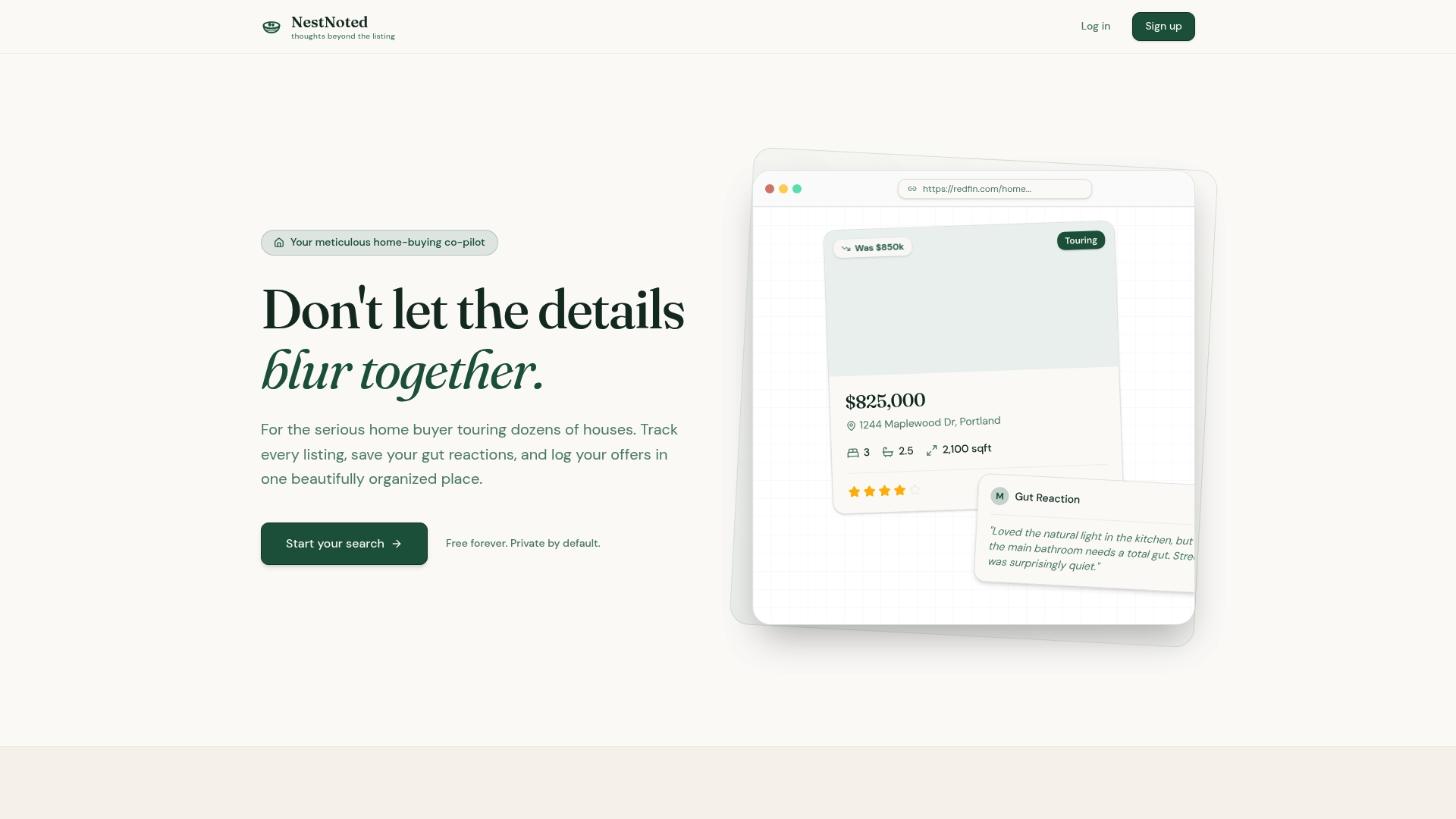
The private notes and ratings feature keeps your candid impressions and sensitive figures confidential by default, so you control exactly what your agent sees and what stays private. When your priorities shift, you update one document in one place instead of resending a chain of emails.
Start your free Nestnoted account and build your one-page brief before your first agent meeting. Registration takes under two minutes, and all core features are free.
Sources
These are the primary resources for verifying agent and lender credentials, reviewing ethical standards, and checking communication best practices:
- A guide for first-time homebuyers — questions to ask your Realtor | TCHFH
- 10 Questions Your Real Estate Agent Doesn’t Want You to Ask | Real Estate Crunch
- Hsh
- Nmlsconsumeraccess
When checking credentials, always prefer official government registries and state records over third-party review sites. Public records don't have an incentive to omit complaints.