

Shared home buying notes are a private, collaborative workspace where buyers and agents log facts and impressions about each property they tour. The core value is simple: independent impressions get preserved before a group conversation can flatten them, key facts stay centralized instead of scattered across texts and photos, and the shortlist-to-offer decision moves faster. Tools like NestNoted build this workflow specifically for that job.
TL;DR:
- Private, shared notes with privacy controls help buyers preserve independent impressions and avoid biased group consensus during property evaluations.
- Using a standardized template with objective and subjective fields and MoSCoW tags ensures consistent, prioritized comparisons across multiple properties.
- Notes should be captured immediately after tours and used to create a shortlist within 24 to 48 hours, enabling timely offer preparation.
- Tools with listing integration, comparison features, and AI assistance support efficient, honest documentation without distractions or exposure to external reviews.
- NestNoted offers a dedicated workspace with auto-imports, comparison charts, collaboration controls, and AI support, tailored for serious buyers and agent teams.
Table of Contents
- Why private, shared notes matter for buyer decisions
- What to capture on every tour: a template that separates facts from feelings
- How to share notes privately without losing honest feedback
- Turning tour notes into a shortlist and then an offer
- What to look for in a note-taking tool: a feature checklist
- When private shared notes win the day
- NestNoted: a private workspace built for this exact job
- Sources
- FAQ
Why private, shared notes matter for buyer decisions
Buyers don't evaluate homes in a vacuum. Research on residential property features shows that framing and the order in which features are presented shape which attributes buyers prioritize, and that preserving each person's independent read of a property before the group discusses it helps avoid convergence on a shared but biased impression. That's the whole argument for private notes: write your own reaction first, compare later.
NAR's coverage of data-driven decision tools makes a related point: software should sharpen the buyer-agent relationship, not replace the agent's judgment. Notes that stay siloed in someone's phone do the opposite. They also create friction:
- Duplicate entry between tour notes, texts to an agent, and offer paperwork wastes time during a fast-moving search.
- Losing the handoff between what a buyer noticed on a walkthrough and what actually makes it into an offer packet costs leverage in negotiations.
What to capture on every tour: a template that separates facts from feelings
The fastest way to compare ten houses without confusing them is a template you fill out the same way every time, ideally while you're still standing in the kitchen.
- Objective fields: address, list price, beds and baths, square footage, visible defects, room measurements, and photos.
- Subjective prompts: overall gut feeling, top three things you liked, top three concerns, and how likely you are to pursue an offer.
- Priority tag: apply a MoSCoW label (must-have, should-have, could-have, won't-have) to each feature that stood out.
That third step matters more than it looks. Research on property feature prioritization supports using structured methods like MoSCoW to rank what actually drives a buying decision, rather than relying on memory or a vague sense of "I liked this one better." Applied consistently across every property, it turns a pile of impressions into a repeatable shortlist process instead of an ad-hoc gut call.
A brief example: 123 Maple Street, $425,000, 3 bed/2 bath, 1,650 sq ft. Kitchen renovated, roof looks newer. Concerns: no garage, busy street. Feeling: strong contender. Priority: garage is a "should-have," not a "must-have." Four lines, and you'd remember this house a month from now.
Pro Tip: Write your subjective impressions before you talk to anyone else who toured the house with you, even your partner.
An open-house tracker template can standardize this further across a whole weekend of showings.

How to share notes privately without losing honest feedback
Sharing notes with a partner, an agent, or family should never mean sharing them with the internet. The safest default treats every note as private until you explicitly invite someone in.
- Set new notes to private by default, then use invite-only workspaces for co-buyers and your agent.
- Generate read-only links for anyone outside the core group, like a lender or a relative who wants an update.
- Lock in each person's independent rating before group discussion starts, then open comment threads for clarifying questions.
- Version notes when an offer is being prepared, and timestamp the moment a decision gets made.
NAR's reporting on AI-driven real estate tools recommends exactly this pattern: a locked "final rating" field that team members complete only after their independent entries are in, so nobody's first impression gets overwritten by whoever spoke first in the car ride home.
Watch for red flags in any tool you choose: public posting features, ad-filled note spaces, or sharing settings that default to open instead of closed. A private home buying workflow built around invite-only access avoids all three.
Turning tour notes into a shortlist and then an offer
Once you've toured a handful of homes, the notes need to become a decision. The process works best as a straight line:
- Capture impressions the same day you tour, while details are fresh.
- Prioritize using MoSCoW tags across all properties, not just the one you saw most recently.
- Narrow to a top three based on must-have and should-have alignment.
- Hand the shortlist to your agent, who prepares an offer packet for the frontrunner.
- Track competing deadlines and seller responses against your other shortlisted backups.
NAR's reporting on connecting real estate tech tools points to a real cost in skipping integration: when systems don't talk to each other, admin work piles up and response times slow down. Auto-populated offer documents and visible handoffs between showing notes and the offer itself cut that friction directly.
Timing depends on the market, but a rough guide holds in most conditions: capture notes the same day, build your shortlist within 24 to 48 hours, and get an offer out within 24 to 72 hours once you've decided. When assembling that offer packet, pull directly from your notes for repair estimates you gathered on the walkthrough, your non-negotiable contingencies, and your planned earnest money position, since those are the details that get lost fastest if they're not already written down.

What to look for in a note-taking tool: a feature checklist
You don't need to name a specific product to know what a good private notes tool should do. Judge any option against this list.
- Privacy controls: private by default, invite-only sharing, and a visible audit trail of who saw or edited what.
- Templates and trackers: standardized open-house fields so every property gets logged the same way.
- Listing integration: import from major listing sources to avoid retyping addresses and prices, plus simple export of an offer packet.
- Comparison tools: side-by-side charts, photo and video attachments, and collaboration controls for co-buyers or agent teams.
- Assistive AI, not decisive AI: a tool that surfaces follow-up questions and summaries but leaves judgment calls to the buyer and agent.
A qualitative study of buyer information use found that buyers move through distinct steps when interpreting listings: identification, specification, evaluation, comparison, and conclusion. A tool that supports that sequence rather than forcing a single verdict field is doing its job.
Avoid anything ad-filled or built around public reviews. Property notes are not restaurant reviews, and a tool that treats them that way will compromise the honesty you need from a co-buyer or your agent. A home comparison chart is a useful shape to look for here, whatever tool builds it.
When private shared notes win the day
Private shared notes matter most in multi-offer markets, for buyers touring a dozen or more properties in a short window, and for couples or agent teams trying to stay aligned without losing individual read on a house. The pattern holds across every serious search: write it down before you talk it out, and keep the record private until you choose to share it.
If you're starting a search now, set up a workspace and run your next open house through the tracker template before you compare notes with anyone else.
— Antony
NestNoted: a private workspace built for this exact job
Everything in the checklist above, NestNoted was built specifically for this job. Notes are private by default, workspaces are invite-only, and there are no ads or promoted listings competing for a buyer's attention.
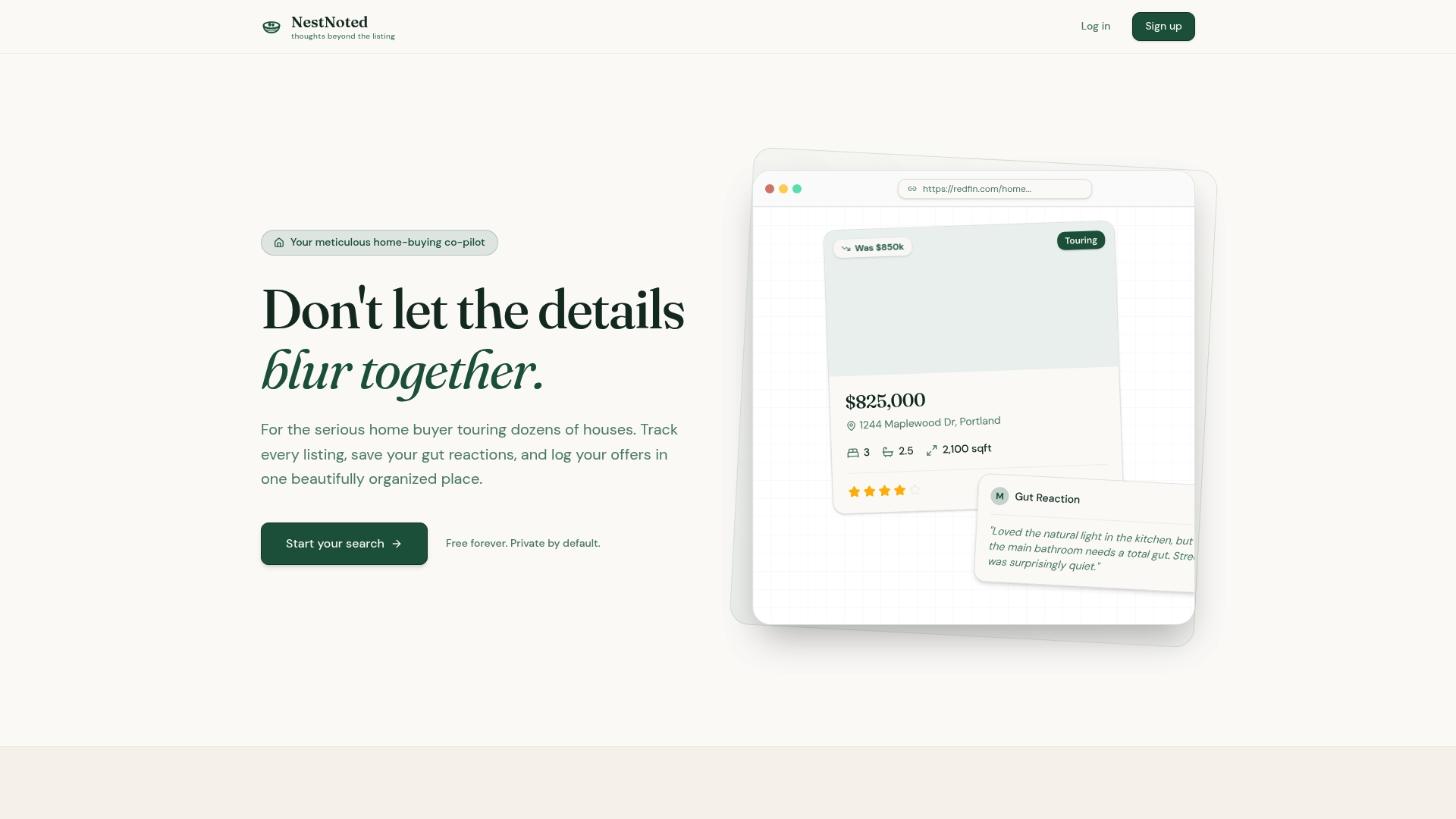
- Auto-imports listings from major real estate sites like Zillow and Redfin, so you're not retyping addresses.
- Side-by-side comparison charts turn your MoSCoW-tagged notes into a fast shortlist.
- Collaboration flows let couples and agent teams share selectively, without exposing private impressions publicly.
- An AI assistant can query your own notes for quick recall, without making the call for you.
This fits serious buyers touring multiple homes and agents preparing offers on tight timelines, not casual browsers scrolling listings for fun. Set up a free workspace at NestNoted and log your next tour before you forget the details.
Sources
- From Stated Importance to Revealed Preferences: Assessing Residential Property Features
- Real estate startup aims to help clients make smarter data-driven decisions
FAQ
What are shared home buying notes exactly?
Shared home buying notes are a private, organized record of what you saw and felt on each property tour, kept in one workspace you control who can access. They typically combine objective facts like square footage with subjective impressions, so buyers and agents can compare properties consistently instead of relying on memory or scattered texts.
How do I keep my notes private while still collaborating?
Set every new note to private by default and only invite specific collaborators, such as a co-buyer or your agent, into that property's workspace. Best practice is to have each person log their independent impression before discussing the house as a group, which research on buyer decision-making links to less biased comparisons.
How fast should I move from touring to making an offer?
A workable pace is same-day note capture, a shortlist within a couple of days, and making an offer shortly after you've decided, though hot markets can compress that timeline further. Tools that auto-populate offer documents from your notes, as described in NAR's reporting on tech integration, can shave real time off that process.
Can an agent use the same notes workspace as their buyer?
Yes, and it's one of the strongest use cases: invite-only workspaces let a buyer and agent share tour notes and offer details without making anything public. Some tools are built for this kind of buyer-agent collaboration alongside couples or co-buyers working through the same shortlist.
Do I need a special app, or can I just use a spreadsheet?
A spreadsheet works for a handful of properties, but it breaks down fast once you're touring a dozen homes with photos, contingencies, and shifting priorities. Purpose-built tools reduce duplicate entry between your notes and your offer paperwork, which NAR's reporting on fragmented real estate tools identifies as a common source of lost information during a search.