

Organizing financing notes means logging Loan Estimate fields, lender terms, and offer history in a private, per-property record instead of scattered PDFs and email threads. The single move that fixes most of the chaos: pull the key numbers off every Loan Estimate into a standardized summary, then attach the original documents behind it in a private workspace. Antony, who writes on buyer workflow for Nestnoted, treats this as the first task after a second showing, not something to sort out during closing week.
TL;DR:
- Tracking all key Loan Estimate fields, including the rate, APR, and lock expiration date, helps prevent losing advantageous rates at critical moments.
- Organizing each property's documents into standardized, clearly named files and comparison tables improves efficiency during negotiations and avoids re-reading old emails.
- Comparing five-year cost figures across lenders provides a more accurate reflection of total loan expenses than relying solely on APRs or interest rates.
- Presenting lenders with a clear, itemized comparison of offers increases chances of getting matched or improved terms during negotiations.
- Using a private, per-property workspace like NestNoted ensures all financing notes, documents, and observations stay organized and accessible for future reference.
Table of Contents
- What Loan Terms Should You Track for Each Property?
- How Do You Request and Verify a Loan Estimate?
- How Should You Name and Structure Financing Files?
- APR or Five-Year Cost: Which Number Actually Matters?
- What Should You Say When Negotiating a Better Rate?
- How Long Should You Keep Financing Documents?
- What Buyers Get Wrong About Tracking Financing
- Where NestNoted Fits Into This Workflow
- Sources
- FAQ
What Loan Terms Should You Track for Each Property?
A Loan Estimate has roughly a dozen numbers that actually matter, and if you're not capturing all of them per property, you'll end up comparing apples to a lender's marketing slide. Here's the field set that makes every quote comparable, whether it's for a starter condo or a fifth showing on a house you're serious about.
Numeric fields to log:
- Quoted interest rate and APR (these are different numbers and both matter)
- Loan amount, points paid, and origination fee
- Estimated closing costs and total cash to close
Loan structure flags:
- Fixed rate versus adjustable rate (ARM), and if ARM, when it adjusts
- Rate-lock status and lock expiration date
- Prepayment penalty, balloon payment, or PMI requirement
- Whether taxes and insurance are escrowed
Metadata that keeps notes usable later:
- Lender name, loan officer contact, and quote date
- Property address, your agent's note, and tour date
- Any house-condition observations that might affect financing (like an appraisal risk on a fixer)
Attachments to save per property:
- The Loan Estimate (LE) itself, plus preapproval letter, lender emails, and any term sheet
Skip the rate-lock expiration date and you're gambling. A locked rate is a time-limited bargaining chip, and if you lose track of when it expires, you can lose the rate entirely at the worst possible moment in the process.
How Do You Request and Verify a Loan Estimate?
Timing and accuracy both matter here, and most buyers get one or both wrong. Request Loan Estimates once you're ready to seriously compare offers, not just window-shop rates. Lenders are required to provide a Loan Estimate within within three business days after you apply, so build your comparison timeline around that clock.
- Apply with complete information. Give every lender the same six data points: your name, income, Social Security number, property address, estimated property value, and desired loan amount. Inconsistent inputs produce Loan Estimates you can't actually compare.
- Check the LE the day it arrives. Confirm the property address is correct, the escrow assumptions match your actual tax and insurance situation, and the rate-lock terms are what you discussed on the phone.
- Catch errors immediately. A typo in the address or an outdated property value can throw off fees enough to matter, and correcting these early saves a renegotiation later.
- Organize supporting docs by property, not by document type. Pay stubs, W-2s, and bank statements for the same loan application belong in one folder, named consistently.
- Call the lender if the LE is late. Three business days is a rule, not a suggestion, and a lender who misses it is worth flagging before you're locked into a relationship.
A mortgage document checklist helps you confirm you've gathered everything before you even submit the application, which cuts down on the back-and-forth that delays Loan Estimates in the first place.
How Should You Name and Structure Financing Files?
Every property record needs the same four-part shape: a one-line summary card, the detailed documents behind it, a negotiation log, and a version history. Skip any one of these and you'll be re-reading old emails during the exact week you have the least time to do it.

The summary card is the part you actually look at day to day. One line should tell you the verdict: lender, rate, APR, and cash to close, nothing more. The documents folder holds everything else, including the actual Loan Estimate, preapproval letter, and any revised versions the lender sends.
File naming that survives multiple lenders and multiple revisions:
Lender_LE_YYYYMMDD.pdffor each Loan Estimate versionPropertyAddress_LE_Summary.pdffor your own extracted comparisonLender_PreApproval_YYYYMMDD.pdffor preapproval letters- Add
_v2,_v3for revisions instead of overwriting the original file
Once you've named things consistently, pull the numbers into columns instead of leaving them buried in PDFs. Rate, APR, points, origination fee, cash to close, and five-year cost as separate fields let you sort and filter across every property you're tracking, which is the entire point of attaching documents to the right property record instead of a generic downloads folder.
Pro Tip: Export your comparison table as a single PDF before a negotiation call. Handing a lender a clean, itemized table of what a competitor offered is far more persuasive than describing numbers from memory, and it removes any room for the lender to argue about what you actually heard.
APR or Five-Year Cost: Which Number Actually Matters?
APR tells you the annualized cost of a loan, but it assumes you keep the loan for its full term, which almost nobody does. A five-year cost comparison is usually the better metric for serious buyers, since it accounts for how much you'll actually pay if you sell or refinance around the median holding period.
- Pull the Loan Estimate's page 3 comparison section, which most lenders already calculate for you as a five-year cost figure.
- If a lender doesn't provide it clearly, calculate it yourself: total principal and interest paid over 60 months, plus upfront fees, minus any principal reduction.
- Compare that number across lenders side by side, using the Loan Estimate comparison method rather than eyeballing rates alone.
- Separate the fees a lender actually controls, like origination charges, points, and lender credits, from fees that vary by location, like transfer taxes or title insurance. Comparing lenders on fees they don't set just muddies the analysis.
Shopping multiple lenders pays off. The HUD mortgage-shopping booklet notes that comparing APR, points, and fees across several lenders can save buyers thousands of dollars over the life of a loan, and Bankrate's guidance recommends gathering at least three quotes before deciding.
What Should You Say When Negotiating a Better Rate?
Once your notes are organized, negotiation stops being guesswork and starts being a presentation. Getting multiple Loan Estimates in hand gives you real leverage, because lenders will often match a clean, apples-to-apples competitor offer when you present it clearly.
- Show up with an itemized comparison, not a vague claim that "another lender offered better terms."
- State exactly what you want changed: a lower rate, a waived fee, or fewer points.
- Ask for a written, revised Loan Estimate rather than a verbal promise.
- Confirm the rate lock terms on any revised offer before you agree to anything.
A short script works better than a long explanation: "Lender B quoted us $3,200 less in closing costs and a rate a quarter point lower. Can you match that in writing?" Watch for red flags while you're at it: inconsistent fees between quotes, a Loan Estimate that arrives late, or an origination charge that jumped with no explanation.
How Long Should You Keep Financing Documents?
Keep closing documents and deeds indefinitely. Loan Estimates and Closing Disclosures should stick around for at least seven years after the sale, long enough to cover tax records and any audit questions. Monthly statements only need a year unless you're mid-dispute or reconciling something specific.
- Encrypted cloud backup for the working copies you actually reference
- A local encrypted copy as a second layer, separate from the cloud
- Physical originals in a fireproof safe or bank safe deposit box
- Purge expired quotes and outdated preapprovals once a deal closes, but keep one auditable folder untouched through the entire closing process
What Buyers Get Wrong About Tracking Financing
The mistake I see most often isn't laziness, it's fragmentation. Buyers save one Loan Estimate as a phone screenshot, another as an email attachment, and a third gets mentioned in a text they can't find three weeks later. By the time they're ready to negotiate, they've lost the leverage that came from having those numbers side by side.
The fix is smaller than people expect. A standardized summary card per property, one clean export before any negotiation call, and a rate-lock date that's actually visible instead of buried in a PDF footer. Those three habits solve most of what goes wrong in a financing search that stretches across a dozen properties.
— Antony
Where NestNoted Fits Into This Workflow
Nestnoted is built around exactly the structure this article describes: a private, per-property workspace where Loan Estimates, preapprovals, and lender emails attach directly to the listing they belong to, instead of living in a generic downloads folder. Every property gets its own card, so a rate quote from a lender never gets confused with the one you got for a house three streets over.
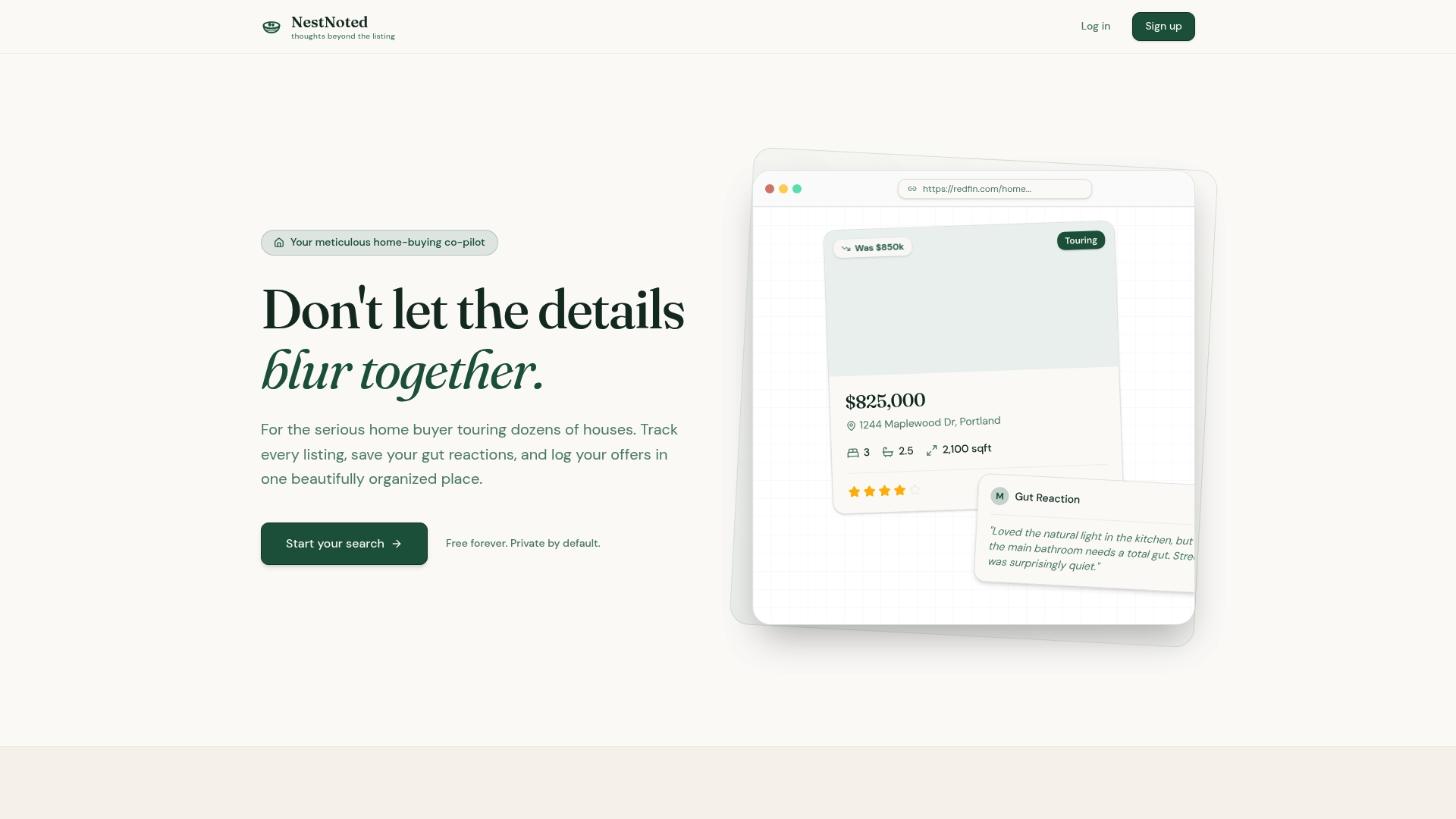
Notes stay private by default, which matters when you're recording honest impressions about a lender's responsiveness or a house's hidden flaws you don't want surfacing in a public review. Side-by-side comparison exports mean you can hand your agent or a lender a clean summary in seconds, and shared workspaces let you collaborate with an agent without giving up control over what stays private. If you're juggling more than two or three properties right now, start a free workspace at NestNoted and build your first per-property financing card before your next showing.
Sources
For the official rules on Loan Estimate timing and comparison, see the CFPB's guidance on requesting and reviewing Loan Estimates. HUD's mortgage-shopping booklet covers negotiation strategy in more depth, and Bankrate's mortgage comparison guide offers calculator-based tools for testing different rate and fee scenarios.
This article is general information, not a substitute for advice from a qualified financial advisor. Consult a qualified financial professional about your own circumstances before acting on anything here.
- Request and review multiple Loan Estimates | Consumer Financial Protection Bureau
- HUD mortgage-shopping booklet
- How To Compare Mortgage Offers | Bankrate
FAQ
What Fields Should I Extract From a Loan Estimate?
Capture the interest rate, APR, loan amount, points, origination fee, closing costs, and cash to close, plus the rate-lock expiration date and whether the loan is fixed or adjustable.
How Long Do Lenders Have to Provide a Loan Estimate?
Lenders must provide a Loan Estimate within three business days after you submit a completed application.
Is APR or Five-Year Cost Better for Comparing Loans?
Five-year cost is usually more useful for serious buyers because it reflects what you'll actually pay if you sell or refinance before the loan's full term, unlike APR, which assumes you keep the loan to maturity.
How Long Should I Keep My Loan Estimates and Closing Disclosures?
Keep Loan Estimates and Closing Disclosures for several years after the sale, and hold onto closing documents and deeds indefinitely.
Can NestNoted Help Me Track Financing Notes Privately?
Yes. NestNoted lets you attach Loan Estimates and lender documents to a private, per-property record, with side-by-side comparison exports for negotiating with lenders or briefing your agent.