

Buyer agent feedback is the private, structured record you keep of a home tour: your ratings, your pros and cons, your offer status, all written down before your memory blurs one house into the next. The fix for lost details isn't a better memory. It's a habit: write a one-line verdict and a quick three-point rating the moment you walk out the door, then build from there with templates and a privacy-first tool.
TL;DR:
- Private, structured buyer feedback helps prevent memory confusion when touring multiple houses, especially with customizable templates for different detail levels.
- Recording notes with timestamped photos, voice memos, and room-by-room observations ensures accurate recall and easier cross-referencing during negotiations.
- Consistent rating scales and short comparison phrases streamline the decision process, enabling faster shortlist creation and more efficient house comparisons.
- Sharing detailed feedback selectively with agents, while keeping sensitive information private, maintains negotiation leverage and prevents premature disclosure of maximum offers.
- Secure, private tools that encrypt data and allow selective sharing support honest feedback and protect buyer privacy throughout the home search process.
Table of Contents
- What Counts as Buyer Agent Feedback (And Why a Template Helps)
- How Do You Record Feedback During a Showing?
- How Should You Organize and Rate Homes You've Toured?
- What's the Best Way to Share Notes With Your Agent?
- What Privacy and Security Steps Should You Take?
- Why Structured Notes Change How You Negotiate
- How NestNoted Puts This System to Work
- Sources
- FAQ
What Counts as Buyer Agent Feedback (And Why a Template Helps)
Buyer agent feedback, in the sense that matters here, has nothing to do with the notes an agent sends back to a listing agent after a showing. It's the opposite direction entirely: private impressions that a buyer or their buyer agent records for themselves, about a property they just walked through. Think of it as a showing diary, not a courtesy message.
The reason a template beats a mental note is simple. After the fourth or fifth showing in a weekend, kitchens start blending together, and the "great natural light" house gets confused with the "weird basement smell" house. A short, consistent structure prevents that.
Essential fields for every entry:
- Address, date and time toured, listing link, asking price
- Room-by-room bullets (kitchen, primary bath, basement, yard)
- Top three red flags spotted during the walkthrough
- Follow-up questions for the seller's agent or inspector
- A rating (1 to 5 works well) and a one-line verdict
- Offer tracker fields: status, offer amount, contingencies, deadline
Three template lengths for different situations:
- The 15-second quick note. Rating, one red flag, one green flag. Use this when you're touring six houses in a Saturday and speed matters more than depth.
- The 90-second structured note. Room-by-room bullets plus the rating row. This is the default for any home you're seriously considering.
- The extended checklist. Full walkthrough with follow-up questions, comparable sales notes, and financing details, saved for your top two or three finalists before an offer goes in.
A ready-made buyer feedback template or a property viewing checklist removes the guesswork of designing your own fields from scratch.
How Do You Record Feedback During a Showing?
The workflow that actually survives a busy open-house Saturday has three steps: a quick scan when you walk in, room-by-room micro-notes as you move through, and a one-sentence verdict before you get back in the car. Skip any of the three and details start slipping.

Start with a 15-second scan the moment you enter: layout, light, smell, first gut reaction. Then work room by room, jotting two or three words per space rather than full sentences. Save the verdict for last, once the whole house has had a chance to sink in.
Photos, short video clips, and voice notes each capture something text can't. A 10-second voice memo recorded in the car afterward often preserves more useful detail than five minutes of typing, because you talk faster than you type and you're less likely to sanitize your honest reaction. Label every photo with the room name in the caption immediately. "Kitchen, cabinets need paint" beats scrolling through 40 unlabeled images three days later trying to remember which house had the ugly countertops.
- Timestamp every note and link it back to the listing so you can cross-reference price changes later
- Snap the listing sheet or flyer for asking price and square footage, since detailed property information ranks among the features buyers rely on most when comparing homes
- In low-signal areas (new construction, rural lots, some condo buildings), record voice notes and photos locally, then sync once you're back in range
Budget 15 to 90 seconds on-site per room, and 3 to 5 minutes total right after you leave the property to finalize the verdict while it's fresh.
Pro Tip: Note the staging, not just the space. A well-staged living room can make a mediocre floor plan look bigger than it is, so jot down what's furniture trickery versus what's actual square footage.

How Should You Organize and Rate Homes You've Toured?
A simple 1 to 5 rating scale, applied consistently, does more work than an elaborate scoring formula. Score a 5 as "would make an offer today," a 3 as "worth a second look," and a 1 as "cross it off." Keep the scale the same across every house you tour, or comparisons stop meaning anything.
Pros and cons work best as short phrases that slot directly into comparison columns, not paragraphs. "Updated kitchen, no yard shade" tells you more at a glance than three sentences of description ever will.
A workable comparison framework covers five categories:
- Price relative to your budget and comparable listings
- Condition and needed repairs
- Commute time and nearby amenities
- Red flags (foundation, roof, HVAC age)
- Negotiation leverage (days on market, price history, seller motivation)
Shortlist anything scoring 4 or above after a second look. Reject anything under 3 without agonizing over it, and delete the notes rather than let a dead listing clutter your active list. This discipline matters more than it sounds, because buyers spend a median of 10 weeks searching for a home, and more than half say finding the right property is the hardest part. Consistent ratings are what keep that 10-week stretch from turning into 20. A side-by-side comparison chart built from these fields makes the shortlist decision almost automatic.
What's the Best Way to Share Notes With Your Agent?
Not every note belongs in your agent's inbox. Keep raw impressions, hesitations, and your maximum offer number private, and share only a distilled summary when it's time to act. Your agent needs your priorities and dealbreakers, not your unfiltered stream of consciousness about the ugly wallpaper.
A shared-workspace protocol with clear statuses avoids confusion on both sides:
- Viewed — toured, notes recorded, no decision yet
- Shortlisted — active contender, agent should know the details
- Rejected — no follow-up needed
- Offer submitted — agent and buyer both track terms and deadlines here
This kind of structure matters because agents pull real weight in a purchase. Eighty-eight percent of buyers use an agent or broker, most commonly to find the right home or negotiate terms, which means the notes you hand off directly shape how your agent negotiates on your behalf.
Pro Tip: Share the "shortlisted" and "offer submitted" statuses freely, but hold back your top-dollar number until you're actually ready to negotiate. Leaking your ceiling early costs you leverage.
NestNoted's shared workspaces let a buyer flip a note from private to agent-visible with one toggle, so you don't have to forward screenshots or retype anything into a group text.
What Privacy and Security Steps Should You Take?
Honest feedback only stays honest when it stays private. The moment you suspect a note might become public or land in a seller's hands, you start softening your language, and softened notes are useless for actual decision-making.
Look for tools that keep notes private by default, offer selective sharing rather than public posting, and encrypt data in transit. Never email an offer amount or contingency list in plain text; use a secure portal or your agent's transaction platform instead.
Quick security habits worth adopting:
- Use a strong, unique password and turn on two-factor authentication for any property-tracking account
- Archive full offer history, including rejected and withdrawn offers, in case questions come up later in the transaction
- Double-check sharing settings before inviting a co-buyer or agent into a workspace
Buyer agents are especially valuable here: 54% of buyers say their agent pointed out a feature or fault they hadn't noticed themselves, which only reinforces why those observations belong in a secure, shared record rather than a text message that gets deleted.
Why Structured Notes Change How You Negotiate
Memory fails buyers more than any spreadsheet or app ever could. I've watched the pattern repeat: someone tours eight houses, falls for house four, and two weeks later can't remember if it was house four or house six that had the finished basement. Structured notes end that guessing game and turn a vague preference into a defensible offer strategy, because you can point to the exact pro and con list that made one house outrank another.
Antony writes for the NestNoted blog on buyer feedback systems and agent note workflows, focused on turning scattered showing impressions into a repeatable process buyers can trust under pressure.
— Antony
How NestNoted Puts This System to Work
NestNoted is the private alternative to juggling screenshots, texts, and a spreadsheet that nobody remembers to update. Everything discussed above, room-by-room notes, ratings, red flags, offer status, lives in one private workspace instead of scattered across your phone.
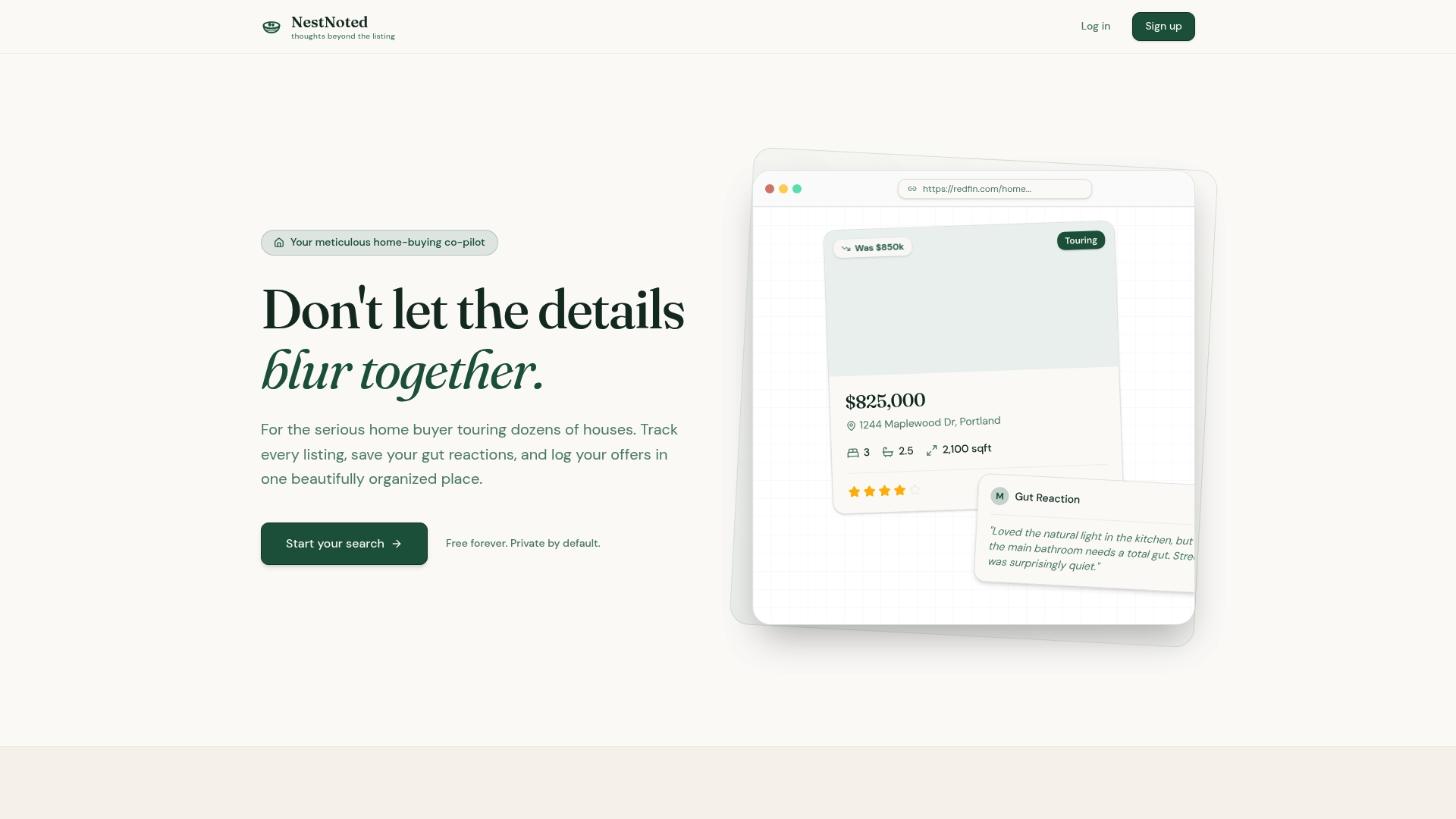
The core features map directly onto the workflow: private-by-default notes so your honest reactions stay honest, room-by-room capture fields, an offer tracker with status labels, and shared workspaces for when you're ready to loop in your agent or a co-buyer. A typical flow looks like this: tour a home and log notes with NestNoted on your phone, watch it get sorted into your shortlist as ratings come in, then track the offer from submission to close, all without leaving the app. Listings sync automatically from major real estate platforms, so you're not retyping addresses and prices by hand.
There's no published pricing tier locking features away. Every core tool, including the AI assistant that can answer questions about your own saved notes, is free to use with an account. If you're mid-search right now, set up NestNoted and log your next showing before the details fade.
Sources
- Key takeaways from NAR’s 2025 Profile of Home Buyers and Sellers
- Highlights from the Profile of Home Buyers and Sellers (NAR)
FAQ
What is buyer agent feedback, exactly?
Buyer agent feedback is a private record of impressions, ratings, and pros/cons that a buyer or buyer agent keeps after touring a home. It's for personal decision-making and negotiation strategy, not for sending back to a listing agent.
How detailed should showing notes be?
A quick note with a rating and one pro/con takes about 15 seconds and works fine for houses you're only casually considering. Save the full room-by-room checklist for homes making your shortlist.
What should I include in an offer tracker?
Track the offer amount, submission date, contingencies, response deadline, and current status (submitted, countered, accepted, or withdrawn). Keeping this in the same place as your showing notes lets you see the full history of a property at a glance.
Is NestNoted free to use?
Yes, NestNoted's core features, including private notes, room-by-room capture, and the offer tracker, are free with an account. Current details and any future plans are listed on NestNoted's site.
How do I keep notes private but still share with my agent?
Choose a tool with private-by-default notes and a selective sharing toggle rather than a shared spreadsheet or group text everyone can edit. Share status updates like "shortlisted" or "offer submitted" while keeping your maximum offer number and raw impressions to yourself until you're ready to negotiate.