

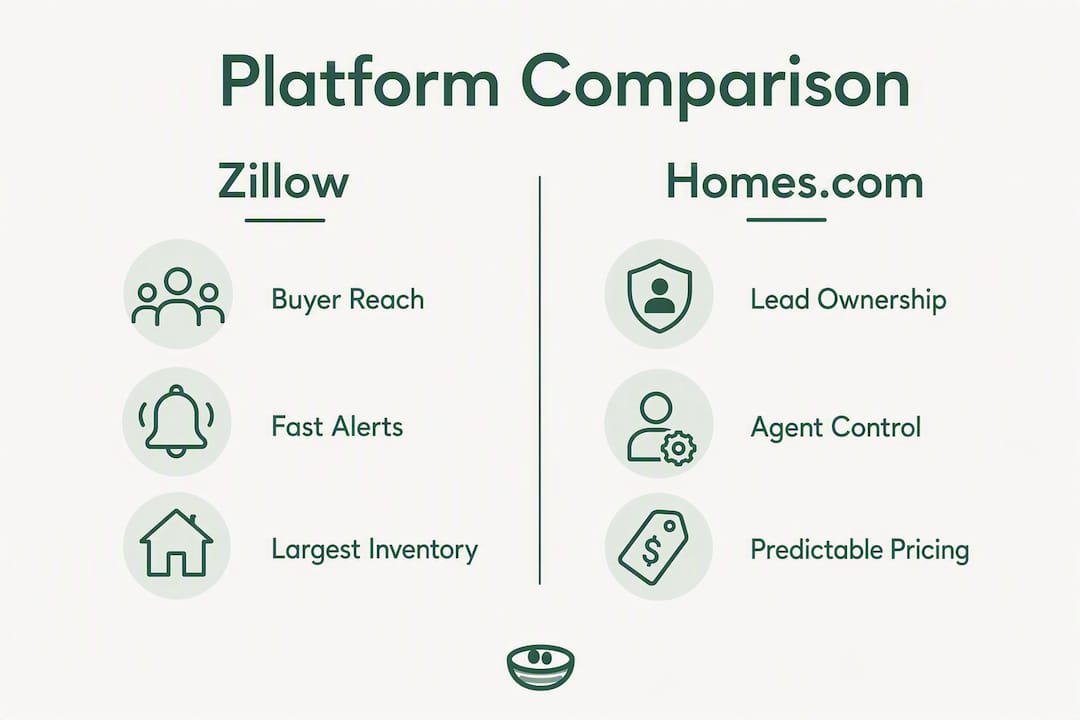
For buyers searching the widest possible inventory, Zillow is the stronger starting point. For listing agents who want leads routed directly to them rather than shared across a buyer pool, Homes.com is the more purposeful choice. The core difference is philosophical: Zillow is built around consumer reach and search experience; Homes.com is built around agent control and lead exclusivity. Most serious practitioners end up using both, and for good reason.
- Buyers: Zillow wins on traffic, search overlays, saved-search alerts, and the Zestimate brand recognition that helps buyers sanity-check asking prices quickly.
- Listing agents: Homes.com wins on lead ownership. Its "Your Listing, Your Lead" model routes inquiries to the listing agent by default, not to the highest bidder in that ZIP code.
- Hybrid users (buyers + agents managing multiple properties): Running both portals together, then organizing shortlisted homes in a private tracker like Nestnoted, gives you the reach of Zillow and the control of Homes.com without losing notes, impressions, or offer history across dozens of tours.
Table of Contents
- How do Zillow and Homes.com compare side by side?
- How we compared these two platforms
- Category winners: which platform leads where?
- Detailed feature comparison: what the evidence actually shows
- How do you choose between Zillow and Homes.com?
- A practical workflow for using Zillow and Homes.com together
- Key Takeaways
- The part most comparisons get wrong about these two platforms
- Nestnoted keeps your search organized across both portals
- Useful sources for further reading
How do Zillow and Homes.com compare side by side?
The table below covers every major dimension buyers and agents care about. Category winners are flagged so you can scan to the rows that matter most for your role.
| Dimension | Zillow | Homes.com | Winner |
|---|---|---|---|
| Best for | Buyers, renters, high-volume teams | Listing agents, seller acquisition | Depends on role |
| Search & UX | Advanced overlays, map search, filters, 2023 redesign | Cleaner listing pages, agent-forward layout | Zillow |
| Listings coverage & accuracy | Largest U.S. inventory, MLS + off-market | Growing MLS coverage, strong in select metros | Zillow |
| Property estimates | Zestimate (widely recognized, publicly visible) | Homes.com estimate (less established) | Zillow |
| Agent tools & pricing | Premier Agent (ZIP bidding), Flex (20–40% success fee) | Boost subscription, pay-at-close options | Homes.com (flexibility) |
| Lead generation & ownership | Shared leads, high volume, competitive | Listing agent gets the lead by default | Homes.com |
| Seller tools & listing exposure | Strong seller dashboard, Zillow Offers history | Free Boost for affected listings post-MLS policy | Zillow (reach) |
| Rental features | Full rental marketplace with tenant screening | Limited rental tools | Zillow |
| Mobile & saved searches | Polished app, instant alerts, saved searches | Functional app, improving | Zillow |
| Customer support & transparency | Mixed agent reviews on support responsiveness | Agent-first positioning, clearer lead routing | Homes.com |
The short version: if you are a buyer or renter, start with Zillow. If you are a listing agent prioritizing lead ownership over raw volume, Homes.com deserves your budget first. Agents running full-service teams often find the best return by blending both portals rather than committing exclusively to either.
How we compared these two platforms
Every category verdict in this article rests on a defined set of criteria, not gut feel. Here is what was measured and how winners were determined for this 2026 evaluation.
- Seller tools and listing exposure: — Dashboard features, listing presentation quality, and policy behavior (including Zillow's May 2025 MLS enforcement and Homes.com's response) were assessed.
Winners were decided by which platform materially outperforms the other on a given dimension for the stated user type. Ties were noted rather than forced into a verdict.
Category winners: which platform leads where?
- Search & UX: Zillow — Zillow's 2023 property page redesign introduced a wider single-scroll format that surfaces square footage, lot size, and the Zestimate in one pass. The search map overlays and filter depth remain the benchmark for consumer portals.
Red flag for agents on Zillow: In high-competition ZIP codes, Premier Agent costs can outpace returns quickly if your team lacks a fast-response system. Empirical team budgets indicate that Zillow's cost-per-closing is higher compared to Homes.com for high-volume listing teams, reflecting a notable cost difference. For example, Homes.com cost-per-closing was reported around $889 for high-volume scenarios versus Zillow at $1,379; Zillow's speed-to-first-response (12 minutes versus Homes.com's 47 minutes in those same tests) gives buyer-focused teams a real conversion edge.
Red flag for buyers on Homes.com: Consumer awareness for Homes.com reached 36% in Q1 2025 after CoStar's aggressive investment, but Zillow's brand recognition still runs significantly higher nationally. In some smaller metros, Homes.com's inventory depth may not yet match Zillow's.
Detailed feature comparison: what the evidence actually shows
Pricing and lead models
Zillow's Premier Agent program prices by ZIP code, so costs vary enormously by market. In dense urban ZIPs, monthly spend can run into thousands of dollars before a single closing. The Flex model shifts that risk to a referral fee of 20–40% of commission at close, which sounds safer but compounds quickly for high-producing agents.

Homes.com's Boost product and membership tiers offer more predictable commitment structures. Pay-at-close options exist in select markets, giving agents a lower barrier to entry. For listing-focused teams running high volume, the math often favors Homes.com: empirical examples showed cost-per-closing around $889 for Homes.com versus $1,379 for Zillow, making the gap real and worth modeling before committing budget.
Pro Tip: Before signing up for either platform's paid tier, run a simple scenario model: take your average commission, multiply by the Flex percentage or Boost monthly cost, then divide by your realistic contact-to-close rate. That number tells you what you are actually paying per closed deal, not just per lead.
Estimate tools
The Zestimate is a known quantity for buyers. Most people searching on Zillow have already seen a Zestimate on a property before they contact an agent, which means agents need to be ready to contextualize it. Homes.com's estimate tool is less prominent and less likely to shape buyer expectations before first contact. For agents, that can actually be an advantage: fewer pre-anchored price expectations to manage.
Market coverage and data freshness
Zillow pulls from a broader set of MLS feeds and updates listings frequently. Homes.com's coverage is strong in markets where CoStar has invested heavily but can lag in smaller metros. If you are searching or listing in a mid-size market, checking both portals for inventory gaps is worth the extra few minutes.
Mobile apps and saved searches
Zillow's app delivers near-instant alerts when a saved search gets a new match. For buyers in fast-moving markets, that speed matters. Homes.com's app has improved but still trails on alert latency and filter depth. For a broader look at house hunting app alternatives, the gap between the two becomes clearer when you test both in the same market simultaneously.

Seller tools and the MLS policy context
After Zillow enforced stricter MLS submission requirements in May 2025, some listings were removed for non-compliance. Homes.com responded by offering free Boost to affected sellers, positioning itself as the agent-friendly alternative. That policy moment accelerated Homes.com's adoption among listing agents who felt Zillow's rules constrained their marketing flexibility. For sellers working with agents who prefer off-MLS or delayed-entry strategies, Homes.com became a more viable primary platform almost overnight.
How do you choose between Zillow and Homes.com?
Buyer checklist
- Do you want the widest possible inventory in one search? Use Zillow first
Agent checklist
- Is lead ownership your top priority? Homes.com routes inquiries to the listing agent by default. Zillow does not.
- Can your team respond to inbound leads within 15 minutes? If not, Zillow's volume advantage erodes fast. Homes.com's leads tend to be fewer but more property-specific.
- Are you primarily a listing agent or a buyer's agent? Listing agents gain more from Homes.com's model; buyer's agents benefit more from Zillow's traffic.
- What is your budget model: pay-per-lead, pay-at-close, or subscription? Zillow's Flex and Premier Agent suit different risk tolerances than Homes.com's Boost and membership tiers.
- Are you in a market where Homes.com has strong consumer awareness? Check local penetration before committing budget.
When a platform is the wrong fit
Zillow is a poor fit if your team cannot handle high lead volume with fast follow-up. Paying for Premier Agent in a competitive ZIP and responding slowly is the fastest way to burn budget. Homes.com is a poor fit if you are a buyer's agent who needs broad consumer reach to attract new clients, since its model is built around listing agents, not buyer acquisition.
For a structured way to compare homes side by side after you have gathered leads from either platform, a private tracker adds a layer of organization neither portal provides natively.
A practical workflow for using Zillow and Homes.com together
The strongest results come from treating these platforms as complementary rather than competing. Here is a step-by-step approach for both buyers and agents.
For buyers
- Start broad on Zillow — Set up saved searches with your core filters (price, beds, baths, ZIP). Turn on instant alerts.
For agents
- Use Zillow for buyer volume — Premier Agent or Flex gives you access to a much larger buyer pool. Build a fast-response system (ISA or dedicated buyer agent) to handle inbound volume within 12 minutes.
- Monitor cost-per-closing quarterly. Run the scenario model from the pro tip above every quarter. Agent resources at Attain RE offer practical frameworks for evaluating portal ROI against your actual close rate.
Pro Tip: Set a response-time SLA of 10 minutes or less for Zillow leads. Research on portal lead conversion consistently shows that contact rates drop sharply after the first 30 minutes. Homes.com leads are more forgiving on response time, but the same urgency discipline still improves conversion.
Key Takeaways
Zillow wins on consumer reach and search features; Homes.com wins on lead ownership and agent control, and the strongest results come from running both platforms with a clear role for each.
| Point | Details |
|---|---|
| Zillow leads on buyer reach | Largest U.S. inventory, fastest alerts, and the most recognized estimate tool make it the default for buyers. |
| Homes.com leads on agent control | "Your Listing, Your Lead" routing gives listing agents direct access to inquiries without competing bidders. |
| Cost-per-closing favors Homes.com at scale | High-volume listing teams have seen notable cost-per-closing differences: Homes.com around $889 per closing versus Zillow at $1,379 in empirical comparisons. |
| Hybrid strategy delivers best ROI | Agents using Zillow for buyer volume and Homes.com for seller leads consistently report stronger overall returns than single-platform users. |
| Nestnoted complements both portals | A private tracker like Nestnoted keeps your notes, impressions, and offer history organized and confidential across every listing you find on either platform. |
The part most comparisons get wrong about these two platforms
Most articles frame the Zillow vs. Homes.com debate as a competition. It is not, at least not for the practitioners who are getting the most out of both.
The real question is not which platform is better. It is which job each platform is built to do. Zillow is a consumer product that happens to have an agent monetization layer on top. Homes.com is an agent product that happens to have a consumer search interface. Those are fundamentally different design philosophies, and they produce fundamentally different outcomes for the same dollar spent.
What I find underappreciated in most agent conversations is the response-time asymmetry. Zillow's lead model rewards speed above almost everything else. A team that responds in 10 minutes will dramatically outperform a team that responds in an hour, even if the slower team has better scripts and more experience. Homes.com's model is more forgiving on that dimension because the lead is already pre-routed to the listing agent, who presumably knows the property. That changes the conversion dynamic entirely.
The other thing worth saying plainly: Homes.com's consumer awareness has grown substantially, but it still means many home shoppers are not starting their search there. For buyers, that gap matters. For listing agents, it matters less, because the leads Homes.com does generate tend to be more intentional and property-specific.
The platforms are not converging. They are diverging. And that is actually good news for anyone willing to use both with a clear strategy.
Nestnoted keeps your search organized across both portals
Zillow and Homes.com each do their job well, but neither one helps you remember what you actually thought about the 14th house you toured, or why you passed on that listing in March. That is the gap Nestnoted fills.

Nestnoted is a private property management tool built for serious home buyers. You can import listings from Zillow, Homes.com, or Redfin, then add your own notes, ratings, and pros and cons that stay completely private by default. No public reviews, no data shared with portals, no agent seeing your candid impressions before you are ready. The full feature set includes side-by-side home comparisons, price-drop alerts, a property pipeline, and an AI assistant that can query your own notes. It is free to use with account registration. If you are juggling listings from multiple portals and losing track of what you actually liked, start organizing with Nestnoted today.
Useful sources for further reading
- Zillow vs. Homes.com: Experts speak on contrasts, agent benefits — HousingWire's expert roundup on the philosophical and practical differences between the two platforms, including agent interviews on lead routing and control.
- Homes.com vs. Zillow: Which is Best for Real Estate in 2026? — The Close's feature-by-feature breakdown with agent-focused scoring and buyer recommendations.
- Best Zillow Alternatives in 2026 for Buyers and Sellers — Nestnoted's analysis of portal alternatives for buyers and sellers who want to compare options beyond the two main platforms.