

The fastest safe way to share notes with your realtor is a private, structured capture that you and your agent can both access, with agent chat or a secure document as your fallback. A public listing link with a short comment works for quick context, but keep your offer strategy and financial details out of casual channels until you know they are secure.
TL;DR:
- Use private, structured notes for capturing detailed impressions, concerns, and offer plans to ensure clarity and confidential communication with your agent.
- Share sensitive documents like the Closing Disclosure only through secure channels, watermark or redact figures, and limit access to necessary parties.
- Rely on agent portals, shared folders, or dedicated tools for consistent, organized, and private record-keeping instead of fragmented texts or emails.
- When providing feedback after a showing, include specific likes, concerns, and next steps with relevant photos named by room for clarity.
- Agents should provide factual information to appraisers, including property details and comparable sales, without attempting to influence valuation.
Table of Contents
- Practical channels: chat, email, and listing links, and when to use each
- What to record in your notes: an actionable buyer checklist
- Privacy and sensitive documents: Closing Disclosures, lender files, and showings
- Formats and workflows that make sharing reliable
- Copy-ready note template: what to send after a showing
- How agents should share factual information with appraisers and lenders
- Antony's take: why private, structured notes help buyers and agents
- NestNoted: a privacy-first place to capture and share buyer notes
- FAQ
- Sources
Practical channels: chat, email, and listing links, and when to use each
Agent chat built into portals like Realtor.com lets you forward a listing and add a quick comment in seconds, which makes it the best option when you want your agent to see something before another buyer does. Many portals now bundle chat and listing-sharing tools directly into the client dashboard, so your agent gets the link, the price history, and your note in one thread instead of three separate apps.
Text and email both work, but they fragment fast. A text sent during a showing gets buried under ten other texts by dinner, and an email thread about "123 Oak Street" turns into a mess once you are touring your fifteenth house. Saved searches and shared feeds solve a different problem: they keep your agent aware of your evolving taste without you typing anything, since every save or skip refines what shows up next.
Here is a quick way to match the channel to the moment:
- Use agent chat or a portal message for a listing you want flagged immediately.
- Use a saved search or shared feed to passively train your agent on your preferences.
- Use a saved search or shared feed to passively train your agent on your preferences.
- Use a screenshot with a one-line caption only for fast, low-stakes context, never for financial details.
- Save longer impressions and offer thinking for a structured note, not a text thread.
What to record in your notes: an actionable buyer checklist
Vague notes produce vague conversations. "Liked the kitchen" tells your agent nothing they can act on, but "kitchen has a 2019 induction range, no dishwasher" gives them something to negotiate or research.
- Top three likes, written as specific, short phrases rather than general praise.
- Top three concerns, especially anything that could affect price or financing, like a sagging deck or a roof that looks original.
- Condition flags, including any repair candidates you noticed and whether they looked urgent or cosmetic.
- Offer posture, meaning your rough budget range, your must-haves versus nice-to-haves, and your timeline.
- Who else is involved, such as a co-buyer's reaction or a parent's move-in date, plus any photos you took.
Pro Tip: Snap photos of flaws and favorites separately, and name the files by room so your agent can match them to your notes without guessing.
Privacy and sensitive documents: Closing Disclosures, lender files, and showings

Your Closing Disclosure is more sensitive than a showing note, and the rules around sharing it are less obvious than most buyers expect. TRID rule clarifications confirm that lenders are permitted to share your Closing Disclosure with your real estate agent, but some lenders still decline to do so out of caution. If your lender refuses, you can request the disclosure directly and choose what to forward yourself.
When you do need to send a document like this, treat it differently from a casual note:
- Use an encrypted upload or a secure portal instead of a plain email attachment.
- Limit recipients to the people who actually need the document.
- Watermark or redact sensitive figures before forwarding a PDF.
Privacy risk is not limited to paperwork. A notable share of prospective homebuyers say they avoid discussing offer strategy or budget inside a home, worried about smart cameras recording their conversations. That habit makes a quiet, private note taken after you leave the property more valuable than a conversation held in the driveway.
Formats and workflows that make sharing reliable
Texts and emails are fast but lose context the moment you tour a second house with a similar layout. A few habits fix most of that: use a consistent subject line per address, attach photos in the same message as your notes, and timestamp anything time-sensitive like a price drop.
- Ad hoc messages are quick but easy to lose; consistent naming helps.
- Shared folders and docs hold more detail but need permission hygiene, since an old link shared with a past agent can linger with access.
- Agent or broker platforms centralize everything, though your data may also sit inside that broker's internal systems.
- Dedicated private buyer tools keep structured fields, private notes, and listing imports in one place without exposing anything publicly.
That last category is where a tool like NestNoted fits: notes stay private by default, listings import automatically, and your agent sees only what you choose to share.
Copy-ready note template: what to send after a showing
A template beats a blank message every time, because it forces you to fill in the parts that matter instead of rambling about the paint color.
- Listing link: paste the address or MLS link.
- Top three likes: short phrases, no full sentences needed.
- Top three concerns: same format, specific over general.
- Offer posture: yes, maybe, or no, plus your rough budget range.
- Timeline or next step: when you want to decide or what you need to see again.
Two examples show how terse this can be: "123 Oak St, yes, under $410,000, want a second showing this weekend" or "47 Birchwood, maybe, roof looked old, need inspector opinion before offer." Attach three to five photos and name them by room so nothing gets mixed up between properties. Our buyer feedback template walks through a version of this you can copy directly.
How agents should share factual information with appraisers and lenders
Agents can give appraisers factual, objective material, but they cannot push toward a number. NCREC guidance on appraiser contact is clear that property features, surveys, and documented comparable sales are fair game, while any attempt to influence the appraiser's opinion of value is not.
A useful appraiser packet typically includes:
- A legal description and plat of survey.
- Blueprints, if they exist.
- A detailed list of upgrades and recent improvements.
- Documented comparable sales and a short, factual summary of why the property may support its price.
NAR guidance on appraisals recommends sending this complete work file early and responding quickly to appraiser questions. Route any value disagreement through your agent and lender rather than contacting the appraiser directly.
Antony's take: why private, structured notes help buyers and agents
Candid notes only stay candid when they are private. Buyers who write freely, without worrying who else might read a comment, give their agents the real picture faster, which speeds up both decisions and negotiation. I built our templates around that idea: short, structured, and private by default until you choose to share them.
— Antony
NestNoted: a privacy-first place to capture and share buyer notes
We built NestNoted around the problem this article keeps circling back to: notes that are honest only work when they are private first. Every note, rating, and offer idea stays confidential by default, so you can write "overpriced, needs a new roof" without wondering who else sees it.
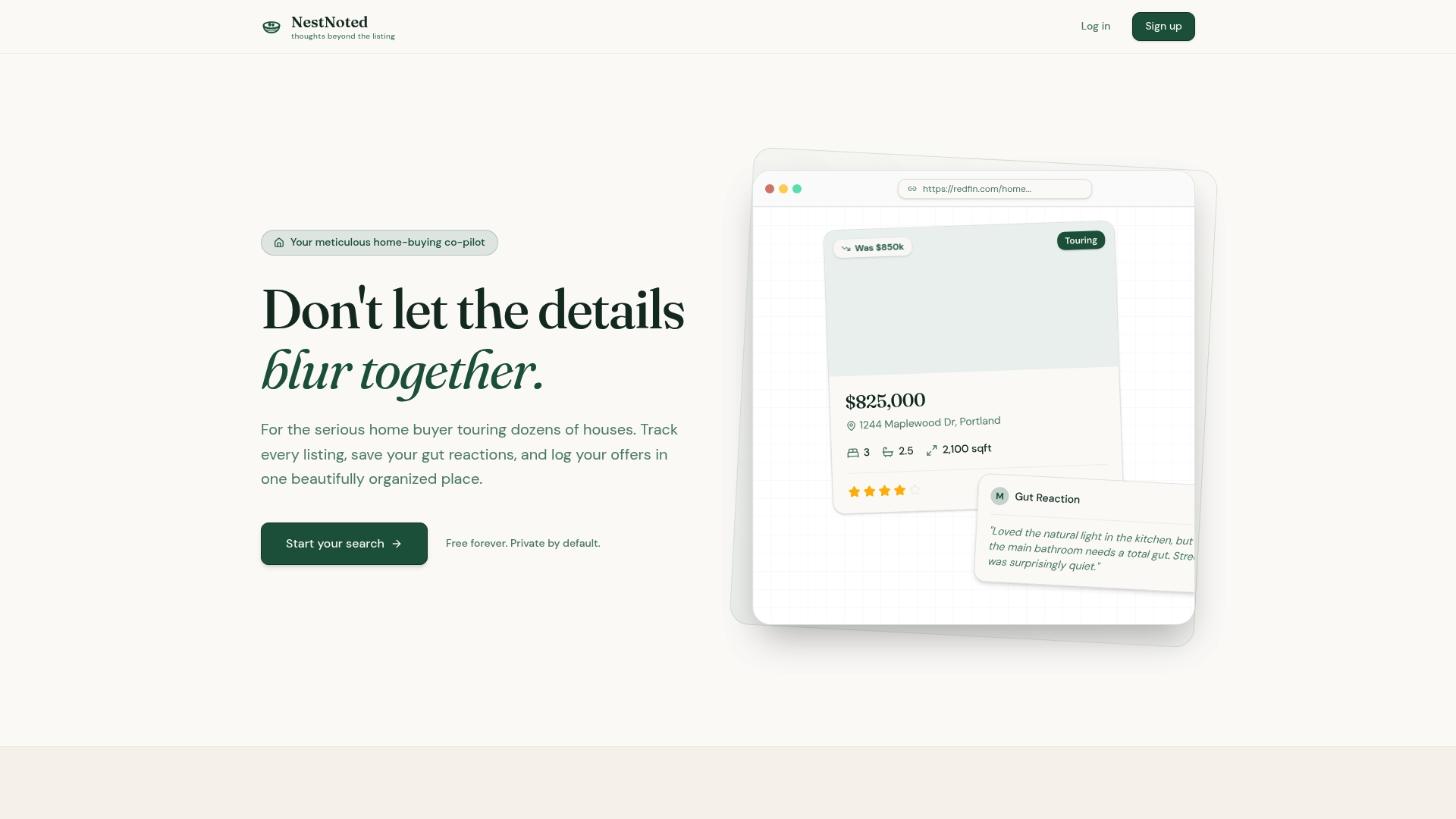
- Listings import automatically from major real estate websites, so you are not retyping addresses.
- Structured fields for likes, concerns, and offer posture turn a vague impression into something your agent can act on.
- A shared workspace lets you invite your agent or a co-buyer only when you decide to, never by default.
If you are touring more than a couple of homes this month, try NestNoted and keep your notes organized and private from the first showing on.
FAQ
Should you share an appraisal with a REALTOR?
Sharing your appraisal with your agent is generally fine and often helpful, since it gives them factual grounds to support or challenge a valuation. Keep in mind that any pushback on the number should go through your agent and lender, not directly to the appraiser, per NCREC guidance.
What is a short and sweet way to thank a real estate agent?
A brief, specific note works best: thank them for a particular effort, like a quick showing turnaround or patient negotiation, rather than a generic compliment. Something like "thanks for squeezing in that Sunday showing, it made the difference" feels genuine and takes seconds to write.
Should you share your closing disclosure with your REALTOR?
You can, and your lender is permitted to share it with your agent under TRID rule clarifications, though some lenders still decline. If that happens, you can request the disclosure yourself and forward only the parts your agent actually needs.
What are real estate notes?
Real estate notes are the observations, concerns, and offer thinking a buyer records about a property, usually after a showing. They work best when specific and timely, covering things like condition flags, budget posture, and timeline rather than general impressions.
Sources
- How sellers are using smart cameras to eavesdrop on homebuyers (reporting that cites a LendingTree survey)
- Update: CFPB rule allows sharing of TRID Closing Disclosure (NCREC bulletin)
- The appraiser’s role isn’t to kill your deal (NAR)