

The best system is simple: a repeatable note template, fast capture (voice and photo), and searchable storage. That's it. Before your next tour, do two things: jot 3 pros and 3 cons on-site, then record a 60 to 90 second voice note the moment you leave, tagged with the neighborhood and any deal-breaker.
TL;DR:
- Keeping structured notes with consistent fields and tags allows quick comparison of homes and helps avoid emotional bias during lengthy searches.
- Recording a voice note immediately after touring each house captures fresh impressions that degrade rapidly, making it essential for accurate recall.
- Using a dedicated workspace to centralize listings, photos, notes, and voice memos prevents scattered information and ensures privacy when sharing feedback.
- Focusing on a deal-breaker flag and categorizing conditions helps prevent unnecessary house visits and streamlines the decision process.
- Backup and searchability of notes are critical, as they turn impressions and hard data into actionable insights, reducing time wasted on irrelevant homes.
Table of Contents
- Why Structured Home Notes Matter
- Field-Ready Home-Tour Checklist: What To Capture Every Time
- Fast Capture: Voice, Photos, and Templates That Actually Get Used
- How To Organize and Search Notes So You Can Find the Right House Fast
- Turning Notes Into Offers, and What To Collect at Closing
- A Privacy-First Workflow Example: NestNoted
- What Most Buyers Get Wrong About Taking Notes
- Get Your Notes Out of Five Different Apps
- Sources
- FAQ
Why Structured Home Notes Matter
Memory does not hold up under repeated house tours. Buyers view a median of seven homes and search for about ten weeks, according to the National Association of Realtors. By week six, the kitchen with good light and the kitchen with the weird smell start to blur together, especially when you're touring three or four properties on the same Saturday.
That's the practical case for search home notes: a system built to be found later, not just written down once. Structured notes also do something less obvious. They reduce emotional bias. Walking into a staged living room with fresh flowers and natural light triggers a gut reaction that has nothing to do with square footage, school zones, or the roof's age. A consistent template forces you to record the same facts every time, which flattens the emotional spike enough to let you compare houses on their actual merits.
There's a structural reason to keep two kinds of records apart from the start. Your gut reaction to the primary bedroom (soft data) is not the same category of information as the survey or the deed (hard data). Mixing them in one running note or one long text thread to your partner is how buyers end up negotiating on a feeling instead of a fact, or worse, misplacing a document they need for closing.

Field-Ready Home-Tour Checklist: What To Capture Every Time
Consistency beats cleverness here. Use the same fields on every walkthrough so two houses toured three weeks apart are still comparable side by side.
- Basic facts — address, MLS or listing ID, list price, beds/baths, square footage, HOA fees, and year built.
- One-sentence opener — write your gut reaction before you forget it ("felt cramped despite the square footage" or "kitchen sold me in ten seconds").
- Top 3 pros and top 3 cons — force yourself to stop at three each; a longer list usually means you're avoiding the real deal-breaker.
- Deal-breaker flag — yes or no, with one line explaining why. This single field saves more time than any other in the template.
- Five photos, same order every time — exterior front, kitchen, primary bedroom, bathroom, and any red flag (a water stain, cracked foundation, aging HVAC unit).
- A 60 to 90 second voice note, recorded in the car right after you leave, before the next showing overwrites your memory of this one.
- A 1 to 5 rating tied to your actual priorities, not a generic score. If commute time matters most, weight the rating toward that.
Name your files something searchable later: 123Maple_kitchen.jpg beats IMG_4471.jpg every time you're scrolling through 40 photos trying to remember which house had the sunroom.
Pro Tip: Record the voice note before you start the car, not after. The three minutes between walking out the front door and pulling out of the driveway are when your impressions are sharpest, and also when they fade fastest.
Fast Capture: Voice, Photos, and Templates That Actually Get Used
The method that works is the one you'll actually do at house number twelve, not just house number one. Buyers often lean on a mix of agent guidance and their own digital research, which means your capture system needs to work solo and stay shareable when an agent or partner needs to see it too.
Voice-first works best for buyers who think out loud. Talking through a room, "this bathroom is small but the light is great, the tile looks recent," captures nuance that a checkbox never will. The catch: an unlabeled voice memo from three weeks ago is close to useless. Transcribe it the same day, or use a tool that transcribes automatically, and tag it with the address before you move on to the next showing.
Photo-first suits buyers who process visually. Five consistent shots per house, same categories every time, turn a phone's camera roll into a rough comparison tool. The habit that makes this work is annotation. A photo with no caption is just clutter six weeks later; a photo captioned "north-facing, gets almost no afternoon sun" tells you something a glance won't.
Template-first is the middle path, and it's the one that scales best across a long search. A short mobile form with the same seven or eight fields every time, filled out before you leave the driveway, means your notes are structured for search from the moment they're created rather than reorganized after the fact.

Whichever method you lean on, the failure point is almost always the same: screenshots of listings, texts from your agent, and saved search alerts end up scattered across four apps instead of living in one place. That scatter is exactly what a centralized workspace for saved listings is built to fix, and it's worth solving early rather than after you've toured 20 homes and lost track of which ones you actually liked.
How To Organize and Search Notes So You Can Find the Right House Fast
Good tags matter more than a good memory. The goal is a system where you can type a query and get an answer in seconds instead of scrolling through weeks of notes trying to remember which house had the finished basement.
Start by keeping soft impressions and hard documents in separate fields or folders, even if they're linked to the same property record. Your note that "the neighbor's dog barks constantly" and the property's actual survey document serve completely different purposes and should never live in the same field.
A workable tagging structure looks like this:
- Neighborhood or zip code — the first filter most buyers reach for.
- Budget band — under $400k, $400 to 500k, over $500k, so you're not comparing houses you can't actually afford.
- Priority flags — big yard, walkable, good schools, move-in ready.
- Condition issues — roof age, foundation concerns, outdated electrical.
- Deal-breaker status — yes, no, or maybe.
Once those tags exist, searching gets specific fast. A query like "rated 4 or higher, big yard, under $450k" should return a short list in seconds, not require you to reread every note you've taken since March. A lightweight index note or dashboard that links out to individual property entries, a pattern borrowed from personal knowledge systems like Obsidian's home note structure, works the same way for house hunting: one anchor page, everything else linked beneath it.
Pro Tip: If you're searching with a partner or an agent, agree on the tag vocabulary before your first tour. "Move-in ready" means something different to everyone, and mismatched tags make shared searches nearly useless.
Back up your notes somewhere that syncs automatically, and think through privacy before you share a workspace. Notes candid enough to be useful ("felt overpriced, seller seems desperate") aren't notes you want visible to a listing agent or a stranger on a public review site.
Turning Notes Into Offers, and What To Collect at Closing
Your pros-and-cons list is more than a memory aid. It's the raw material for your offer. A note that says "inspector flagged the water heater, roof is 12 years old" becomes a concrete ask for a credit or a repair before you sign anything, and a photo timestamped the day of the tour backs up your negotiating position if the seller pushes back.
Once you're under contract, the paperwork needs its own checklist, separate from your tour notes:
- Closing Disclosure — the document that spells out your final loan terms and costs.
- Deed — the legal document transferring ownership.
- Mortgage and promissory note — your loan agreement and repayment terms.
The CFPB requires lenders to deliver the Closing Disclosure at least three business days before closing, and that window exists so you can actually compare it against your original Loan Estimate rather than skimming it at the closing table. Use those three days. The CFPB's own closing checklist recommends requesting the Closing Disclosure, deed, mortgage, and promissory note in advance and reviewing every figure line by line.
If a number on the Closing Disclosure doesn't match what you expected, that's the moment to call your agent or a real estate attorney, not the moment to shrug and sign. A $200 discrepancy in closing costs is a phone call. A $2,000 one is a reason to delay.
A Privacy-First Workflow Example: NestNoted
Here's what that whole system looks like when it's built into one workspace instead of scattered across five apps. NestNoted maps directly onto the checklist above:
- Auto-imports listings from sites like Zillow and Redfin, so you're not manually re-entering addresses and prices.
- Attaches photos and voice notes to each property record, keeping tour impressions next to the facts.
- Tags and rates properties on your own criteria, then runs side-by-side comparisons when you're down to a shortlist.
- Keeps everything private by default, which matters when your honest note says "overpriced" and you don't want that visible to anyone outside your search.
A dedicated workspace like this earns its place once you're touring seriously, comparing more than a handful of homes, or coordinating with a partner or agent who needs to see the same notes you do. If you're looking at two houses total and deciding within a week, a notes app on your phone is genuinely enough. Past that point, the spreadsheet and the scattered screenshots start costing you more time than the workspace would.
What Most Buyers Get Wrong About Taking Notes
The conventional advice, "just keep good notes," misses the actual failure point. Buyers don't fail because they forget to write things down. They fail because what they write down isn't structured for retrieval. A three-page rambling note about a house you saw in March is not a note, it's a diary entry, and diary entries don't answer the question "which houses had a yard big enough for the dog and stayed under budget."
The overrated advice is the spreadsheet. Spreadsheets are great at rows and terrible at nuance. They can hold your budget band and your square footage, but they choke on "the light in the kitchen was incredible" or a photo of the crack in the foundation. Home buying generates both kinds of data constantly, and a system that only handles one kind is only half a system.
What actually works is boring and specific: the same seven fields every time, a voice note recorded within minutes of leaving, and tags built before the first tour, not invented halfway through. Prioritize the deal-breaker flag above everything else. It's the single field that saves you from touring house number nineteen when house number four already disqualified itself in week two.
— Antony
Get Your Notes Out of Five Different Apps
If you're already juggling saved listings on Zillow, a group text with your partner, voice memos in your phone, and a half-finished spreadsheet, the fix isn't another app to check. It's one private workspace that holds all of it. A dedicated platform can pull listings in automatically, keep your pros, cons, and voice notes attached to each property, and protect your candid impressions from uninvited viewers.
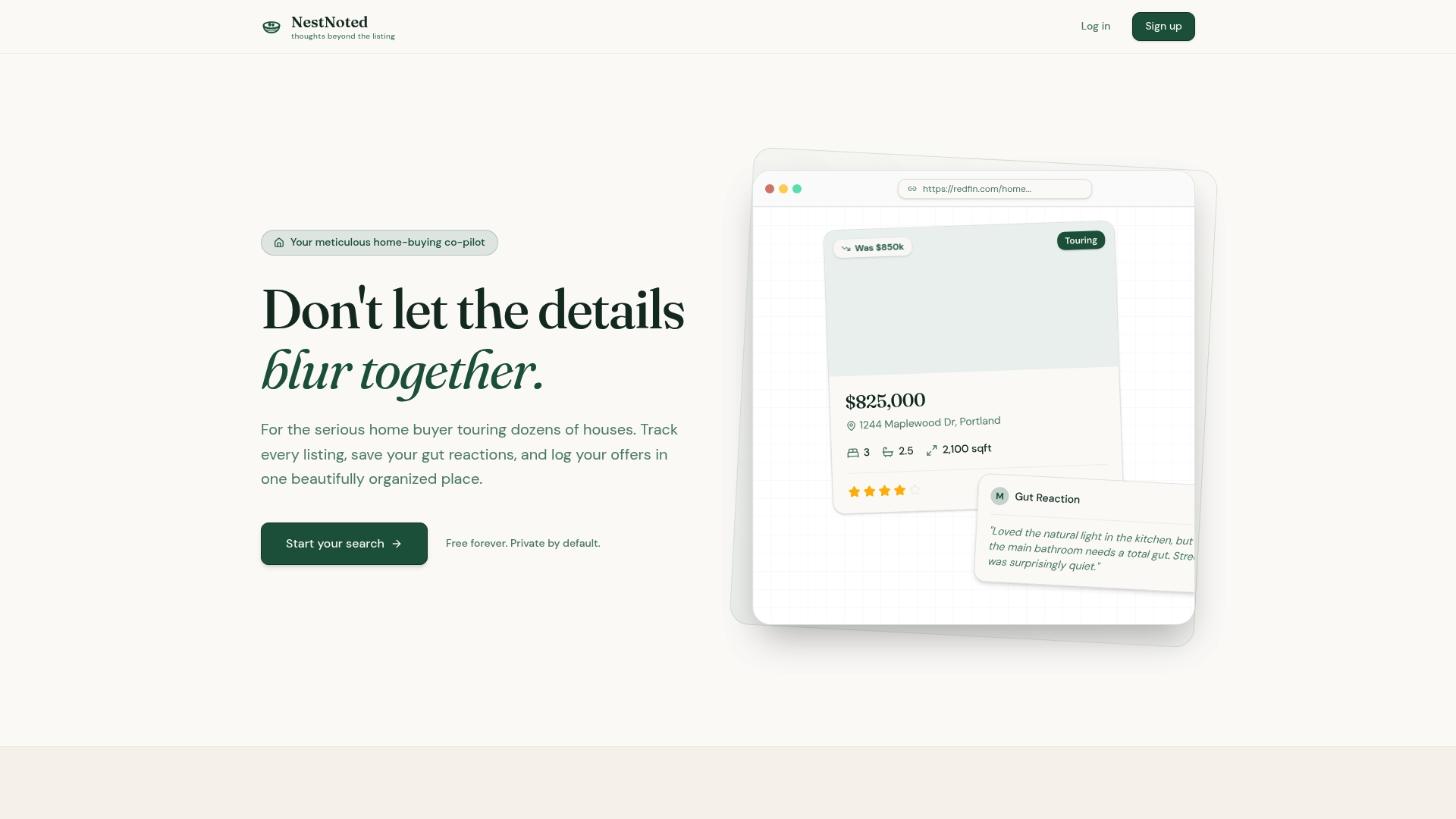
That privacy piece matters more than it sounds. Review-based platforms put your feedback in public. NestNoted doesn't, so you can write "overpriced, seller seems desperate" without worrying who sees it. It also skips the ads and promoted listings that clutter most search tools, and it's built for exactly the workflow this article walks through: tag, rate, compare, decide. If you're touring more than a couple of houses this month, start your workspace at NestNoted before your next showing, not after you've lost track of the third one.
Sources
Verify closing timelines with the CFPB's mortgage closing checklist, check regional closing cost expectations, and grab a downloadable home tour checklist before your next showing.
- Consumer Financial Protection Bureau — When do I get a Closing Disclosure?
- NAR — 2025 Profile of Home Buyers and Sellers (highlights)
FAQ
Can You Find Out the History of Your Home?
Yes. County recorder or assessor offices keep public deed records, sale prices, and permit history, and many are searchable online by address. Title companies can also pull a full chain of ownership if you need it for a specific transaction.
What Records Reveal a House's History?
Deeds, property tax records, permit filings, and past MLS listings are the main sources. A title report, ordered during the buying process, will also surface liens, easements, or ownership disputes tied to the property.
What Is the Best Way To Search for Homes?
The most reliable approach pairs a major listing site for browsing with a private note system for tracking what you've actually seen. Buyers who search for about ten weeks and view a median of seven homes need a way to compare properties that isn't relying on memory alone, which is where a tool like NestNoted fits in.
How Can I Access My House Search History?
Most listing sites, including Zillow and Redfin, save your search and viewing history under your account settings if you're logged in. For a fuller picture that includes your own notes and ratings, not just clicks, a dedicated workspace keeps that history organized and searchable long after the listing itself disappears.