

Enable TOTP-based multi-factor authentication, confirm your platform encrypts data with AES-256 at rest and TLS 1.3 in transit, enforce role-based access control, and export your notes regularly. Do this first: turn on an authenticator app and pull a fresh export today. A tool like Nestnoted defaults to private notes, which removes most of the guesswork from the process.
TL;DR:
- Enabling TOTP-based multi-factor authentication provides strong account security that blocks most forms of hacking, especially when platform support confirms AES-256 encryption and TLS 1.3.
- Regularly exporting encrypted backups of notes and search data and removing outdated recovery options reduce long-term exposure from data leaks or account takeovers.
- Using a dedicated home-search email and avoiding public Wi-Fi for uploads help contain cross-platform profiling and prevent accidental disclosure of negotiation details.
- Setting precise permissions with time limits and performing quarterly audits on shared workspace access minimizes sharing risks and prevents outdated access from remaining active.
- Promptly changing passwords, revoking sessions, and requesting full data exports are critical steps to contain damage and document exposure if an account is compromised.
Table of Contents
- Where Saved Searches, Notes, and Offers Are Vulnerable
- Which Technical Protections Should You Verify First?
- How Should Buyers and Agents Build a Privacy-First Routine?
- How Do You Set Permissions for Agents and Co-Buyers?
- What Should You Do If Your Account Is Compromised?
- Why Privacy-By-Default Changes How Buyers Actually Use These Tools
- Keep Your Home Search Private With Nestnoted
- Sources
- FAQ
Where Saved Searches, Notes, and Offers Are Vulnerable
Your search notes are more revealing than they look. A file that includes specific negotiation details, like an amount you might bid over asking or negative remarks about the neighborhood, is exactly the kind of information that can hurt you if it leaks to the wrong person.
The exposure comes from a few predictable places, and most buyers only think about one of them:
- Profiling and negotiation leaks. Detailed impressions and pricing notes can reveal your ceiling if an agent, seller, or platform shares them carelessly.
- Account takeover. A reused password or a phished login hands over months of touring history in one move.
- Overbroad sharing and third-party integrations. A workspace shared with an old agent or a forgotten app connection quietly extends your exposure long after the relationship ends.
- Device compromise. A lost phone or an unlocked laptop is often the easiest way in, no hacking required.
- Platform business-model risk. Some tools repurpose search behavior for advertising or lead generation, which the FTC has flagged as a real consumer risk. Ask directly whether your notes are ever used for anything beyond your own account.
Which Technical Protections Should You Verify First?
Run through this list before you trust any platform with months of touring notes and offer history.
- Confirm encryption standards. Ask support (or check the trust/security page) that data is encrypted with AES-256 at rest and TLS 1.3 in transit. If a platform can't answer this in one sentence, treat that as a red flag.
- Turn on TOTP-based multi-factor authentication. Authenticator apps like Google Authenticator or Authy generate a rotating code that isn't vulnerable to SIM-swap attacks the way SMS codes are. NIST's Digital Identity Guidelines name TOTP-based authentication as the stronger option, with SMS as a fallback only.
- Use a password manager. Unique, generated passwords for your search account close the single most common entry point for account takeover.
- Tighten recovery options. Remove old phone numbers or backup emails you no longer control, since a stale recovery path is an open door.
- Confirm audit logs exist. Ask whether the platform logs login attempts and permission changes, and who actually reviews those alerts when something looks off.
Pro Tip: Password reuse, not sophisticated hacking, is behind most account takeovers. If your home-search login matches any other account you own, change it today.
None of this is exotic. It's the same baseline CISA recommends for account security generally, applied to a tool that happens to hold your offer strategy.

How Should Buyers and Agents Build a Privacy-First Routine?
Good security here isn't a one-time setup. It's a handful of habits repeated on a schedule, and they take less time than most people expect.
- Create a dedicated home-search email. Using one address only for listing sites and your property tracker limits cross-service profiling. If that inbox is ever compromised, the damage stays contained.
- Enroll your devices in management. A phone or laptop with remote wipe enabled means a lost device doesn't turn into a leaked offer history.
- Skip public Wi-Fi for uploads. Coffee shop networks are fine for browsing listings; they're a bad place to sync photos and notes from a private tour. Use your phone's cellular connection or a trusted network instead.
- Set an export cadence. Pull your data monthly during an active search and keep an encrypted local backup, following the practical rule of three copies across two types of media, with one stored off-site.
- Schedule quarterly permission reviews. Check who still has access to your workspace, and file a deletion request once you close.
A dedicated home-search email does more heavy lifting than most buyers realize, since it stops your Zillow searches, your agent's CRM, and your property tracker from ever cross-referencing your behavior. Consistency matters more than any single tool here: quarterly reviews and a steady export habit close more real exposure than a one-time security setting ever will.
How Do You Set Permissions for Agents and Co-Buyers?
Shared workspaces are where privacy usually breaks down, not because anyone acts maliciously, but because access outlives the reason it was granted.
- Grant least privilege by default. Give an agent or co-buyer only the role they need, not full access to every note and offer.
- Prefer per-listing sharing over blanket access. If your partner is helping compare three homes, share those three, not the entire pipeline going back six months.
- Set time limits on invitations. An access grant tied to an expiration date doesn't need to be remembered later.
- Run quarterly permission audits. Role-based access control paired with regular review cycles is the standard recommendation, and revoking access the moment a relationship changes, such as switching agents, should be automatic, not an afterthought.
- Tag sensitive notes separately. Your absolute price ceiling or a note about a contingency you're willing to drop deserves stricter visibility than a general impression of the kitchen.
What Should You Do If Your Account Is Compromised?
Speed matters more than perfection here. The goal is to contain exposure first, document second, escalate only if the platform doesn't respond.
- Change your password immediately and revoke all active sessions from every device.
- Reissue MFA through a fresh authenticator app enrollment, not a re-sent code to the same compromised channel.
- Notify anyone in your shared workspace, including your agent, so they know your notes may have been exposed.
- Request a full data export of your notes, saved searches, and offers, and check the file for completeness against what you remember saving.
- Ask for deletion in writing and keep the support ticket number and confirmation as documentation.
- Escalate if needed. A zero-trust and access-logging framework like NIST's property-management reference design is the standard a platform should be able to point to; if it can't explain its logging or access controls at all, that's worth raising with a consumer protection body.
Why Privacy-By-Default Changes How Buyers Actually Use These Tools
Security that runs quietly in the background beats security that demands constant attention. When encryption, default-private sharing, and MFA are baked in rather than optional, buyers write more honest notes, because they aren't second-guessing who might read them.
That's the real payoff of privacy-by-default: candor. A buyer who trusts that a note stays private will actually write down the awkward truth, "loved the layout, hated the busy street," instead of a sanitized version. The tool builds around that assumption directly, keeping notes private unless explicitly shared, with export and import tools that make switching or backing up painless. An agent working three buyers at once benefits the same way: private notes per client, shared only where it helps the deal.
— Antony
Keep Your Home Search Private With Nestnoted
This tool is an alternative to a messy spreadsheet or a shared note app for tracking listings, offers, and impressions. Notes stay private by default, nothing is visible to other users or shown as public reviews, and it syncs listings directly from sites like Zillow and Redfin instead of requiring retyping details by hand.
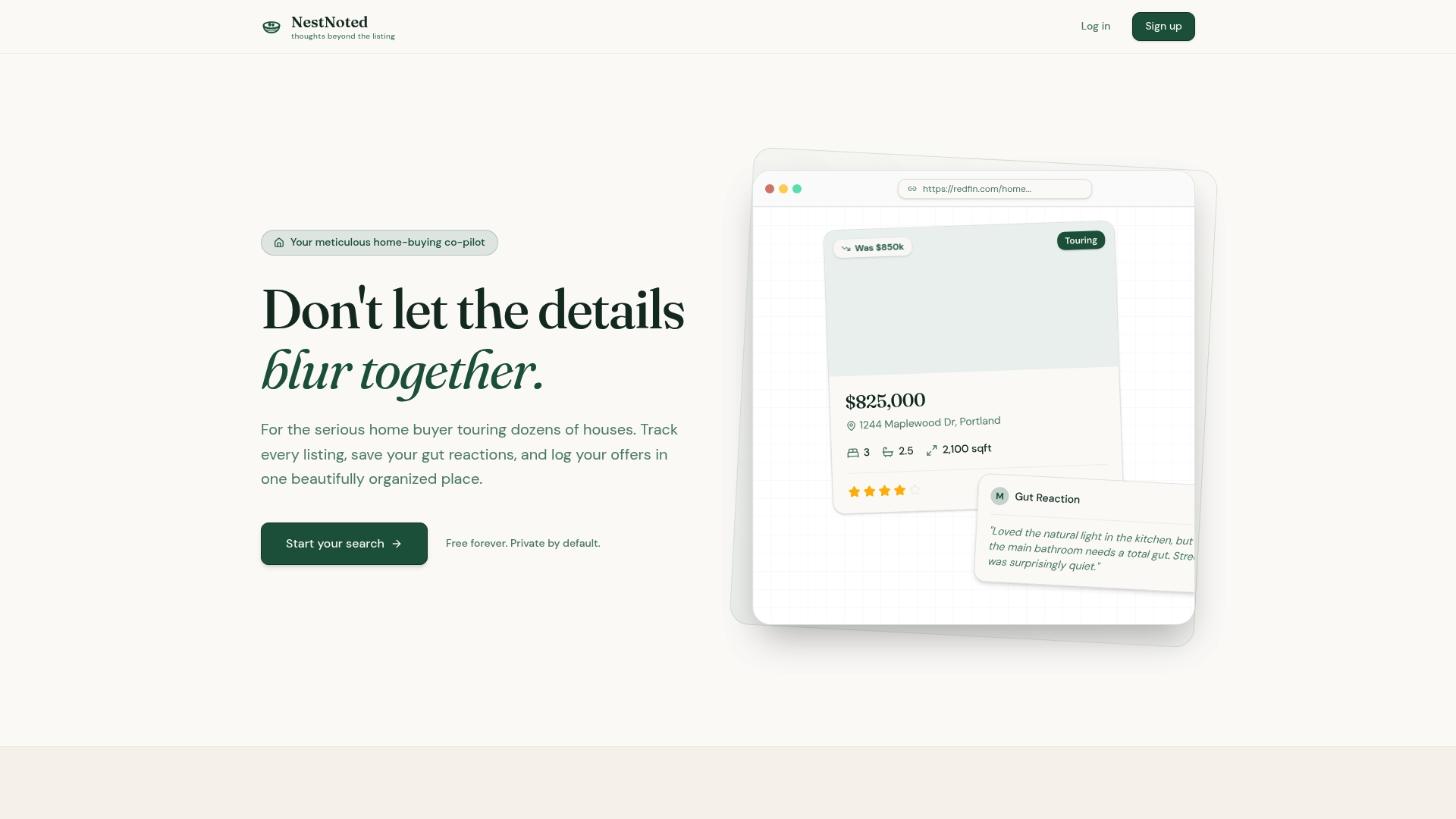
For a buyer touring a dozen homes in a month, that means writing "this one felt cramped in person" without wondering who else might see it, and pulling up a side-by-side comparison the night before an offer is due instead of scrolling through old texts. Agents get the same benefit when collaborating with clients: shared visibility where it helps, privacy everywhere else. If you're actively touring homes right now, set up your private workspace on Nestnoted and start logging your next tour before you forget the details that actually matter.
Sources
Check NIST's TLS guidelines and role-based access control practices for the technical standards behind these recommendations.
- Guidelines for Transport Layer Security (TLS) — NIST
- Digital Identity Guidelines (SP 800-63) — NIST
- NIST SP 1800-27: Securing Property Management Systems
FAQ
What's the single most effective step to protect home search data?
Enabling TOTP-based multi-factor authentication is the strongest single step, since it blocks account takeover even if your password leaks. NIST's guidelines rank authenticator apps above SMS codes for this reason.
How do I secure my home search history across devices?
Enroll every device you use for touring in device management with remote wipe enabled, and avoid uploading photos or notes over public Wi-Fi. A dedicated search email also limits how much your activity gets cross-referenced between apps.
Should I export my data before closing on a home?
Yes. Export your notes, saved searches, and offers on a regular cadence during your search, keep an encrypted local backup, and request deletion from the platform once the transaction closes.
Is Nestnoted private by default?
Yes. The platform keeps all notes and ratings private unless users choose to share them, with no public reviews or ad-driven use of search data. Current pricing details are available directly on Nestnoted's site.
How often should shared workspace permissions be reviewed?
Quarterly reviews are the standard recommendation for shared property workspaces, paired with immediate revocation whenever an agent or co-buyer relationship ends. This keeps access matched to who actually still needs it, based on role-based access control best practices.