

The MLS (Multiple Listing Service) is the source of truth for active-market listings. Zillow is the best public discovery tool for broad browsing. Those two sentences cover most of what buyers and sellers need to know, but the details matter a lot when money is on the line.
Here's the short version:
- Buyers: Start on Zillow or a similar portal to explore neighborhoods and get a feel for the market. Once you're serious about a property, switch to MLS access through a licensed agent for real-time status and complete data.
- Sellers: List on the MLS through an agent or flat-fee service for full exposure to buyer's agents. Zillow amplifies that reach to the public, but it doesn't replace MLS coverage.
- Pricing: Treat the Zestimate as a rough ballpark, not a number to negotiate from. The National Association of Realtors (NAR) and local MLS boards set the rules that keep MLS data current and reliable.
- Tracking: Use a private tool like Nestnoted to organize what you find across both platforms without losing notes or getting nudged by portal algorithms.
Table of Contents
- How do MLS and Zillow compare across the dimensions that matter?
- What is the MLS and who can actually access it?
- What is Zillow, and how does it get its listing data?
- Why does a property sometimes show on Zillow but not on the MLS?
- Which platform is more accurate, and when does it matter?
- How should buyers use Zillow and the MLS step by step?
- How should sellers use Zillow and the MLS together?
- How do you correct a listing error on Zillow?
- How Nestnoted helps you manage Zillow finds and MLS alerts
- Key Takeaways
- The part of this comparison most articles skip
- Organize your Zillow finds and MLS alerts with Nestnoted
- Sources and further reading
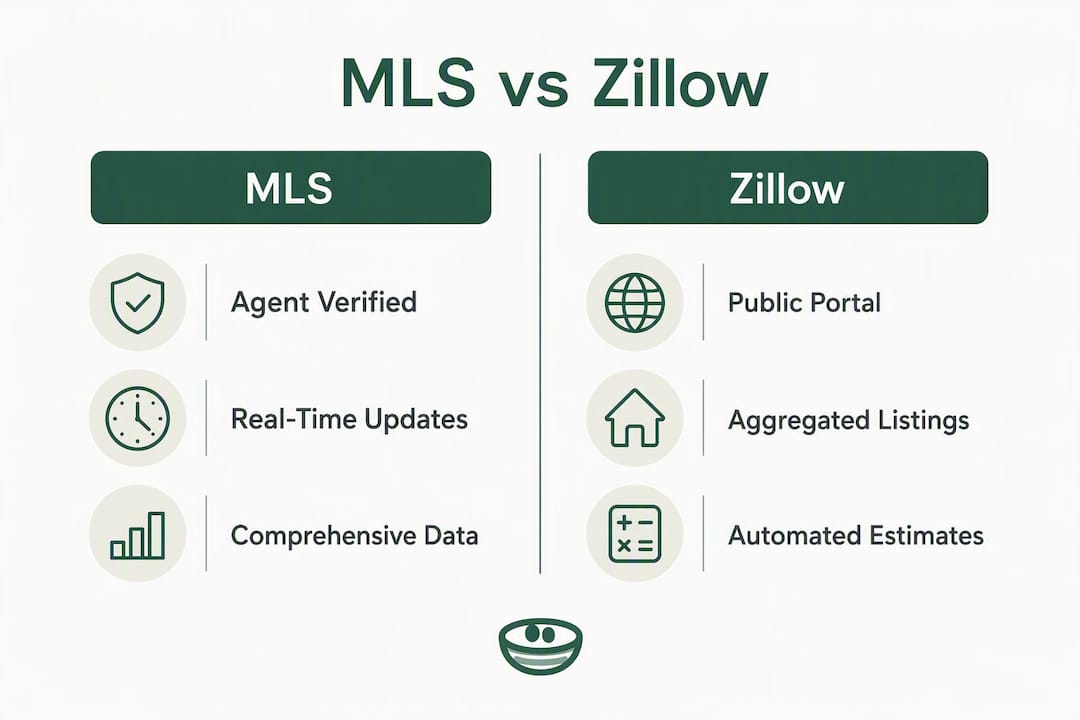
How do MLS and Zillow compare across the dimensions that matter?
| Dimension | MLS | Zillow |
|---|---|---|
| Accuracy / source of truth | Primary source; agent-verified data | Aggregated; can lag or contain errors |
| Update frequency | Near real-time (minutes after agent action) | Hours to 24–48+ hours behind |
| Who controls the listing | Licensed listing agent / broker | Agent, owner, or Zillow's own data pulls |
| Audience & marketing reach | Agents and brokers only (direct access) | Hundreds of millions of public visitors monthly |
| Cost to list | Agent commission or flat-fee MLS service | Free for FSBO; paid Premier Agent placement for agents |
| Buyer tools | Agent-supplied alerts, full data fields, agent-only remarks | Saved searches, Zestimate, neighborhood filters, map tools |
| Error correction | Agent corrects at source; updates propagate to portals | Report problem flow in Zillow UI; MLS correction is faster |
Quick takeaways:
- The MLS wins on accuracy and timeliness; Zillow wins on reach and user experience.
- Portals pull from MLS feeds, so MLS is upstream of everything buyers see publicly.
- Sellers who skip the MLS lose access to the agent network that drives most transactions.
- Buyers who rely only on Zillow risk acting on stale or incomplete data in fast markets.
What is the MLS and who can actually access it?
The MLS is a network of regional databases operated by local real estate boards and governed by NAR policies. There are hundreds of regional MLS systems across the country, each covering a specific geographic area. Only licensed agents and brokers can submit listings and access the full database directly.
What makes MLS data different from what you see on public portals is the depth. A typical MLS entry contains hundreds of data fields: room dimensions, utility details, HOA rules, showing instructions, agent-only remarks, and compensation offers to buyer's agents. None of that appears on Zillow. Status changes (active, pending, under contract, sold) update within minutes of an agent's action, not hours.
NAR's Clear Cooperation Policy requires that most listings be entered into the MLS within one business day of any public marketing. That rule exists to keep the market transparent and to prevent agents from quietly shopping listings to preferred buyers before the broader market sees them.
What MLS listings typically include:
- Full property details (square footage, lot size, year built, room count)
- Agent-only remarks (showing instructions, seller motivation, offer preferences)
- Compensation structure for buyer's agents
- Status history (days on market, price reductions, prior listings)
- Tax and legal parcel data linked to the entry
Pro Tip: Buyers can't log into the MLS directly, but a buyer's agent can set up automated MLS alerts that email you new matches within minutes of a listing going live. That speed advantage is real in competitive markets where good homes go under contract in hours.
What is Zillow, and how does it get its listing data?
Zillow is a consumer portal that aggregates listing data from multiple sources: MLS feeds via IDX (Internet Data Exchange) agreements, direct FSBO submissions from homeowners, and third-party data sources like tax records and other aggregators. Trulia, which Zillow acquired, operates on the same data infrastructure. Redfin is a brokerage that also operates a consumer portal, giving it slightly faster MLS access than pure aggregators, but it still functions as a portal for most buyers.

The business model shapes the product. Zillow generates hundreds of millions of visits per month and has built major revenue lines around curated MLS-derived inventory, primarily through its Premier Agent program, where agents pay to appear as the contact on listings in their target zip codes. That incentive structure means Zillow is optimized for engagement and lead generation, not raw data transparency.
What consumer portals add that the MLS doesn't offer publicly:
- Zestimate and similar automated valuation models (AVMs)
- FSBO and pre-foreclosure listings not in any regional MLS
- Neighborhood data, school ratings, commute tools, and walkability scores
- Saved search alerts and mobile apps built for casual browsing
- Rental platform context for buyers comparing rent vs. buy options
Pro Tip: The Zestimate is a useful starting point for a neighborhood price check, but automated estimates carry median error rates in the low single digits for on-market homes and larger spreads for off-market properties. Before making or countering an offer, ask your agent for a comparative market analysis (CMA). The CMA uses actual closed sales from the MLS, not a model trained on public data.
Why does a property sometimes show on Zillow but not on the MLS?
This mismatch trips up buyers more often than most people realize. The reasons fall into a few clear categories.
Syndication choices. Listing agents or sellers can opt out of syndicating to specific portals. A listing might be active in the MLS but deliberately kept off Zillow, often because the seller wants to control who contacts them or because the agent prefers to field inquiries directly.
FSBO submissions. Homeowners can post directly to Zillow without ever entering a regional MLS. Public portals aggregate MLS feeds plus FSBO and third-party sources, which increases breadth but introduces unverified entries that no agent has reviewed.
Timing gaps. Even when a listing is in both systems, the data doesn't update simultaneously. MLS changes propagate to portals through scheduled feed refreshes, not instant pushes.
Data errors. Tax records, duplicate feeds, and third-party aggregators can create ghost listings, wrong addresses, or outdated sold properties that still show as active.
| Source | Typical update window |
|---|---|
| Zillow / Trulia | Hours to 24–48+ hours |
The lag isn't always accidental. Portals may intentionally delay status updates or show stale "active" statuses to preserve engagement and lead capture. A listing that went pending yesterday might still show as active on Zillow today, generating inquiries that feed the Premier Agent system.
Which platform is more accurate, and when does it matter?
For transaction-stage decisions, the MLS wins by a wide margin. Status changes, price reductions, and offer deadlines are reflected in the MLS within minutes of an agent's update. Portals can lag by a day or more, and in a market where a well-priced home gets multiple offers in 48 hours, that gap costs buyers real opportunities.
Valuation accuracy is a separate question. Automated estimates like the Zestimate report median error rates in the low single digits for on-market homes, but the spread widens significantly for off-market properties, unusual floor plans, or homes in thin-transaction markets. An agent's CMA, built from recent closed comps in the MLS, is almost always more reliable for offer pricing.
Where portals hold their own is in the discovery phase. Browsing Zillow to understand a neighborhood's price range, school options, and inventory levels is genuinely useful. The problem is when buyers carry portal assumptions into the offer stage without verifying against live MLS data.
Pro Tip: In a hot market, set up MLS alerts through your agent and treat Zillow as a supplement for neighborhood context only. In a slower market with longer days on market, portals are fine for lead-in research, but always confirm status with your agent before scheduling a tour.
How should buyers use Zillow and the MLS step by step?
A staged approach keeps you from wasting time on listings that are already gone and from missing homes that haven't hit the portals yet.
- Longlist with portals. Use Zillow, Trulia, or similar sites to explore neighborhoods, set price filters, and get a feel for what your budget buys in different areas. Save searches and turn on email alerts for new listings.
- Shortlist with MLS access. Once you've identified target neighborhoods, ask your buyer's agent to set up direct MLS alerts. These arrive faster and include agent-only remarks that portals strip out.
- Verify before touring. Before driving to any property, confirm current status with your agent. A listing that looks active on Zillow may already be under contract.
- Document impressions privately. After each tour, log your notes somewhere the algorithm can't see. Portal apps track your behavior and surface listings based on engagement patterns, not your actual preferences.
- Prepare offers with a CMA. When you're ready to move, ask your agent for a CMA on the target property. That's the number to anchor your offer to, not the Zestimate.
Tracking without getting nudged:
- Use a home comparison chart to score properties on your own criteria
- Keep offer history, tour notes, and pros/cons in a private tracker like Nestnoted
- Avoid saving too many properties on portal apps; their recommendation engines learn from saves and can pull you toward listings that generate more leads, not better fits
Pro Tip: Portal apps track which listings you linger on and surface similar ones. That's useful for discovery but can subtly narrow your search. Keeping a private open house tracker outside the portal breaks that feedback loop and keeps your criteria honest.
How should sellers use Zillow and the MLS together?
The MLS is where transactions start. Most buyer's agents search the MLS exclusively for client inventory, which means a home that's only posted on Zillow as an FSBO is invisible to the majority of active buyers in the market. Sellers who only list FSBO on portals can significantly reduce exposure because agents simply don't search there.
Seller workflow:
- List on the MLS first. Work with a full-service agent or a flat-fee MLS service. Flat-fee services typically charge a few hundred dollars to enter your listing into the regional MLS without a full listing-agent commission, though you'll still typically offer a buyer's agent commission.
- Confirm IDX syndication. Once your listing is in the MLS, it should automatically syndicate to Zillow, Trulia, Redfin, and other portals via IDX feeds. Verify this with your agent or service provider within 24–48 hours of going live.
- Monitor portal accuracy. Check your Zillow listing after syndication. Confirm that photos, price, square footage, and status are correct. Errors introduced during the feed transfer are common.
- Update statuses promptly. NAR and local MLS rules require timely status updates. Letting a listing sit as "active" after accepting an offer can create legal and ethical complications.
For sellers with limited budgets, a flat-fee MLS listing combined with Zillow's free FSBO tools gives broad coverage at a fraction of a full commission. The trade-off is handling showings, negotiations, and paperwork yourself.
Pro Tip: If you're selling in a specialized situation, such as a divorce or estate sale, working with agents who understand the MLS rules for those scenarios matters more than the listing platform. The MLS entry is the legal and professional record; the portal is just the window display.
How do you correct a listing error on Zillow?
Errors on Zillow are common, and fixing them at the source (the MLS) is almost always faster than waiting for Zillow's editorial process.
- Claim the listing. Log into Zillow and search for the property. If you're the owner or listing agent, claim it through the "Claim this home" or agent dashboard flow.
- Use the "Report a problem" link. On any listing page, scroll to the bottom and select "Report a problem." Choose the error type (status, price, photos, square footage, address).
- Document your proof. Screenshot the MLS entry showing the correct data. Public records from the county assessor's office also work for factual details like square footage or lot size.
- Correct the MLS entry directly. If you're the listing agent, update the MLS record. Portal feeds pull from the MLS, so a corrected MLS entry will usually fix the portal display within the next feed refresh cycle (hours to 48 hours).
- Follow up. If the Zillow error persists after 48 hours, contact Zillow support directly with your documentation.
Common errors worth fixing immediately:
- Status showing "active" when the property is under contract or sold
- Wrong list price (often from a prior listing cycle)
- Incorrect square footage pulled from outdated tax records
- Missing or wrong photos
- Address errors that prevent the listing from appearing in the right map area
How Nestnoted helps you manage Zillow finds and MLS alerts
The gap between discovery on Zillow and verification via MLS is where serious buyers lose track of details. You tour a dozen homes, save favorites on three different apps, and two weeks later you can't remember which house had the low ceilings or which one had the offer deadline your agent mentioned.
Nestnoted is built specifically for that problem. It's a private property management tool where you can log impressions, rate properties, track offers, and compare listings side by side, all without the data being visible to portals or agents unless you choose to share it. The privacy-first design matters: candid notes about a home's flaws are more useful when you're not worried about them being seen by the seller's agent.
What Nestnoted adds to your workflow:
- Side-by-side comparisons — so you can score homes on your own criteria, not portal-suggested ones
Pro Tip: Serious buyers who track 10–20 properties at once need a system that doesn't nudge them toward engagement. Nestnoted keeps your notes private by default, which means your impressions stay honest and your agent gets clean, organized information instead of forwarded screenshots.
Key Takeaways
The MLS is the authoritative source for active listing data; Zillow is the best public discovery tool, but buyers and sellers should verify everything through MLS access before making financial decisions.
| Point | Details |
|---|---|
| MLS is the source of truth | Agent-verified data updates in minutes; portals can lag hours to 48+ hours behind. |
| Use portals for discovery only | Zillow and Trulia are best for neighborhood research, not transaction-stage decisions. |
| Sellers need MLS exposure | FSBO-only portal listings miss most buyer's agents, who search the MLS exclusively. |
| Zestimate is a ballpark | Automated valuations carry error spreads; always get a CMA before making an offer. |
| Nestnoted bridges the gap | Track MLS alerts and portal finds privately in one place with side-by-side comparisons. |
The part of this comparison most articles skip
Most MLS vs Zillow articles frame this as a data quality debate. It's actually a business incentives debate, and that framing changes what you do with the information.
Zillow is not trying to give you the most accurate real estate database. It's trying to keep you on Zillow long enough to become a lead. That's not a criticism; it's just how the business works. The Zestimate exists partly because it gives you a reason to check back when prices change. The "active" status that's actually pending exists partly because a pending listing still generates inquiries. The algorithm that surfaces certain listings over others reflects which agents are paying for placement, not which homes best match your criteria.
The MLS has its own distortions. Clear Cooperation rules are contested, pocket listings still happen, and agent-only remarks can contain information that tilts the playing field toward buyers with agent representation. But the MLS is at least governed by professional rules with enforcement mechanisms. Portals are governed by engagement metrics.
The practical conclusion: use both, but know which one you're trusting and why. Zillow for the map view and the neighborhood feel. MLS access through your agent for anything you're about to spend money on. And keep your own notes somewhere neither platform can see them.
Organize your Zillow finds and MLS alerts with Nestnoted
Tracking properties across Zillow, Redfin, and MLS alerts without a system means losing the details that matter most: which house had the foundation issue your agent flagged, which one had the offer deadline, which one you loved but your partner didn't.

Nestnoted gives serious buyers a private, organized workspace to manage all of it. Sync listings from major platforms, log private notes after every tour, compare properties side by side, and share a clean workspace with your agent. No spreadsheets, no lost messages, no portal algorithm deciding what you see next.
- Side-by-side comparisons: — score homes on criteria you set, not Zillow's ranking logic
Start organizing your search at Nestnoted — free to use, no credit card required.
Sources and further reading
- Gently Nudged: How Real Estate Platforms Curate Your Home Hunt — Realty Times
- HUD Fair Housing and Equal Opportunity — hud.gov
- NMLS Consumer Access — nmlsconsumeraccess.org
This article is general information, not legal or financial advice. Verify current MLS rules, listing requirements, and local procedures with a licensed real estate professional in your market.