

Log the primary reason you're passing on a listing, plus three pros and three cons, within 30 minutes of leaving the showing. That single habit is the difference between a property tracker that actually improves your search and a pile of vague memories that blur together after the fifth open house.
Do it while the smell of the basement is still in your head. Waiting even a day lets details soften into generic impressions like "it just wasn't right," which helps nobody, including the agent trying to recalibrate your next dozen showings.
Capture these fields at minimum:
- Condition and inspection risk (moisture, foundation, roof age, deferred maintenance)
- Layout and bedroom count against your actual needs
- Price relative to comparable sales and appraisal gap risk
- Insurability and any flagged coverage issues
- HOA rules or covenants that conflict with your plans
- Commute or location factors that showed up in person, not just on the map
Buyers who skip this step tend to repeat the same mistake: touring homes with the identical flaw three or four times before the pattern becomes obvious. A quick post-showing recap of top pros, top cons, and anything left to verify catches that pattern early, before decision fatigue sets in and every house starts to look interchangeable.
Key Takeaways
A rejection log only works if you record the primary reason and three pros and three cons within 30 minutes of the showing, using consistent fields you can search later.
| Point | Details |
|---|---|
| Capture fast | Log the primary reason plus three pros and three cons within 30 minutes to keep impressions accurate. |
| Use the deal-breaker framework | Separate hard no's from negotiable wants so showings move faster and patterns become visible. |
| Tag consistently | Apply the same tags (price, hvac, commute) across listings to spot repeating problems early. |
| Track market signals | Watch days on market, price cuts, and showing activity to read a listing's own rejection signs. |
| Use Nestnoted to standardize | Nestnoted's import, ratings, and tagging fields turn this workflow into a five-minute habit instead of a spreadsheet chore. |
Table of Contents
- What Are the Most Common Log House Rejection Reasons?
- How Do You Log a Rejected Listing Properly?
- What Are Some Ready-to-Use Rejection Note Templates?
- How Does NestNoted Support This Logging Workflow?
- Why Most Buyers Log Rejections Wrong
- Log Your Rejections Faster With Nestnoted
- Sources
What Are the Most Common Log House Rejection Reasons?
Most rejection reasons fall into five buckets, and sorting them that way matters because it tells you which ones are worth revisiting and which ones are permanent no's.
1. Deal breakers. These are the irreversible or prohibitively expensive issues: a location that adds longer than you are willing to commute, a layout that can't be fixed without a full renovation, an HOA that bans the home business you run, or a bedroom count that simply won't work for your family. A Deal Breakers vs Needs vs Wants worksheet forces you to separate these hard no's from preferences you could still negotiate around, and that separation alone speeds up every showing that follows.

2. Condition and inspection risk. Moisture staining, foundation cracks, an aging roof, or a laundry list of deferred maintenance don't automatically kill a deal, but they deserve their own tag rather than getting lumped into a vague "needs work" note. Log them as inspection-risk items with a rough repair estimate if you can. Water intrusion and structural movement are two of the most common defects that surface late in a transaction, and flagging them early saves you from falling in love with a house you'll walk away from anyway; understanding common issues like these is crucial as explained in property defects explained.
3. Financial and transactional red flags. Price sitting well above comparable sales, a lender hinting at appraisal gap risk, or an insurance carrier balking at coverage all belong in this category. These are worth a separate tag from condition issues because the fix (renegotiate, waive contingency, shop insurers) is completely different. If appraisal risk is unfamiliar territory, it's worth understanding appraisal gap coverage before you're staring down a low valuation with an offer already in.
4. Market and presentation signals. A listing that's sat on the market for 60-plus days, taken two price cuts, or shows almost no other showing activity is telling you something the photos won't. Track days on market and price-reduction history the same way you'd track your own notes. A withdrawn or expired listing is the market's own rejection log, and reading it correctly can tell you whether a home is overpriced, poorly marketed, or genuinely flawed.
5. Psychological signals. If you find yourself writing three paragraphs justifying a house that has two deal breakers, that's a signal worth logging too. Repeated justification is often decision fatigue in disguise, especially in a competitive market where urgency makes an ordinary house feel like your last chance.
Pro Tip: Tag condition issues separately from financial issues, even when they're related. A foundation crack that scares off your lender is a different problem to solve than a foundation crack that just needs monitoring, and a single "bad condition" tag hides that distinction.
How Do You Log a Rejected Listing Properly?
A rejection note is only useful if it's structured the same way every time. Inconsistent notes are unsearchable notes, and unsearchable notes don't reveal patterns.
Record these fields for every listing you pass on:
- Address and listing ID
- Showing date and time
- Primary rejection reason (the one that actually killed it)
- Secondary reasons (contributing factors, even minor ones)
- Ratings from 0 to 5 on condition, layout, location, and price
- Photos with annotated callouts on the specific problem areas
- A rough repair or inspection-risk estimate where relevant
Follow a six-step routine right after you leave the property:
- Open your tracker before you're back in the car, not after dinner.
- Write the primary reason first, in one sentence.
- Add three pros and three cons without overthinking the wording.
- Rate the core axes (condition, layout, location, price) from 0 to 5.
- Attach two or three photos of the specific issue, not the whole house.
- Tag the entry so it's searchable later (e.g., "foundation," "hoa," "commute").
A 30-minute capture window preserves your raw impression before it gets rewritten by hindsight. Buyers who wait until evening tend to soften real problems into fuzzier language, which defeats the purpose of the log.
Tags matter more than most buyers realize. If "moisture" shows up on four different listings in six weeks, that's not bad luck. That's a signal your price range or neighborhood has a systemic issue worth discussing with your agent before touring a fifth similar house.
Here's a sample entry, written the way it should actually look in your tracker:
412 Birchwood Lane. Rejected: appraisal gap risk, comps 8% below asking. Pros: updated kitchen, fenced yard, quiet street. Cons: overpriced for area, HVAC is 18 years old, no dedicated office space. Tags: price, hvac, comps. Next step: monitor for price drop.
What Are Some Ready-to-Use Rejection Note Templates?
Copy these into your tracker and adjust the numbers to match your own priorities. Each one follows the same shape: a one-line verdict, three pros, three cons, and a next-step tag.
- Location/commute: Rejected: 22-minute commute exceeds our 15-minute limit. Pros: great schools, large lot, updated bathrooms. Cons: highway noise, no sidewalks, commute too long. Tag: monitor-only.
- Layout/bedroom count: Rejected: only 2 bedrooms, need 3. Pros: open floor plan, natural light, finished basement. Cons: no third bedroom, small closets, one bathroom. Tag: deal-breaker.
- Inspection risk/condition: Rejected: visible foundation cracking, musty basement smell. Pros: good bones, large kitchen, mature landscaping. Cons: foundation concern, roof near end of life, outdated electrical. Tag: inspection-risk.
- Price/appraisal risk: Rejected: listed 10% above nearest comps. Pros: move-in ready, great block, updated systems. Cons: overpriced, low appraisal likely, seller unwilling to negotiate. Tag: watch-for-price-cut.
- Insurance/HOA: Rejected: HOA restricts rentals, insurer flagged roof age. Pros: pool access, gated community, low crime area. Cons: rental restriction, insurance surcharge, high HOA dues. Tag: deal-breaker.
- Monitor for price drop: Rejected for now: priced above our range but no other issues. Pros: ideal layout, great location, updated kitchen. Cons: price only. Tag: revisit-in-30-days.
Adjust the bedroom counts, commute limits, and price thresholds in these templates to match your own deal breakers. A template built around someone else's priorities won't surface your patterns.
How Does NestNoted Support This Logging Workflow?
Nestnoted's listing tracker maps directly onto the fields above, which is why it works better for this than a spreadsheet. Listing import pulls in address and photos automatically. Notes and ratings fields hold your 0 to 5 scores. Pros-and-cons fields keep the three-and-three format standardized across every showing. A status pipeline moves listings from "touring" to "rejected" to "monitoring," and tags make repeating issues searchable across your entire history.
The six-step routine looks like this inside the app: capture the primary reason, tag it, rate the core axes, attach photos, write the one-line verdict, and set the next-step status.
Notes stay private by default, which means you can write "overpriced and the sellers know it" without worrying it becomes public feedback. That candor is what makes the pattern-spotting actually work, for both you and your agent.
Why Most Buyers Log Rejections Wrong
Most advice on this topic focuses on the emotional side of house hunting: trust your gut, don't overthink it, you'll know when it's right. That advice is fine for the final decision, but it's terrible for the search itself. Gut feelings don't compound into patterns. Structured notes do.
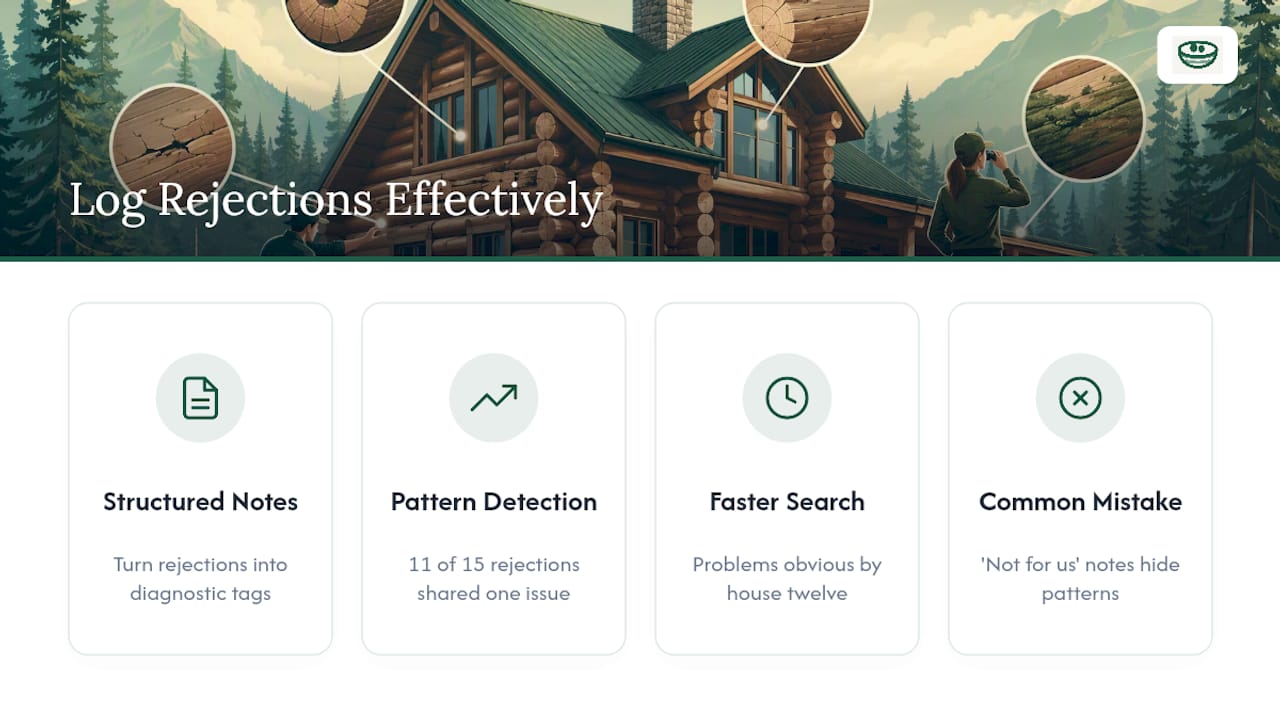
The buyers who move fastest through a search aren't the ones with the clearest intuition. They're the ones who can look back at fifteen rejected listings and immediately see that eleven of them died on the same issue, usually price or commute, sometimes a specific inspection risk that keeps resurfacing. That's not intuition. That's a tagging system doing its job.
The mistake I see most often is treating rejection notes as a formality instead of a diagnostic tool. Write "not for us" enough times and you'll tour thirty houses to find the one that was obvious by house twelve, if only the notes had been specific enough to show the pattern.
— Antony
Log Your Rejections Faster With Nestnoted
Nestnoted is built around the exact workflow this article describes: capture the primary reason, tag it, rate it, and move on, without losing the details to memory or a messy group text thread. Where a spreadsheet forces you to build your own fields from scratch, Nestnoted already has listing import, notes and ratings, pros-and-cons fields, a status pipeline, and tags set up and ready to use the moment you sign up.

Import a listing you toured this week and try one of the templates above inside your first entry. If you want a faster start, the AI assistant can help summarize your raw notes into the one-line verdict and three-and-three format automatically. Check the full feature set and create a free account to start logging your next showing before the details fade.