

Earnest money is a good-faith deposit you submit with an offer to show the seller you're serious. A down payment is the larger cash amount you pay at closing that directly reduces your loan principal. The two are not separate costs stacked on top of each other. According to HomeLight, your earnest money is credited toward your total cash-to-close at settlement and is typically applied to your down payment or closing costs. The National Association of Realtors (NAR) reports that typical deposits commonly range around 1% to 3% of the purchase price, with higher deposits sometimes seen in competitive markets.
Table of Contents
- What is earnest money and how does it work?
- Is earnest money refundable?
- What is a down payment and how does it affect your loan?
- How earnest money and your down payment connect at closing
- How much earnest money should you offer?
- Quick answers to common earnest money and down payment questions
- A practical checklist to protect your earnest money
- Key Takeaways
- The part most buyers underestimate
- Nestnoted helps you stay organized through every deadline
- Useful sources for homebuyers
What is earnest money and how does it work?
Earnest money, sometimes called a good-faith deposit, is the amount you put up when your offer is accepted to prove you intend to follow through. Sellers use it as a filter. Without skin in the game, a buyer could tie up a property for weeks and walk away with zero consequences.
When you pay it and who holds it
You typically deliver earnest money within one to three business days of an accepted offer, though some contracts require it simultaneously with the offer itself. The funds go to a neutral third party, not the seller directly. That holder is usually a title company, escrow company, real estate attorney, or sometimes the listing brokerage. NAR's consumer escrow guide explains that escrow releases funds only when all contract terms are met or when both parties provide written instruction.
Payment is almost always by certified check or wire transfer. Before you send a wire, call the escrow company directly using a phone number you looked up independently, not one from an email. Wire fraud targeting homebuyers is a real and growing problem.
How much earnest money should you expect to pay?
- Credible's mortgage research notes that typical earnest money deposits often fall within a low single-digit percentage of the purchase price
- In more competitive markets, deposits may be larger
- Some markets and new-construction contracts use fixed-dollar amounts regardless of price
Quick escrow verification checklist
- Confirm the escrow holder's full legal name and account number in writing
- Call the title or escrow company directly to verify wire instructions
- Get a receipt or confirmation the funds were received
- Save the escrow officer's direct contact information
Is earnest money refundable?
The short answer: it depends on your contract and whether a valid contingency covers your reason for canceling. If you back out for a reason the contract protects, you get your deposit back. If you walk away without a covered reason, the seller can keep it.
Experian's homebuying guidance is direct on this point: refundability hinges entirely on the purchase agreement and the presence of valid contingencies.
The four contingencies that protect your deposit
- Appraisal contingency — Lets you cancel or renegotiate if the property appraises below the purchase price.
Deadlines are where buyers lose money
Missing a contingency deadline is the most common way buyers forfeit deposits. If your inspection period expires and you haven't submitted a written objection or cancellation, you've effectively waived that protection. The same logic applies to loan approval deadlines and appraisal review windows. Mark every deadline on the day you sign the contract, not the day before it expires.
When disputes arise, NAR's guidance on earnest money regulations notes that releasing funds requires written instruction from both parties, and unresolved disputes can escalate to arbitration or legal action. That process is slow and expensive for everyone involved.
Pro Tip: Ask your agent to build a contingency deadline calendar the day you go under contract. Every removal date, every response window, every loan milestone should be in writing and tracked somewhere you'll actually check.
What is a down payment and how does it affect your loan?
A down payment is the cash you bring to the closing table that goes directly toward the purchase price. It reduces the amount you need to borrow, which lowers your monthly payment and the total interest you'll pay over the life of the loan.

Chase's mortgage education resources confirm that down payments are paid at closing and commonly range from a few percent up to around 20%, depending on loan program and buyer qualifications. Some programs allow qualified buyers to put down as little as a small single-digit percentage; the 20% threshold is significant regarding private mortgage insurance (PMI).
Loan-to-value and PMI
Loan-to-value (LTV) is simply your loan amount divided by the home's appraised value. A 10% down payment gives you a 90% LTV. Lenders view higher LTV as higher risk, which is why PMI exists: it protects the lender, not you, and adds to your monthly cost until you reach roughly 20% equity.
What the down payment covers vs. what it doesn't
- Covers: — a portion of the purchase price, reducing your loan principal
Closing costs typically run 2%–5% of the loan amount and are paid separately at closing. A 20% down payment does not include them.
How earnest money and your down payment connect at closing
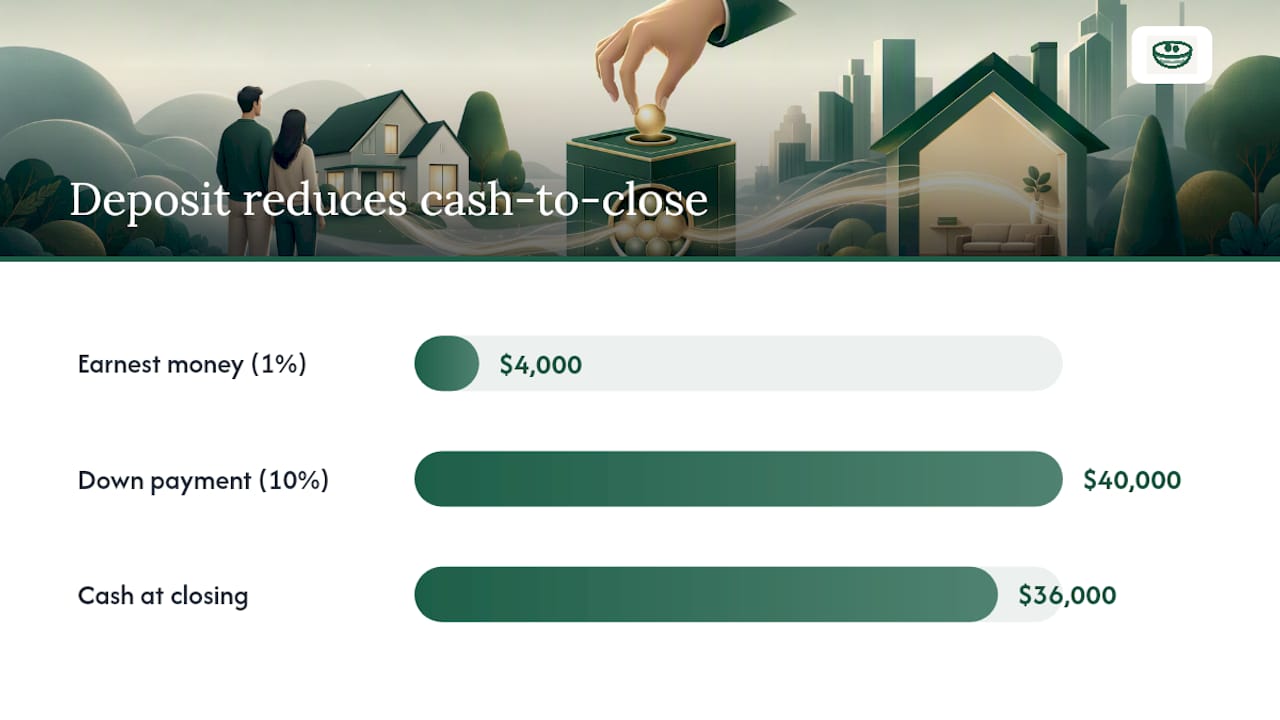
Here's the practical link between the two: your earnest money deposit reduces the cash you need to bring to closing. It's credited on your closing disclosure against your total cash-to-close, and it can be applied to your down payment, closing costs, or both.
Step-by-step example on a $400,000 home
- Purchase price: $400,000
- Earnest money (1%) — $4,000 paid upfront
- Down payment (10%) — $40,000 total required
Your earnest money didn't disappear. It's sitting in escrow and gets applied at settlement.
Sample calculations at three price points
| Purchase Price | Earnest Money (1%) | Down Payment (10%) | Cash at Closing (Down Payment Less Deposit) |
|---|---|---|---|
| — | — | $30,000 | — |
| $400,000 | $4,000 | $40,000 | $36,000 |
| — | — | $100,000 | — |
Closing costs are separate and not reflected above. Figures assume earnest money is applied to the down payment.
Your closing disclosure, which your lender is required to provide at least three business days before closing, will show exactly how the escrow credit is applied. Review it line by line.
How much earnest money should you offer?
There's no single right answer. The standard starting point is 1%–3%, but the right number for your situation depends on the market, the competition, and how much risk you're willing to carry.
NAR's research on earnest money notes that sellers in competitive markets may favor offers with higher deposits when evaluating multiple bids. A larger deposit signals commitment. It also means more money at risk if something goes wrong.
Factors that push the deposit higher
- Multiple competing offers on the same property
- A seller's market with low inventory
- New construction or builder contracts (often require fixed amounts)
- You're waiving one or more contingencies
- Cash offers in your market are common (a higher deposit can help a financed offer compete; see how cash offers affect market dynamics)
Factors that justify a lower deposit
- Buyer's market with few competing offers
- Strong contingency protections in the contract
- Limited liquidity before closing
- Seller is highly motivated
Work with your agent to calibrate. A good agent knows the local norms and can tell you what sellers in that specific neighborhood are seeing. Deposit size is one lever among several: price, contingencies, and closing timeline all factor into how an offer is received.
Quick answers to common earnest money and down payment questions
Earnest money on a $400,000 home
At 1%, that's $4,000. At 2%, it's $8,000. Both are within the typical range; which is appropriate depends on the market and competition.
Is $20,000 a good down payment on a $400,000 home?
$20,000 is 5% of $400,000. That meets the minimum for many conventional loan programs, but you'd carry PMI and have a 95% LTV. Your monthly payment and total interest will be higher than with a larger down payment. It's a workable starting point, not an ideal one.
Does 20% down include closing costs?
No. A 20% down payment on a $400,000 home is $80,000, paid toward the purchase price. Closing costs are a separate line item, typically another $8,000–$20,000 depending on your loan and location.
Down payment on a — home
- At 10%: $100,000
- At 20%: $200,000 (avoids PMI on most conventional loans)
- At 3% (if eligible): $30,000, though jumbo loan minimums often require more
Jumbo loans, which typically apply to purchases above the conforming loan limit, often carry higher down payment requirements than standard conventional loans. Confirm the current limit with a licensed lender verified through NMLS Consumer Access.
A practical checklist to protect your earnest money
The fastest way to lose a deposit is to miss a deadline. The second fastest is to have no documentation when a dispute arises. Both are preventable.
Chronological protection checklist
- Closing day: — Review your closing disclosure line by line. Confirm the earnest money credit appears correctly.
Document management
Keep copies of: the signed purchase agreement, earnest money receipt, escrow instructions, all written contingency notices, and every email or text related to deadlines. Store them somewhere you can access quickly, not just in an email thread you'll have to search.
Nestnoted's document storage features let you attach contract copies, receipts, and escrow communications directly to a property record, so everything is in one place when you need it. Use the listing tracker to log contingency deadlines alongside your property notes.
Pro Tip: When you remove a contingency, do it in writing and keep a timestamped copy. Verbal agreements about contingency waivers are nearly impossible to enforce if a dispute goes to arbitration.
This article is general information, not legal or financial advice. Confirm current rules with a licensed real estate attorney or qualified professional in your state.
Key Takeaways
Earnest money is credited at closing and reduces your cash-to-close; a down payment is the larger amount paid at settlement that directly reduces your loan principal and affects your LTV and PMI obligations.
| Point | Details |
|---|---|
| Earnest money is a credit, not an extra cost | At closing, your deposit is applied to your down payment or closing costs, reducing cash due. |
| Typical deposit range is 1%–3% | Competitive markets can push deposits to about 10%; some contracts use fixed-dollar amounts. |
| Contingencies protect your deposit | Inspection, financing, appraisal, and title contingencies let you cancel and recover funds. |
| Missing deadlines causes forfeiture | Track every contingency removal date from day one; verbal waivers offer no protection. |
| Nestnoted organizes your offer details | Use Nestnoted to log deadlines, store documents, and track each property's offer status privately. |
The part most buyers underestimate
Most buyers focus on the size of the deposit and miss the real risk: the deadlines attached to it. A $5,000 earnest deposit on a $400,000 home feels manageable until you realize you missed the inspection objection window by 48 hours and now the seller has legal grounds to keep it.
The contingency system is genuinely well-designed for buyers. Inspection, financing, appraisal, and title protections cover the vast majority of legitimate reasons a deal falls apart. The problem isn't the system. It's that buyers treat contingency deadlines as rough guidelines rather than hard cutoffs with financial consequences.
Agents who advise buyers well spend real time on this conversation: not just "here are your contingencies" but "here is the exact date each one expires, here is what you need to submit, and here is what happens if you don't." If your agent hasn't walked you through that calendar, ask for it explicitly.
On deposit size: the instinct to offer a larger deposit to win a competitive bid is understandable, but it's worth pausing on the math. A higher deposit doesn't strengthen your legal position if the deal falls apart. It just means more money is at risk. In a multiple-offer situation, a cleaner offer with fewer contingencies often does more work than a bigger deposit. Use the deposit as a signal of seriousness, not as a substitute for a well-structured offer.
Nestnoted helps you stay organized through every deadline
Losing an earnest deposit to a missed deadline is one of the most avoidable mistakes in a home purchase. Nestnoted gives serious buyers a private, organized workspace to track every property, log offer details, and store the documents that matter most when a dispute arises.
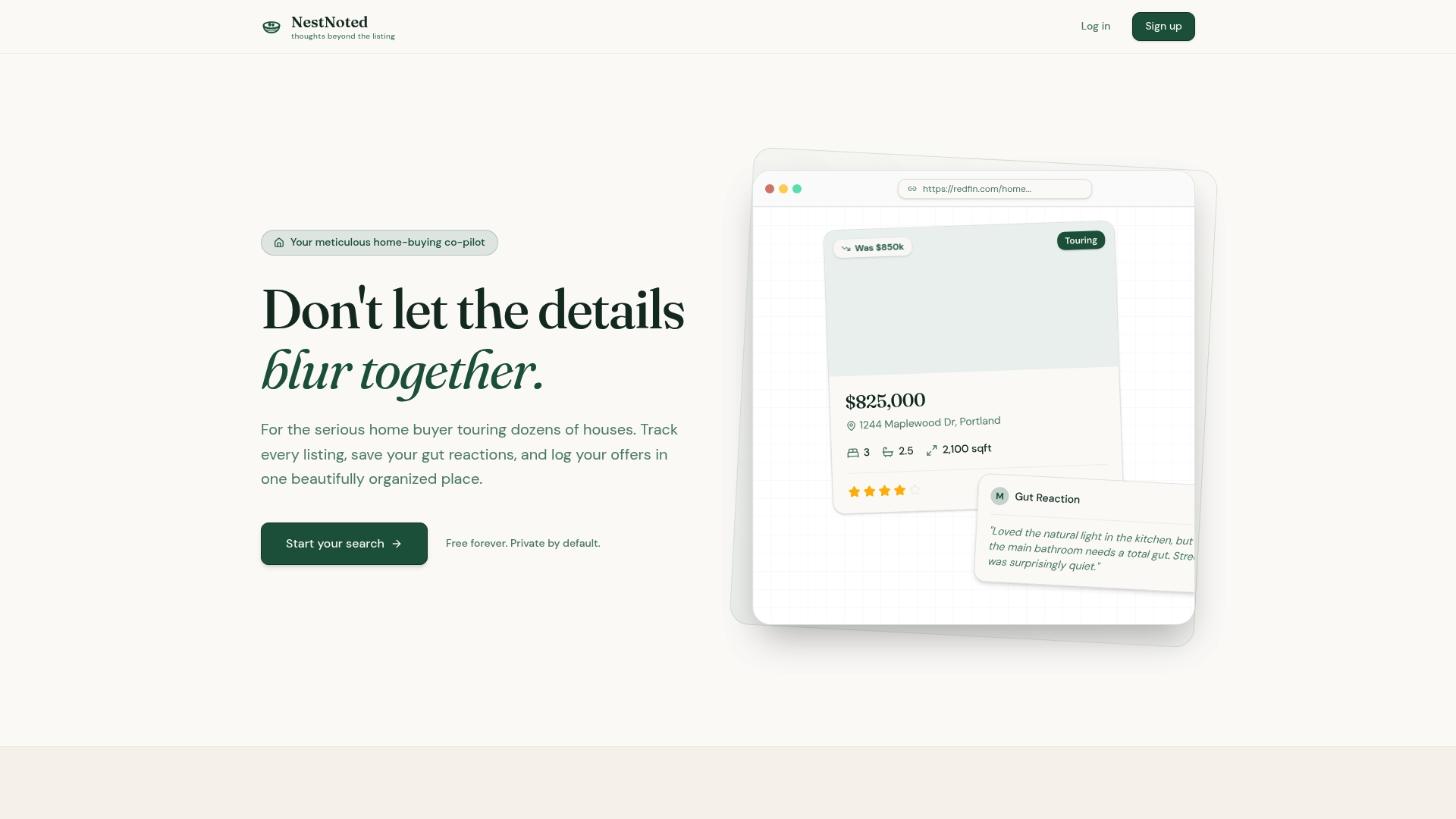
With Nestnoted, you can attach contract copies and escrow receipts directly to a property record, set notes on contingency dates, and keep your offer strategy confidential by default. No spreadsheet juggling, no digging through email threads at 9 PM before a deadline. Everything tied to a property stays in one place, accessible when it counts.
If you're actively touring homes and managing offers, start tracking your properties with Nestnoted before your next offer goes in.
Useful sources for homebuyers
- Earnest Money vs. Down Payment: What’s the Difference?
- Consumer Guide: Escrow and Earnest Money
- Earnest Money in Real Estate: Refunds, Returns and Regulations
- How Much Earnest Money Do You Need for a Home Purchase?
- What is earnest money and how much is enough?
- nmlsconsumeraccess.org