

The fastest way to know if a house will be expensive to run is to get 12 months of bills (or an address-based utility estimate), annualize them, and stack that number against every other property on your shortlist. Anything less is a guess dressed up as a decision.
Before you tour another house, ask the agent for these numbers on every property that makes your shortlist:
- 12 months of electricity, natural gas, water/sewer, and trash bills (not summer only, not winter only)
- Primary fuel type and the age of the HVAC system
- Which utilities, if any, are bundled into an HOA fee
Convert everything to an annual total, then divide by 12 for a monthly equivalent. A $1,200 annual gap between two houses works out to about $100 a month, which is real money against a mortgage qualification or a monthly budget. That single comparison, done consistently across every property, is what separates an informed offer from a lucky guess.
Key Takeaways
Comparing utility costs between homes requires 12 months of address-specific data, category-by-category estimates, and adjustments for climate, HVAC condition, and occupant behavior.
| Point | Details |
|---|---|
| Get 12 months of bills first | A single month hides seasonal spikes; a full year reveals the real annual cost. |
| Prioritize HVAC and insulation | Heating and cooling drive roughly half of home energy use, making equipment condition the biggest cost lever. |
| Normalize before comparing | Use dollars-per-square-foot or dollars-per-bedroom to compare homes of different sizes fairly. |
| Pay for an audit when it's close | A walk-through or diagnostic audit earns its cost when two finalists are within $50 a month of each other. |
| Track it all in one place | Nestnoted stores bills, audit reports, and side-by-side utility scores privately for every property you tour. |
Table of Contents
- How Do You Compare Utility Costs Between Properties?
- How Do You Estimate Each Utility Category?
- Why Do Two Similar Homes Have Different Utility Costs?
- Is a Professional Energy Audit Worth Paying For?
- How Do You Build a Utility Cost Comparison Worksheet?
- What Do Buyers Usually Miss on a Home Tour?
- Keep Your Utility Comparisons Organized With Nestnoted
- Sources
How Do You Compare Utility Costs Between Properties?
Start with the seller, not with a national average. A full 12-month bill history catches what a single statement never shows: the July air-conditioning spike, the February gas bill, the irrigation season creeping into July and August water charges. One month of data tells you almost nothing about a house's real operating cost.
Here's the order that actually works:
- Ask the listing agent for 12 months of bills. Frame it as a standard due-diligence request, the same way you'd ask for a seller disclosure. Most agents can pull this from the seller directly.
- Call the utility company for an address-based estimate. Electric, gas, and water providers will often give a prospective buyer or their agent typical usage for a specific address, even without full billing access, according to Redfin's guide to estimating utility costs.
- Fall back on neighborhood comparables. If bills genuinely don't exist (new construction, a seller who won't share), ask your agent for typical annual ranges on two or three similar homes nearby, or check municipal average consumption data for the ZIP code.
Pro Tip: Ask for bills in the same email where you request the seller disclosure. Bundling the ask makes it feel routine instead of invasive, and sellers rarely push back on it.
How Do You Estimate Each Utility Category?
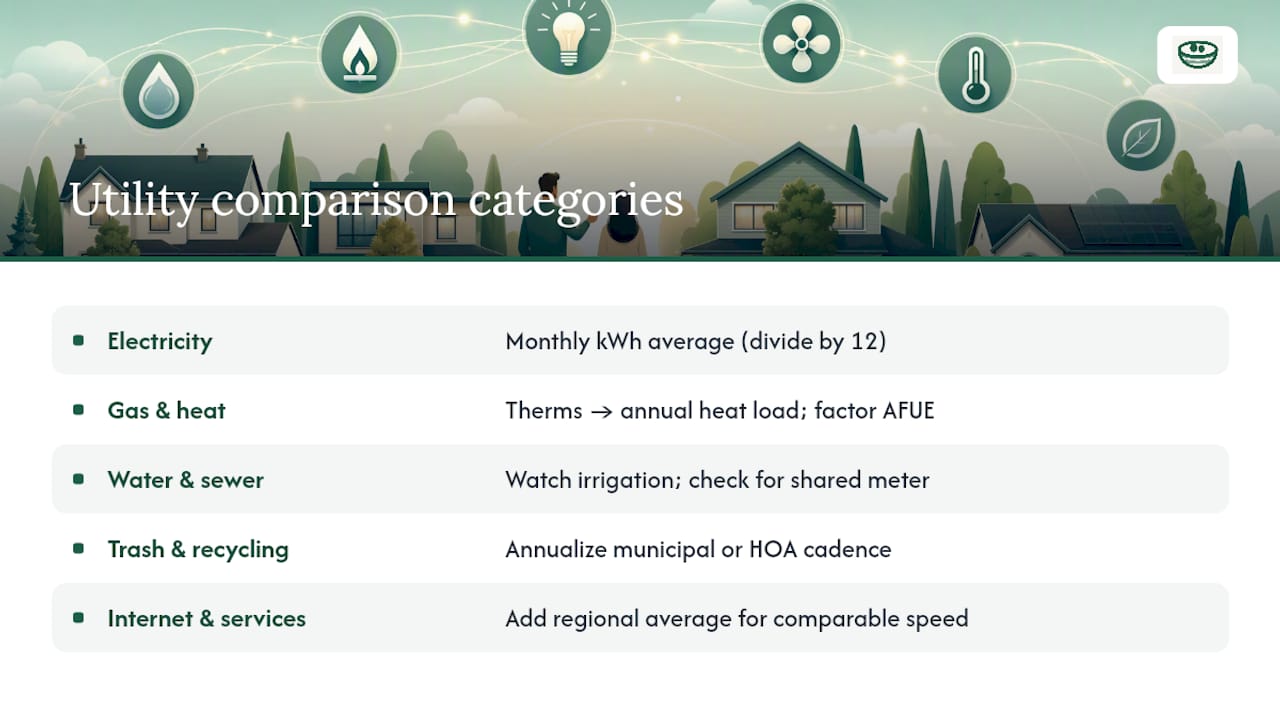
Break the comparison into five categories, because lumping "utilities" into one number hides where the real cost differences live.
Electricity. Pull the kWh totals from each bill, divide by 12 for a monthly average, then adjust upward if the home has window units, an electric water heater, or a pool pump the current owner may not run year-round. Watch for time-of-use rate plans in states like California and Texas, where the same kWh usage can cost 20 to 40 percent more if concentrated in peak afternoon hours.
Gas and heat. Convert therms into an annual heat load and factor in the heating system's efficiency rating (AFUE). A furnace rated at 80% AFUE burns noticeably more fuel than a 95% high-efficiency unit to deliver the same warmth. Heat pumps complicate this further because they run on electricity, not gas, so a heat-pump home's gas bill might only reflect a water heater or stove.
Water and sewer. Check for irrigation systems, which can double a summer water bill in dry climates. Also confirm whether the meter is shared with a neighboring unit, common in older duplexes and some condos, which muddies any bill you're handed.
Trash and recycling. Municipal service is usually billed quarterly or folded into property tax; HOA-covered trash shows up nowhere on a utility bill at all. Annualize whatever cadence applies so it's comparable across properties.
Internet and recurring services. If you count these in your monthly carrying-cost math (and you should, since they're as fixed as an electric bill), add the average regional rate for comparable speed tiers.
A quick worked example: a home using 900 kWh a month at a $0.15/kWh rate runs about $135 a month in electricity alone, before gas, water, or trash enter the picture.
Heating and cooling typically account for about half of a home's total energy use, with electricity and natural gas together making up the vast majority of residential energy consumption. That single statistic is why HVAC condition and insulation quality matter more to your comparison than almost anything else on the checklist.
Why Do Two Similar Homes Have Different Utility Costs?
Square footage alone won't explain a $150-a-month gap between two houses on the same block. A quick normalizer is Energy Use Intensity, or EUI: total annual energy divided by square footage. Comparing dollars-per-square-foot, or dollars-per-bedroom for a faster gut check, puts homes of different sizes on the same scale.
The variables that actually move the number:
- Climate zone and how many heating or cooling degree days the area logs annually
- HVAC age, SEER rating for cooling, AFUE rating for heating
- Insulation quality, duct condition, and window seals
- Water heater type (tank, tankless, heat pump) and age
- Existing solar panels or other renewable systems
- How the current occupants actually use the space (thermostat habits, number of people, work-from-home schedules)
Old, poorly sealed windows can push that even higher, but so can inefficient interior doors, which is why how new interior doors improve energy efficiency in older Portland homes matters.
Pro Tip: Watch for the "cheap mortgage, expensive house" trap. A smaller down payment on an older, drafty home can look like the better deal on paper while quietly eating $200 a month in wasted energy. Run both numbers before you fall for the lower list price. Details like visible duct condition and window quality are worth logging on every showing.

Is a Professional Energy Audit Worth Paying For?
It depends on how close your top two houses are on paper. If one property is a clear winner on annualized cost, skip the audit and move on. If the gap is $50 a month or less between two homes you're seriously considering, an audit earns its cost by telling you why.
Two tiers exist:
- A quick walk-through audit takes about an hour, costs relatively little, and gives you a general read on insulation and obvious inefficiencies.
- A full diagnostic audit runs closer to four hours and includes a blower-door test, duct leakage testing, and infrared scanning, according to Energy.
The Home Energy Score functions like a miles-per-gallon rating for houses, a simple, comparable number that can already appear in some listings and increasingly factors into appraisals in certain markets. Push for a walk-through audit on any home over 20 years old, or any comparison where the utility delta between two finalists is large enough to change your offer.
How Do You Build a Utility Cost Comparison Worksheet?
A worksheet only works if every property gets the exact same columns. Set up: annualized electricity, gas, water/sewer, trash, internet, HOA-included utilities, total annual cost, monthly equivalent, a comfort margin (your padding for undersized systems or drafty windows), estimated retrofit cost, and a notes field for anything a spreadsheet can't capture.
Score properties in two passes. First, rank by raw total annual cost, the number that most directly affects affordability. Second, apply a weighted adjustment if one utility matters more to you than others, say, you're planning solar and care most about the electric baseline.
A quick example: House A runs $3,800 a year in combined utilities; House B runs $5,000. That $1,200 delta works out to $100 a month, which might be the difference between qualifying for a slightly higher mortgage on House A or stretching your budget thin on House B.
If House B needs $4,000 in attic insulation to close that gap, divide the retrofit cost by the annual savings for a rough payback period, in this case, about three and a half years. That math belongs in your notes column, not just your head. Buyers who outgrow a basic spreadsheet often move to a dedicated house-hunting scoring template once they're comparing more than three or four serious contenders.
What Do Buyers Usually Miss on a Home Tour?
Most buyers ask for one month of bills, forget to check whether the HOA covers water or trash, and never ask about irrigation until the first summer bill arrives. On tour, check the thermostat type, peek at duct access points, note the water heater's age tag, and look for obvious insulation gaps around attic hatches and window frames.
Nestnoted keeps every bill, audit report, and comparison score attached privately to each property, so nothing gets lost between the fifth and fifteenth house you tour.
— Antony
Keep Your Utility Comparisons Organized With Nestnoted
Nestnoted gives you one private place to store the bills, audit reports, and comparison scores that make property-level utility math actually usable, instead of scattered across email threads and phone photos. Attach a seller's 12-month utility history directly to that property's profile, run side-by-side scoring against every other home on your list, and set price-drop alerts so you're not re-checking listings by hand. If you're working with an agent, share the workspace and let them see your notes and worksheet in real time instead of texting screenshots back and forth. Keep in mind that any seller-provided bills or disclosures should be handled per your agent's confidentiality guidelines. Start a free Nestnoted account and set up your first property comparison before your next tour.
Sources
- Use of energy in homes - U.S. Energy Information Administration (EIA)
- Energy Saver: Tips on Saving Money and Energy in Your Home (U.S. Department of Energy)
- Average Utilities Cost per Month: 2026 Budgeting Guide | HomeReadyCalc • HomeReadyCalc
- How to Estimate Utility Costs When Buying a House | Redfin