

A backup offer is a fully executed purchase agreement that stays dormant until the seller cancels the primary contract and delivers written notice, at which point it becomes the active deal. It helps buyers hold a real place in line instead of walking away empty handed, and it gives sellers a safety net against a fallen-through deal. The catch: state forms and deposit rules vary, so the exact activation steps depend on where the property sits.
TL;DR:
- Backup offers have a low but real chance of converting, with about 5% to 6% of contracts failing to close quarterly, creating opportunities for backup buyers.
- Activation depends on written notice from the seller canceling the primary contract, with earnest money often deposited only after activation, not at signing.
- The contingency periods like inspections and financing start counting from the activation date, which may be sudden and leave little warning for buyers.
- Particular state forms and rules significantly influence deposit timing, activation procedures, and when contingency clocks begin, so verifying local requirements is essential.
- Buyers should prepare a professional, verified offer with credible financing proof and a realistic, flexible closing date to improve chances of acceptance and activation.
Table of Contents
- What a backup offer actually is
- How backup offers work step by step
- Contract terms and red flags to check before signing
- How buyers make a strong backup offer
- Why sellers accept backup offers
- State rules you need to check before signing
- A practical checklist for staying in backup position
- Antony's take on staying sane in backup position
- How NestNoted keeps your backup offer organized
- Where to verify the details
- Sources
- FAQ
What a backup offer actually is
A backup offer is not a casual expression of interest. It is a purchase agreement paired with a backup addendum that names the primary contract and spells out what has to happen for the backup to take over. Standard addenda include a few recurring clauses.
- Activation language that ties the backup's start to written notice that the primary contract has been canceled.
- A deposit schedule that says when and where earnest money gets deposited, often delayed until activation.
- An expiration date after which the backup offer dies on its own.
- Escrow instructions naming who holds funds and how they move if the deal falls through.
An unaccepted offer sitting in an agent's inbox carries no weight. An executed backup contract, once both parties sign it, is a binding agreement, according to legal analysis of backup contracts.
How backup offers work step by step
The mechanics follow a predictable sequence, though the details shift by state.
- Buyer and seller sign the backup purchase agreement and addendum, and the agent delivers it to all parties.
- The primary contract runs its course while the backup sits in reserve, with no contingency clocks running yet for the backup buyer.
- If the primary contract fails, the seller sends written notice of cancellation, which activates the backup, and this is the moment contingency periods, like inspection and financing windows, start counting.
- Earnest money for the backup is typically deposited into escrow only after activation, not at signing, though some state forms differ.
- A buyer can usually withdraw before activation without penalty; after activation, the backup functions as a standard purchase contract with the same obligations.
Because contingency clocks reset from the activation date rather than the original signing date, a buyer who has done nothing but wait can suddenly be facing a 10-day inspection window with almost no warning.
Contract terms and red flags to check before signing
The fine print in a backup addendum determines how much risk you are actually taking on. Before signing, look closely at a handful of details.
- Confirm exactly where and when earnest money gets deposited, and what triggers its return if the backup expires unused.
- Check who is authorized to deliver activation notice, since vague wording here can delay or dispute when the clock actually starts.
- Look for an expiration date; an indefinite backup can tie up your financing preapproval and limit your ability to pursue other homes.
- Read the contingency clock language carefully so you know precisely when inspection and appraisal periods begin.
Watch for a few warning signs: activation language that does not specify how notice is delivered, sellers who reserve the right to keep soliciting higher offers even after accepting your backup, and addenda that skip escrow instructions entirely. Any of these can leave a buyer stuck in limbo or a deposit in dispute.
Pro Tip: Ask your agent to confirm in writing who at the brokerage is responsible for sending activation notice, so there is no ambiguity about when your contingency clocks start.
How buyers make a strong backup offer
A backup offer still needs to look attractive, because sellers can decide not to sign one at all or to keep negotiating with other buyers.
- Provide credible financing proof, whether a preapproval letter or proof of funds, along with a realistic closing date the seller can plan around.
- Include your lender's direct contact information in the offer packet so the listing agent can verify financing without delay.
- Decide which contingencies you are willing to keep and spell out escrow timing clearly, rather than leaving it to the addendum's default language.
- Negotiate an expiration date that gives you a real shot at activation without locking up your search indefinitely.
- Line up your inspector and lender ahead of time so you can meet contingency windows the moment the backup activates.
Presenting the offer professionally, meaning a clean packet, a short cover note from your agent, and no unnecessary contingencies, tends to make a real difference in whether a seller bothers to sign at all.
Pro Tip: Treat your backup offer packet the same way you would a first-choice offer: complete, verified, and ready to move the day it activates.
Why sellers accept backup offers
Sellers agree to backup offers because a fallen-through contract is expensive: every day back on the market is a day of carrying costs and lost momentum. A signed backup means a seller does not have to relist and restart the marketing clock if the primary buyer cannot close.
- A backup gives the seller a ready replacement buyer instead of a cold restart.
- The seller retains full control: they can accept a backup, counter it, invite a better offer, or keep negotiating with the primary buyer, a decision authority NAR's multiple-offer guidance confirms sits with the seller.
- Canceling a primary contract prematurely carries real legal risk, including breach claims or a lis pendens filing if the original buyer disputes the termination.
- Listing agents protect everyone by using precise, written cancellation and activation procedures and coordinating closely with escrow and title.
Read more on how listing agents handle multiple offers and their disclosure obligations to buyers on both sides.
State rules you need to check before signing
Backup offer mechanics are not uniform across the country, and the differences matter more than most buyers expect.
- California and Texas addenda handle deposit timing and activation differently, so a form that works one way in one state may work another way elsewhere.
- Some state forms delay contingency periods until a signed cancellation of the prior contract is fully executed, while others use an amended effective date or a separate notice document to mark activation.
- Wording differences directly affect when your earnest money is due and when your inspection or appraisal clock legally starts running.
- Always read your state's actual realtor association backup addendum rather than assuming it mirrors a form from another state, and involve a real estate attorney for any unusual or heavily modified terms.
The safest approach is to ask your agent for the specific form your state association publishes and to compare it clause by clause against what you have been told verbally.
A practical checklist for staying in backup position
Waiting in backup position is not passive. It requires the same readiness as an active contract, just on a shorter fuse once activation hits.
- Set calendar reminders at 5, 3, and 1 day before your backup offer's expiration date, and repeat the pattern for any contingency windows once activated.
- Keep your lender and inspector on standby with your documents ready to go, since activation can happen with little warning.
- Decide your personal cutoff in advance, meaning the point at which you would rather withdraw and keep looking than stay tied to one property.
- If you withdraw, send written termination notice to the seller or listing agent and follow up until your earnest money is formally released.
Earnest money tied to a backup offer typically returns to the buyer once the backup expires unused or is properly withdrawn before activation, according to guidance on backup contract mechanics. Tools like a 5/3/1 reminder system make this far easier to track than a mental note or a sticky calendar.
Pro Tip: Confirm your escrow release process in writing before you ever sign a backup, so you are not chasing a refund after the fact.

Antony's take on staying sane in backup position

Backup offers reward buyers who treat them as real transactions, not lottery tickets. The buyers who do well keep their contingency deadlines visible somewhere private, so a two-week wait does not turn into a missed inspection window out of sheer distraction. Lining up an inspector and lender before activation, not after, is the single biggest predictor of a smooth close once the notice arrives.
The part most buyers get wrong is stopping their search entirely. A backup offer is insurance, not a guarantee, and roughly 5% to 6% of contracts fail to close in a given quarter depending on the market, which means your odds are real but not certain. Keep touring.
— Antony
How NestNoted keeps your backup offer organized
Staying activation-ready means juggling deadlines, lender contacts, and inspection availability across however many properties you are tracking at once, and a notes app or a spreadsheet buckles fast under that load. Some tools are built specifically for this kind of tracking.
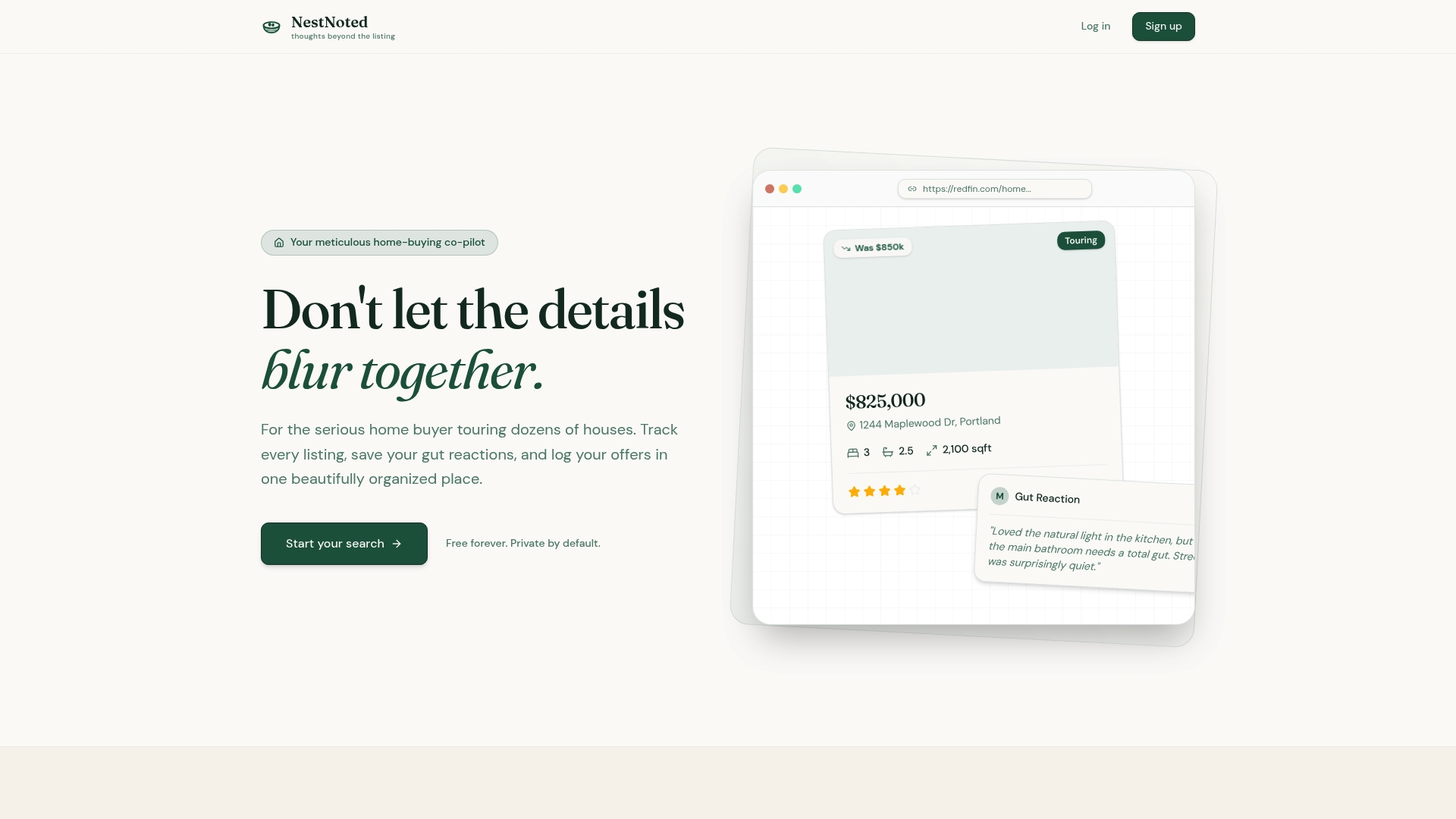
- Private notes on every property toured, kept confidential to help maintain honest impressions.
- Contingency reminders that flag expiration dates and activation windows before they sneak up.
- Side-by-side comparison of competing offers to see terms clearly instead of relying on memory.
- Document storage that keeps lender preapprovals and inspection reports attached to the appropriate property.
If you are managing a backup offer alongside an active search, a private, organized system like the one described in comparing offer terms privately beats scattered notes every time. Create a free NestNoted account and set up your first property before your next tour.
Where to verify the details
For the legal mechanics of backup contracts, see the LegalClarity explainer and NAR's multiple-offer guidance. Always check your state realtor association's own backup addendum for exact wording.
Sources
- A Buyers' and Sellers' Guide to Multiple Offer Negotiations
- Real Estate Backup Offer: What It Is and How It Works - LegalClarity
FAQ
What are the chances of a backup offer being accepted?
Acceptance depends entirely on the seller, who can choose to sign a backup, counter it, or keep negotiating with other buyers instead, a decision authority confirmed in NAR's multiple-offer guidance. A well-prepared offer with solid financing and a flexible closing date tends to improve your odds.
How often do backup offers go through?
Backup offers convert more often than many buyers assume, since roughly 5% to 6% of contracts fail to close in a given quarter, depending on the market. That failure rate is exactly what creates the opening for a backup buyer to move into the primary position.
How do backup offers work?
A backup offer is a signed purchase agreement that stays inactive until the seller cancels the primary contract and delivers written notice, at which point contingency clocks start and the backup becomes a standard active contract. Earnest money for the backup is typically deposited only after activation, though this varies by state form.
Why would a seller accept a backup offer?
Sellers accept backup offers to avoid the cost and delay of relisting if the primary contract falls through, giving them a ready buyer instead of starting the marketing process over. The seller keeps full control throughout, deciding whether to accept, counter, or continue negotiating with the original buyer.