

An escalation clause is a provision in a purchase offer that automatically raises your bid by a set dollar increment above any competing offer, up to a maximum price you choose in advance. According to Realtor.com, the clause only triggers when a bona fide higher offer actually exists — if no one outbids you, you pay your original price.
Three things to know right now:
- When it helps: Multi-offer situations where you want to stay competitive without guessing how high to go upfront.
- Primary risk: If the escalated price exceeds the home's appraised value, your lender (including Freddie Mac-backed loans) typically won't cover the gap — you pay the difference in cash.
- One action to take: Before adding an escalation clause to any offer, set a firm cap with your agent and confirm your lender can fund it.
Key Takeaways
An escalation clause only protects you when it's paired with a firm cap, a verification requirement, and a clear-eyed look at your appraisal and lender limits.
| Point | Details |
|---|---|
| Three core elements | Every escalation clause needs an initial offer, a dollar increment, and a maximum cap. |
| Appraisal gap risk | If the escalated price exceeds appraised value, your lender won't cover the gap — you pay it in cash. |
| Verification is non-negotiable | Require a redacted copy of any competing offer; without it, you can't confirm the trigger was legitimate. |
| When to skip it | In slow markets or when a seller calls for highest-and-best, a clean strong offer usually wins. |
| Nestnoted for tracking | Nestnoted lets you log caps, comps, and offer history privately so your maximum is based on numbers, not emotion. |
Table of Contents
- What are the basics of an escalation clause?
- How does an escalation clause work? A numeric example
- Pros, cons, and when you should actually use an escalation clause
- What are the biggest financial risks of escalating your offer?
- How to draft a safe escalation clause and what to avoid
- What are the alternatives to an escalation clause?
- Questions to ask your agent and attorney before adding an escalator
- Track your offers and caps before you set your maximum
- The honest case for treating escalators as a last resort
- Nestnoted helps you stay organized when offers get competitive
- Sources
What are the basics of an escalation clause?
An escalation clause, sometimes called an escalator clause, has three core components. Miss any one of them and the clause either fails to trigger or exposes you to unexpected costs.
The three required elements:
- Initial bona fide offer: Your starting purchase price — a real, good-faith number you'd accept if no competing offers existed. This is not a throwaway low bid; it's the floor of your negotiation.
- Escalation increment: The fixed dollar amount by which your offer beats any competing offer. If you choose a fixed dollar increment and a competitor bids a certain amount, your offer becomes that amount plus the increment.
- Maximum cap: The absolute ceiling you will pay, no matter how many competing offers exist. Once your escalated price hits this number, it stops — you either win at the cap or lose the home.
Short glossary for clause language you'll encounter:
- Bona fide offer: A legitimate, written offer from a real buyer — not a verbal claim or an inflated number the seller invents.
- Increment: The beat amount, stated in dollars (e.g., "$2,500 above any competing offer").
- Cap: Your maximum price, written explicitly into the clause.
- Gross vs. net proceeds: Gross price is the total contract price; net proceeds subtract seller concessions. Specifying which basis triggers escalation matters — a mismatch can mean your clause never fires when you expect it to.
The clause sits dormant unless a higher competing offer arrives. That single mechanic is what makes it useful in a hot market and irrelevant in a slow one.
How does an escalation clause work? A numeric example
The mechanics become clear with numbers. Here's a step-by-step walkthrough.
- Suppose you submit an initial offer on a home with a certain price, specifying an escalation increment and a maximum cap.
- When a competing offer arrives at a certain price, your clause triggers and increases your offer by the increment above that competing offer.
- If another competing offer comes in that would exceed your cap when increased by the increment, your offer stays at your cap.
- If no competing offer exceeds your initial offer, you pay your original offer price.
One complication worth knowing: Freddie Mac notes that when multiple buyers use escalation clauses, the offers can leapfrog each other automatically until someone's cap is hit. In a four-buyer scenario, this can push prices to the highest cap in the room fast.
Here's a sample clause structure your agent can adapt:
Red flag to watch: Any clause that skips the verification requirement — the part where the seller must show you the competing offer — leaves you exposed to phantom bids. LegalClarity's drafting guidance treats verification as non-negotiable.
Pros, cons, and when you should actually use an escalation clause
Business Insider's breakdown frames it well: escalation clauses help buyers stay competitive in multiple-offer situations while avoiding overpaying — but their value depends entirely on market conditions and how the seller chooses to handle competing offers.
Pros:
- You stay in the running without submitting your highest number upfront.
- The clause signals seriousness to the seller without requiring a blind guess.
- You only pay what's needed to beat the competition, not a dollar more (up to your cap).
Cons:
- Your cap is visible to the seller, which reveals your ceiling and weakens future negotiation leverage.
- An escalated price can outrun the home's appraised value, creating a cash gap at closing.
- Some sellers simply dislike them. Realtor.com reports that sellers sometimes prefer clean, straightforward offers and may call for a highest-and-best round instead of accepting escalators.
Use an escalation clause if:
- You're in a confirmed multi-offer situation and your agent has intelligence on competing bids.
- You have a clear budget ceiling and can fund a potential appraisal gap.
- The seller's agent has confirmed escalators are acceptable.
Skip it if:
- The seller has already requested highest-and-best offers — an escalator at that stage often reads as evasive.
- You're in a slow market with little competition; a strong clean offer closes faster.
- You can't cover a cash shortfall if the escalated price exceeds appraisal.
What are the biggest financial risks of escalating your offer?
The appraisal gap is the risk most buyers underestimate. Here's how it plays out in practice.
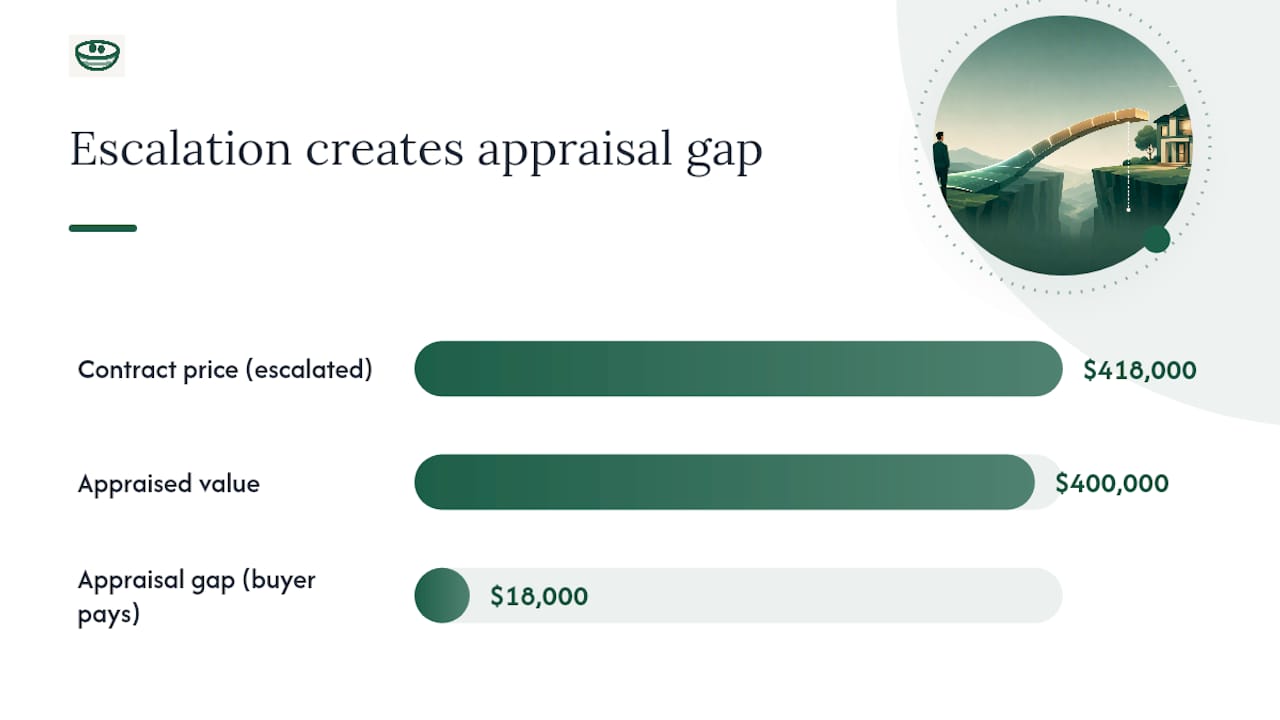
Say your escalation clause pushes your offer to $418,000. The home appraises at $400,000. The $18,000 gap between the appraised value and your contract price? That comes out of your pocket at closing, on top of your down payment. Experian's guidance on escalation clauses is direct: lenders generally won't fund above appraised value, and buyers must cover the difference in cash or renegotiate.
Key risks to plan for:
- Appraisal shortfall: The escalated price exceeds what the appraiser determines the home is worth.
- Lender cap: Your pre-approval amount may not stretch to cover the escalated price, especially if the gap is large.
- Multi-escalator chains: When several buyers use escalation clauses, prices can climb to the highest cap automatically, leaving the winner with a large appraisal gap to cover.
- Verification failure: Without proof of a bona fide competing offer, you have no way to confirm the trigger was legitimate.
Before you set your cap, confirm three numbers with your lender: your pre-approval ceiling, the maximum loan amount at the expected appraised value, and how much cash you can bring to close a gap. A progressive payment schedule can also help you map out what cash reserves you'll need at each stage of closing.
Statistic to keep in mind: Appraisal gaps are most common in fast-moving markets where sale prices consistently run above list price — the same conditions that make escalation clauses attractive in the first place.
How to draft a safe escalation clause and what to avoid
A well-drafted clause protects you. A sloppy one can cost you thousands or leave you in a contract dispute.
Every safe escalation clause needs these elements:
- A clear initial offer price (your floor).
- A specific dollar increment stated in the clause.
- An explicit maximum cap, written as a dollar amount.
- A verification requirement: the seller must provide a redacted copy of any competing offer used to trigger escalation.
- Gross vs. net proceeds language: state whether escalation compares gross contract price or net proceeds after seller concessions.
- An appraisal contingency that protects you if the escalated price exceeds appraised value.
- A clause specifying what happens if your cap is exceeded — typically, the offer lapses or you have the option to match.
Common red flags in clause language:
- No verification requirement — leaves you unable to confirm a competing offer was real.
- Vague trigger language ("in the event of other offers") without specifying bona fide written offers.
- No gross/net clarification — a seller offering concessions can manipulate which number triggers your escalation.
- Missing appraisal contingency — you're on the hook for any gap.
Pro Tip: Set your increment based on the market's typical price gap between competing offers, not on a round number that feels comfortable. RISMedia recommends increments of $5,000 or more in many markets — a $1,000 increment in a competitive city market signals you're not serious. Your agent's recent comp data is the right input, not intuition.
What are the alternatives to an escalation clause?
An escalation clause is one tool, not the only one. Several strategies can be equally effective depending on the seller's priorities.
Alternatives worth considering:
- Submit your highest-and-best offer upfront. In a seller's market, a clean, strong number with no conditions often beats an escalator — sellers know exactly what they're getting.
- Increase earnest money or down payment. A larger earnest money deposit signals financial strength and commitment without revealing a price ceiling.
- Shorten contingency periods. A faster inspection or financing timeline reduces the seller's risk and can tip a close decision.
- Offer a flexible closing date. Sellers who need time to find their next home often value timeline flexibility over a few thousand dollars.
- Waive minor contingencies carefully. Only waive what you've genuinely assessed — waiving an inspection contingency on a 1950s home without a pre-inspection is a gamble, not a strategy.
When a strong initial offer beats an escalator: if your agent's intel suggests one or two other buyers are in the mix and the seller prefers simplicity, a clean offer at your true maximum is cleaner and harder to dismiss. When an escalator wins: if you genuinely don't know how many competing offers exist and you want to stay in the running without overshooting, the clause lets the market set the price up to your limit.
Some buyers combine both: a strong initial offer that's already above list, plus a modest escalator with a tight cap. That signals seriousness at the starting price while still covering a surprise competing bid.
Questions to ask your agent and attorney before adding an escalator
Run through this checklist before your agent submits any offer with an escalation clause.
- Will the seller accept escalation clauses? Some sellers' agents reject them outright or call for highest-and-best instead — confirm before drafting.
- How will competing offers be verified? Ask specifically whether the seller will provide redacted copies of competing offers.
- Can your lender fund the cap? Confirm your pre-approval covers your maximum price and ask what happens if the appraised value falls short.
- Is an appraisal contingency included? If the escalated price exceeds appraisal, you need an exit or renegotiation right.
- Is escalation based on gross price or net proceeds? Clarify this before signing — it changes when and how the clause fires.
- What happens if your cap is exceeded? The clause should specify whether your offer lapses or you have a right to match.
Ask your agent or attorney to:
- Review the verification language and confirm it requires a written, redacted competing offer.
- Confirm the gross vs. net proceeds basis matches how the seller's agent calculates competing offers.
- Check whether the appraisal contingency language in your escalation clause aligns with the rest of your purchase agreement.
For a broader pre-offer workflow, the home buying checklist for serious buyers covers the full sequence from pre-approval to closing.
Track your offers and caps before you set your maximum
The most common escalation mistake isn't a drafting error — it's setting a cap based on emotion rather than numbers. Buyers who've toured 15 homes and fallen in love with one tend to push their cap higher than their lender, their comps, or their cash reserves actually support.
A simple tracking routine prevents that. Before submitting any offer with an escalation clause, log these five data points somewhere private:
- Your pre-approval ceiling (the hard lender limit).
- Recent comparable sales (comps) for the property.
- The maximum cash you can bring to close an appraisal gap.
- Your initial offer price and the increment you're considering.
- The cap you're considering — and whether it's above the highest comp.
If your cap exceeds the highest recent comp by more than your available cash cushion, you're setting yourself up for a gap you can't cover. That's the number that should set your ceiling, not how much you want the house.
Pro Tip: Use a private property tracker to log these figures for every property you're considering an offer on. Keeping them in one place, separate from your email thread and your agent's texts, means you're comparing numbers — not memories — when the moment comes.

Organizing offers, caps, proofs, and appraisal comps in a private tracker prevents emotional overbidding and helps buyers choose caps based on lender limits and comps, not impulse — a point Freddie Mac's homebuying guidance supports directly.
The honest case for treating escalators as a last resort
Escalation clauses get a lot of attention in hot markets, and the mechanics are genuinely useful. But the framing that bothers me is the idea that adding one is a low-risk move — a way to "let the market decide" your price. It isn't. You're handing the seller a window into your ceiling, and in a negotiation, that's a real concession.
The buyers who use escalation clauses well are the ones who've already done the math: they know their pre-approval limit, they've run the comps, and they've confirmed with their lender exactly how much of an appraisal gap they can absorb. For them, the clause is a precision tool. For everyone else, it's a way to accidentally commit to a price they can't fund.
The verification requirement is where most buyers get sloppy. Requiring a redacted copy of the competing offer isn't just a formality — it's the only thing standing between you and a seller who claims a competing offer exists when it doesn't. LegalClarity's drafting guidance treats this as the single most important clause element, and I'd agree. Before you sign anything with an escalation clause, have your agent or a real estate attorney read the verification language specifically.
Nestnoted helps you stay organized when offers get competitive
Bidding wars move fast. The buyers who make clear-headed decisions under pressure are the ones who already have their numbers written down somewhere private before the competing offer arrives.

Nestnoted is built for exactly that moment. Instead of piecing together your cap, comps, and lender limit from a chain of texts and emails, you keep everything in one private workspace — your offer history, property notes, appraisal comps, and side-by-side comparisons, all confidential by default. No spreadsheet to lose, no notes scattered across apps.
- Log your initial offer, increment, and cap for each property you're tracking.
- Store appraisal comps and lender pre-approval details privately, away from shared portals.
- Use side-by-side comparisons to see which properties are worth escalating on and which aren't.
- Collaborate with your agent in a shared workspace without exposing your notes publicly.
Start organizing your offers with Nestnoted — free to use, with all core features available from day one.
Sources
- Should My Offer Include an Escalation Clause? - My Home by Freddie Mac
- How to Write an Escalation Clause in Real Estate - LegalClarity
- What Is an Escalation Clause?
- What is an Escalation Clause? — Experian
This article is general information, not a substitute for advice from a qualified lawyer. Consult a qualified legal professional about your own circumstances before acting on anything here.