

Most financed home purchases close in 30 to 45 days from an accepted offer; cash deals can close in 7 to 21 days. The single move that keeps either timeline on track is entering your acceptance date and target close date into a tracker on day one, then letting every deadline (inspection, appraisal, financing, Closing Disclosure) auto-fill from those two anchors. Skip that step and you're relying on memory and scattered emails to catch a deadline that, if missed, can push your closing date by weeks.
TL;DR:
- Most financed home closings take between 30 to 45 days, but relying on a tracker from day one is crucial to avoid missed deadlines.
- Appraisals, underwriting, and title work are the main sources of delays, especially when appraisal values come in low or title issues arise.
- Starting from two anchor dates and working backward helps ensure enough time to meet federal and lender-specific milestones, like the three-day Closing Disclosure rule.
- Consistent tracking and clear communication with your agent, lender, and title company reduce stress by eliminating uncertainty about upcoming deadlines.
- Using a dedicated tool like NestNoted streamlines deadline management, notes, and sharing schedules to prevent last-minute surprises during closing.
Table of Contents
- Average Time to Close on a House: What to Expect
- What Are the Steps in a Home Closing Timeline?
- How Long Does Each Closing Stage Take, and What Causes Delays?
- How to Track a Closing Timeline Without Losing Your Mind
- How NestNoted and a Disciplined Reminder System Keep You on Schedule
- Why Buyers Who Track Dates Lose Less Sleep
- Turn This Timeline Into Your Own Tracked Schedule
- Where to Verify Closing Rules and Build Your Own Schedule
- Sources
- FAQ
Average Time to Close on a House: What to Expect
A conventional loan typically closes in 30 to 45 days after the seller accepts your offer, according to a closing timeline calculator built around this data. Cash purchases skip mortgage underwriting entirely, so they can wrap up in as little as one to three weeks. New construction and complex transactions, meanwhile, routinely stretch past 60 days because they add builder schedules, permits, and sometimes land surveys into the mix.
The gap between the fastest and slowest closings comes down to a handful of variables:
- Lender processing speed varies widely between banks, credit unions, and online lenders, even for the same loan type.
- Appraisal scheduling depends on local appraiser availability, which tightens in hot markets.
- Title issues like unresolved liens or boundary disputes can add days or weeks with no warning.
- Inspection negotiations over repair credits sometimes reopen contract terms and reset the clock.
| Financing Type | Typical Closing Window |
|---|---|
| Conventional loan | 30 to 45 days |
| FHA or VA loan | typically 30 to 45 days |
| Cash purchase | typically about 7 to 21 days |
| New construction | often 60 days or more |
What Are the Steps in a Home Closing Timeline?
Every closing moves through the same core milestones, but the exact number of days at each stage depends on your lender, your market, and how clean the property's title turns out to be. Here's the order, with realistic windows for each step.
- Effective date (offer acceptance). This is day zero. Every other deadline in your contract, inspection period, appraisal contingency, financing contingency, gets calculated from this date, so confirm it in writing with your agent before you do anything else.
- Inspection period (typically 7 to 15 days). You schedule the home inspection, review the report, and negotiate repairs or credits with the seller. This window is often the first place a timeline slips, since re-negotiation can eat several extra days.
- Appraisal ordered and completed (roughly 1 to 2 weeks). Your lender orders the appraisal once you're under contract. A low appraisal doesn't just delay things, it can force a renegotiation of price or a larger down payment, which pushes underwriting back further.
- Underwriting and conditional approval (2 to 4 weeks, often overlapping with the above). The underwriter reviews income, assets, credit, and the appraisal, then issues conditions you or your lender need to clear.
- Clear to Close (CTC). This milestone means the lender has satisfied every underwriting condition and is ready to draw final documents, according to Rocket Mortgage's explanation of the process. Lenders generally recommend hitting CTC at least 5 business days before your scheduled closing to leave room for the Closing Disclosure waiting period.
- Title search and title commitment. Run in parallel with underwriting, this step checks for liens, ownership disputes, and easements. Problems here, an unreleased lien from a previous owner, for example, are among the most common last-minute delays.
- Closing Disclosure (CD) issuance and the 3-business-day wait. Federal TRID rules require you receive the CD at least three business days before closing. If your loan terms change materially after that, the clock resets to zero.
- Final walkthrough. Usually scheduled 24 to 48 hours before closing, this confirms the home is in the agreed condition and any negotiated repairs were completed.
- Closing day. You sign the final paperwork, funds are wired or a cashier's check is delivered, and the title transfers.
Pro Tip: Treat your Clear to Close date, not your closing date, as the milestone to protect. Everything downstream of CTC is mostly paperwork; everything upstream is where delays actually happen.
How Long Does Each Closing Stage Take, and What Causes Delays?
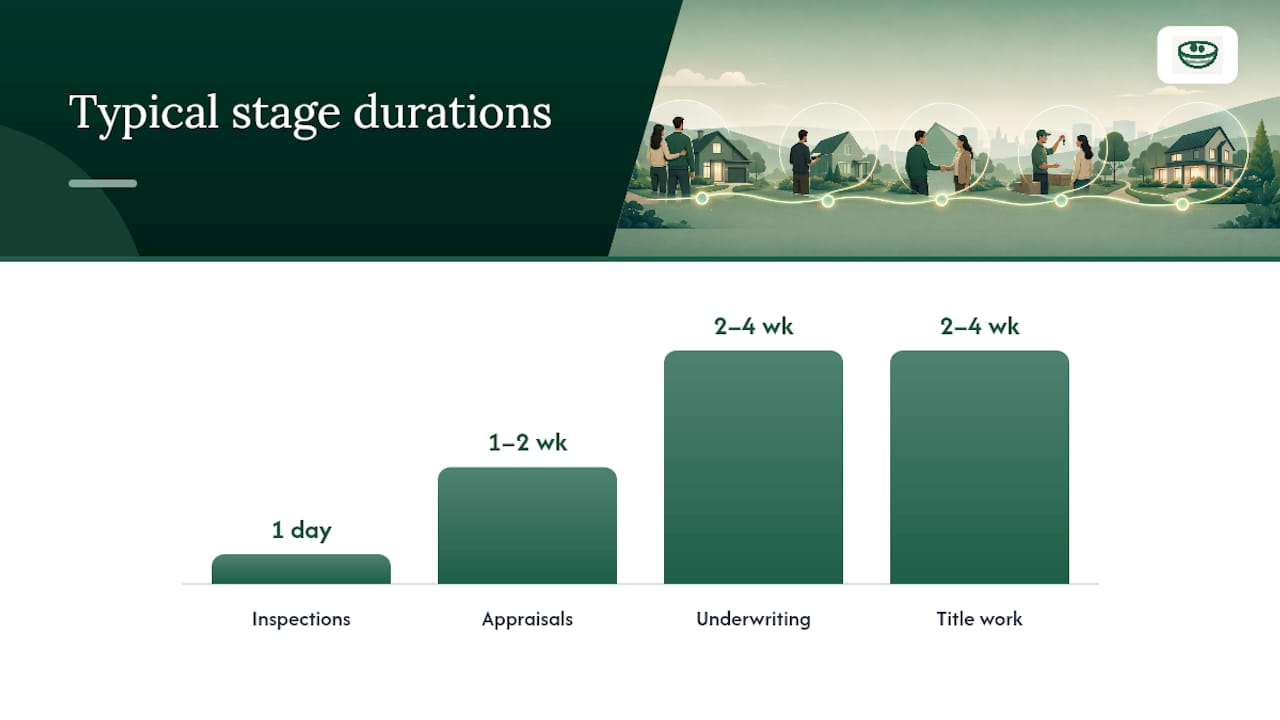
Inspections generally take a single day to complete but can extend the negotiation period by a week if repair requests go back and forth. Appraisals take one to two weeks from order to report, though a revision request (common when the initial value comes in low) adds several more days. Underwriting is the longest variable stage, often two to four weeks, and title work usually finishes within that same window unless a lien or ownership question surfaces.
The delays that actually blow up a closing date tend to come from a short list of repeat offenders:
- A TRID reset triggered by a last-minute rate lock change, credit adjustment, or added fee.
- An appraisal that comes in below contract price, forcing renegotiation or a bigger down payment.
- A title defect, like an old lien, that requires a payoff or legal resolution before the title company will issue a clean commitment.
- Missing lender documents, pay stubs, bank statements, letters of explanation, that sit in someone's inbox instead of getting uploaded.
A transaction tracker that lays out every milestone from your two anchor dates typically covers 50 to 70 individual tasks across the five phases of a closing. That volume is exactly why relying on memory or a string of text messages tends to fail: there are simply too many moving parts for any one person to hold in their head. When your loan officer gives you a status update, ask specifically whether underwriting conditions are "cleared" or just "received", those are not the same thing, and the gap between them is where most surprise delays hide.
How to Track a Closing Timeline Without Losing Your Mind
Start with two dates: your acceptance date and your target close date. Everything else, inspection deadline, appraisal contingency, financing contingency, CD issuance, should be calculated backward and forward from those anchors rather than tracked as isolated events. Professional agents lean on this anchor-date approach because it forces every intermediary deadline to update automatically if one milestone shifts, instead of leaving you to manually recalculate a dozen dates by hand.
Backward scheduling matters more than most buyers realize. Instead of just counting forward from acceptance, work backward from your desired closing date: if you want to close on the 30th, your lender needs Clear to Close by roughly the 23rd or 25th to leave a safe buffer for the TRID three-day wait. Build in that cushion deliberately rather than hoping everything lines up on its own.
A few tracking habits make the difference between a smooth close and a scramble:
- Keep a shared calendar with your agent, lender, and title company so everyone sees the same dates.
- Use a printed or exported transaction schedule you can reference offline during calls.
- Separate a "deadline" column from a "removal confirmed" column so you know whether a contingency has simply expired or was formally waived in writing.
- Check status weekly at minimum, daily during the final two weeks before closing.
| Milestone | Target Timing Relative to Close |
|---|---|
| Clear to Close | 5 to 7 business days before |
| Closing Disclosure issued | At least 3 business days before |
| Final walkthrough | 1 to 2 days before |
| Funds/wire confirmation | Day of closing |
If a deadline is 48 hours out and you haven't heard back from your lender or title company, that's your cue to call, not email and wait. A mortgage document checklist can help you spot which paperwork gaps are most likely to hold up underwriting before they become urgent.
How NestNoted and a Disciplined Reminder System Keep You on Schedule
A tool can turn your acceptance date and target close date into a full deadline map instead of a blank spreadsheet you have to build yourself. Enter those two date once, and the tool materializes your inspection window, appraisal timing, and financing deadlines around them, the same anchor-date logic professional agents already use.
A workflow that holds up under pressure usually includes:
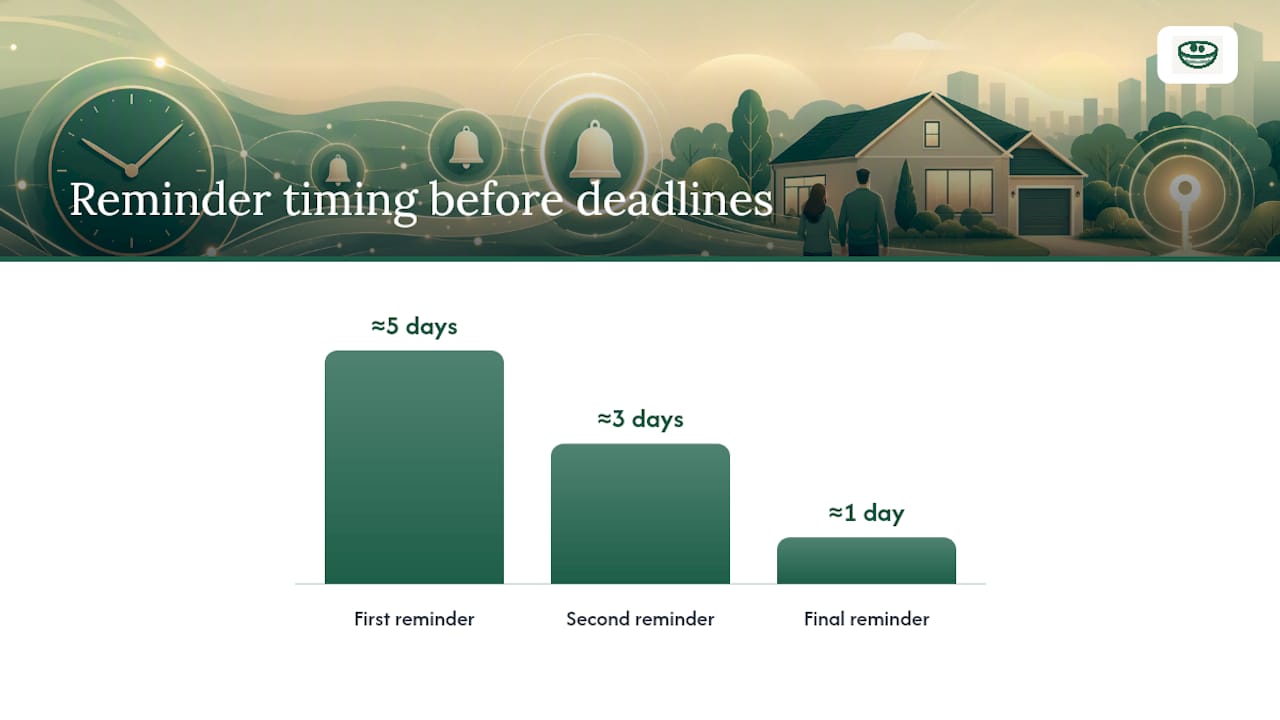
- Setting reminders roughly 5, 3, and 1 days ahead of each contingency deadline, not just on the day it's due.
- Keeping "deadline" and "removal confirmed" as separate fields so there's no ambiguity about whether a contingency was waived or simply expired.
- Exporting a shareable PDF timeline for your agent, lender, and title company so everyone works from one source of truth.
- Logging private notes on each property, inspection concerns, appraisal conversations, without those details getting lost in a group text.
Why Buyers Who Track Dates Lose Less Sleep
The buyers who handle closing the best aren't the ones with the fastest lenders. They're the ones who know exactly which deadline is next and who's responsible for it. Most of the stress in a transaction comes from uncertainty, not from the actual work of closing, and uncertainty disappears the moment you can see every date laid out in front of you. If you take one thing from this guide, make it this: set your anchor dates the day your offer is accepted, and let the rest of the schedule build itself from there.
— Antony
Turn This Timeline Into Your Own Tracked Schedule
Every workflow in this guide, anchor dates, milestone tracking, a shareable export, is exactly what NestNoted was built to handle for you. Instead of juggling a spreadsheet or a chain of text messages with your agent, you get one private, organized place to watch your closing move from accepted offer to keys in hand.

Inside your account, you can:
- Enter your acceptance date and target close date and let deadlines populate automatically.
- Keep private notes on inspection findings, appraisal conversations, and lender conditions, visible only to you unless you choose to share them.
- Export a timeline you can hand to your agent, lender, or title company so everyone works from the same dates.
Create a free NestNoted account today and map your own contract to close before your next deadline sneaks up on you.
Where to Verify Closing Rules and Build Your Own Schedule
For the federal rule on Closing Disclosure timing, consult the CFPB's guidance on closing disclosures. For a starting point on milestone math, a closing timeline calculator helps, but always confirm final dates with your lender, title company, and agent directly.
Sources
- What is a closing disclosure? (CFPB)
- Closing timeline calculator (HomeExpertly)
- Real estate transaction tracker — DashLoops
- What does clear to close mean? (Rocket Mortgage)
FAQ
What Is a Typical Closing Timeline?
A financed home purchase typically closes in 30 to 45 days from accepted offer, while cash purchases can close in 7 to 21 days, according to industry timeline data. New construction or complex deals often take 60 days or more.
What Is the Three-Day Rule for Closing?
Federal TRID rules require lenders to give borrowers the Closing Disclosure at least three business days before closing. If loan terms change materially after that, the waiting period restarts.
What Are the Steps of the Closing Process?
The process moves from offer acceptance through inspection, appraisal, underwriting, Clear to Close, title commitment, Closing Disclosure issuance, final walkthrough, and closing day, in roughly that order, though several stages overlap.
What Is the Typical Timeline for a Clear to Close?
Clear to Close typically arrives after two to four weeks of underwriting, and lenders recommend hitting it at least 5 business days before your scheduled closing to leave room for the mandatory CD waiting period.
How Can I Track My Closing Deadlines Without Missing One?
Set your acceptance date and target close date as anchors, then use a tracker like NestNoted or a transaction tracker to auto-generate every deadline, checking status at least weekly and daily in the final two weeks.