

The single highest-leverage fix is simple: stop touring homes until you have real mortgage pre-approval and a total housing budget that includes taxes, insurance, HOA dues, and maintenance, not just a monthly payment estimate. The next two most urgent house hunting mistakes are waiving inspections to win a bidding war and letting emotion set your top offer. Fix those three, tour only homes in your verified range, and score each one against a written checklist.
TL;DR:
- Buyers should obtain pre-approval before touring homes to avoid overpaying and to ensure sellers trust their financing ability.
- Setting a firm maximum bid and writing it down prior to offers helps prevent emotional bidding and overextending during negotiations.
- Conducting thorough neighborhood research on commute times, schools, and resale factors reduces future surprises and investment risks.
- Using a detailed checklist, photos, and notes at every showing prevents confusion and missing critical home flaws during multiple house tours.
- Verifying zoning, permits, and the history of renovations can reveal hidden issues that might complicate future resale or violate regulations.
Table of Contents
- The Top 10 House Hunting Mistakes First-Time Buyers Make
- The Financial Mistakes That Cost the Most Money
- How to Protect Your Due Diligence in a Competitive Market
- Why Neighborhood Research Beats Staging Every Time
- Getting Organized on Tours Prevents the Worst Mistakes
- Timing the Market and Seasonal House Hunting Trends
- Common Pitfalls in Making Offers
- Not Considering Future Personal and Market Changes
- Failing to Verify Zoning and Legal Restrictions
- Ignoring Renovations and Undisclosed Defects
- Misunderstanding Contingencies Beyond Inspection
- An Author's Perspective: The One Habit That Prevents Most Regret
- An Organizational Tool Built for Serious Home Buyers
- Sources
The Top 10 House Hunting Mistakes First-Time Buyers Make
Most house hunting mistakes fall into three buckets: money problems, due diligence shortcuts, and plain disorganization. Here's the full list, ranked roughly by how much they cost you.
1. Touring homes without pre-approval. A pre-qualification is a guess based on what you told a loan officer. A pre-approval is a lender's underwritten commitment based on verified income, credit, and assets, and it's what sellers actually trust. Skipping it commonly leads buyers to overpay by a few percent once they finally do get financed, because they've fallen for a house before knowing what they can actually borrow. Fix: get pre-approved before your first showing, not after your third offer gets rejected.
2. Setting a budget you can't actually sustain. Going house-poor happens when the mortgage fits on paper but nothing else does. Fix: run your numbers against the CFPB's affordability guidance before you fall for anything above your range.
3. Waiving inspection or appraisal contingencies. This is the single riskiest concession in a hot market. Fix: negotiate a shorter inspection window instead of no inspection at all.
4. Not shopping lenders. Buyers who accept the first-rate quote leave real savings on the table over the life of the loan. Fix: get quotes from at least three lenders within the same two-week window so the credit inquiries count as one pull.
5. Bidding emotionally in a multiple-offer situation. Falling in love with a kitchen and chasing a bidding war past your limit is how buyers end up underwater on value. Fix: set your absolute ceiling in writing before you ever submit an offer.
6. Buying at the very top of your pre-approval. Pre-approval tells you the maximum a lender will hand you, not what you should spend. Fix: treat your pre-approval number as a wall, not a target.
7. Ignoring neighborhood and resale factors. A gorgeous renovation on a block with a failing school district or a 45-minute reverse commute is a resale problem waiting to happen. Fix: research the area as hard as you research the house.
8. Skipping the title search or title insurance. Liens, boundary disputes, and unresolved ownership claims don't show up on a walkthrough. Fix: never waive title insurance to save a few hundred dollars at closing.
9. Moving money or opening new credit before closing. A new car loan or a big furniture purchase between pre-approval and closing can change your debt ratios enough to sink financing. Fix: freeze all credit activity until keys are in your hand.
10. Losing track of details across a dozen showings. Buyers who tour eight houses in two weekends routinely mix up which one had the leaky basement and which one had the good light. Buyer checklists commonly recommend bringing an agent, taking notes, and photographing every room, precisely because memory fails fast under volume.
The Financial Mistakes That Cost the Most Money
Money mistakes dwarf the rest of this list in dollar terms, and three specific errors do most of the damage.
Pre-approval versus pre-qualification isn't a technicality. Pre-qualification is a soft estimate; pre-approval means a lender has verified your income, assets, and credit and is ready to fund. In a competitive market, sellers routinely favor a pre-approved buyer over a higher offer backed by a mere pre-qualification, because pre-approval signals the deal will actually close.
The 28/36 rule still works as a gut check. No more than 28% of gross monthly income should go to housing costs (principal, interest, taxes, insurance), and no more than 36% to total debt including the mortgage. Pair that with the "1% rule" for maintenance: budget roughly 1% of the home's value every year for upkeep and repairs. On a $400,000 house, that's $4,000 annually that a lot of first-time buyers forget to plan for.
The overbid math: Skipping pre-approval and shopping without a firm ceiling commonly leads buyers to overpay by a few percent on the purchase price. On a $350,000 home, that's $7,000 to $14,000 walked straight into the mortgage, compounding with interest for 30 years.
Practical tactics that actually hold the line:
- Set a firm maximum bid in writing before your first offer, and don't renegotiate it in the heat of a bidding war.
- Earmark cash reserves specifically for an appraisal gap, since lenders won't finance the difference between an appraised value and an inflated sale price.
- Use escalation clauses carefully. They can win a deal, but they also telegraph your ceiling to a savvy seller's agent.
- Get quotes from three lenders and compare the annual percentage rate, not just the headline interest rate. A mortgage calculator makes it easy to see how small rate differences move your monthly payment and total cash to close.
How to Protect Your Due Diligence in a Competitive Market
An inspection contingency lets you walk away or renegotiate if a home has serious problems. An appraisal contingency protects you from being forced to close if the bank's appraised value comes in below the price you agreed to pay. Waive both, and you're financially exposed with no exit. Buyers who skip inspections face a median undiscovered repair cost of roughly $14,000 in the first year of ownership.
You don't have to choose between losing the house and skipping due diligence entirely. Compromise tactics that work in hot markets include shortening the inspection window to 5 to 7 days, or paying for an information-only pre-offer inspection so you know what you're bidding on before you even write the offer. For older homes, add specialist inspections: a sewer scope, a roof assessment, and an HVAC checkup catch problems a general inspector often misses.
Ask your inspector directly about the roof's remaining lifespan, any moisture signs in the crawlspace or attic, and the age of the electrical panel. Those three questions surface the most expensive surprises.

Pro Tip: Bring a flashlight and check under every sink and around every toilet base yourself before the inspector even arrives. Water stains you spot in five minutes can save you an entire negotiation.
Why Neighborhood Research Beats Staging Every Time
- Drive the commute at rush hour, not on a quiet Sunday. The 12 minutes Google Maps promises can become 35 minutes with real traffic.
- Pull school district ratings and permit history, even if you don't have kids. Both affect resale value.
- Check comparable sales and the listing's own history. A property that's had two price reductions and 60 days on market is telling you something the photos don't.
- Score each neighborhood against your own top 3 to 5 priorities (commute, schools, walkability, safety) on a simple 1 to 5 scale before you fall for a kitchen.
Getting Organized on Tours Prevents the Worst Mistakes
Disorganization is quietly one of the most expensive house hunting mistakes, because it causes the others. Buyers who lose track of which house had which flaw end up making rushed, emotional offers just to end the confusion.
A workable process looks like this: a pre-tour checklist for every showing, timestamped photos of each room, a quick 1 to 5 rating against your non-negotiables, centralized notes instead of scattered texts, and a running log of every offer deadline.
- Rate each home immediately after leaving, while details are still fresh.
- Photograph problem areas separately from the pretty ones.
- Track every contingency deadline in one place, not in your head.
This is exactly the gap a private tool like Nestnoted is built to close, letting you log impressions, ratings, and offer details on every property without digging through text threads or a messy spreadsheet.
Pro Tip: Rate a house honestly the moment you're back in the car, before you talk yourself into it or out of it on the drive home.
Timing the Market and Seasonal House Hunting Trends
Spring brings the most listings and the most competition; buyers who tour in March through May typically face more bidding wars and tighter timelines. Late fall and winter see fewer new listings, but the buyers who are still shopping tend to be serious, and sellers who haven't moved their home by then are often more motivated to negotiate on price or closing costs.
That doesn't mean winter is automatically the smarter play. Fewer listings means less to choose from, and if your job or lease has a hard deadline, waiting for a seasonal dip you can't control is its own mistake. What matters more than the calendar is your own local market's inventory level right now. A market with rising days-on-market and price cuts favors patience and negotiation. A market with multiple offers on everything under $400,000 favors speed and a tight pre-approval.
Rate hikes and local job growth shift these patterns year to year, so treat national headlines about "the best month to buy" skeptically. Check your target zip code's actual inventory and average days on market instead of assuming a nationwide seasonal rule applies to your street.
Common Pitfalls in Making Offers
Lowballing a motivated seller in a balanced or hot market often backfires. It signals you're not serious, and in a multiple-offer situation it can knock you out of consideration before negotiations even start. On the flip side, offering full asking price on a home that's sat for 90 days with no other interest wastes leverage you already had.
The fix is reading the seller's actual motivation, not just the listing price. A property with a job-relocation deadline, an estate sale, or a contingent sale on the seller's next home often has room to negotiate on price, closing timeline, or repair credits, even if the listing looks firm. A property that just hit the market in a tight inventory area, with a seller in no rush, usually doesn't.
Ask your agent to find out days on market, any prior price changes, and why the seller is moving. Ignoring seller motivation and applying the same offer strategy to every house is one of the more avoidable house buying pitfalls on this list, because the information is usually available for the asking.
Not Considering Future Personal and Market Changes
A house that fits your life today can stop fitting in three years. Buyers routinely skip questions like: will this commute still work if the job changes? Is there room for a second child? What happens to the neighborhood if the empty lot next door gets developed?
Market changes matter just as much as personal ones. Interest rates that reset on an adjustable mortgage, planned commercial development nearby, or a school district redrawing boundaries can all move a home's value or livability without you doing anything wrong. Ask your agent about pending zoning applications or development plans in the immediate area before you commit. A five-year outlook, even a rough one, catches problems a walkthrough never will.
Failing to Verify Zoning and Legal Restrictions
Zoning determines what you can legally do with a property, and it's one of the most overlooked house hunting mistakes because it never comes up on a tour. A charming detached garage might be a legal accessory dwelling unit, or it might be an unpermitted structure the city could force you to remove. A backyard that looks perfect for an addition might sit in a setback zone that prohibits building closer to the property line.
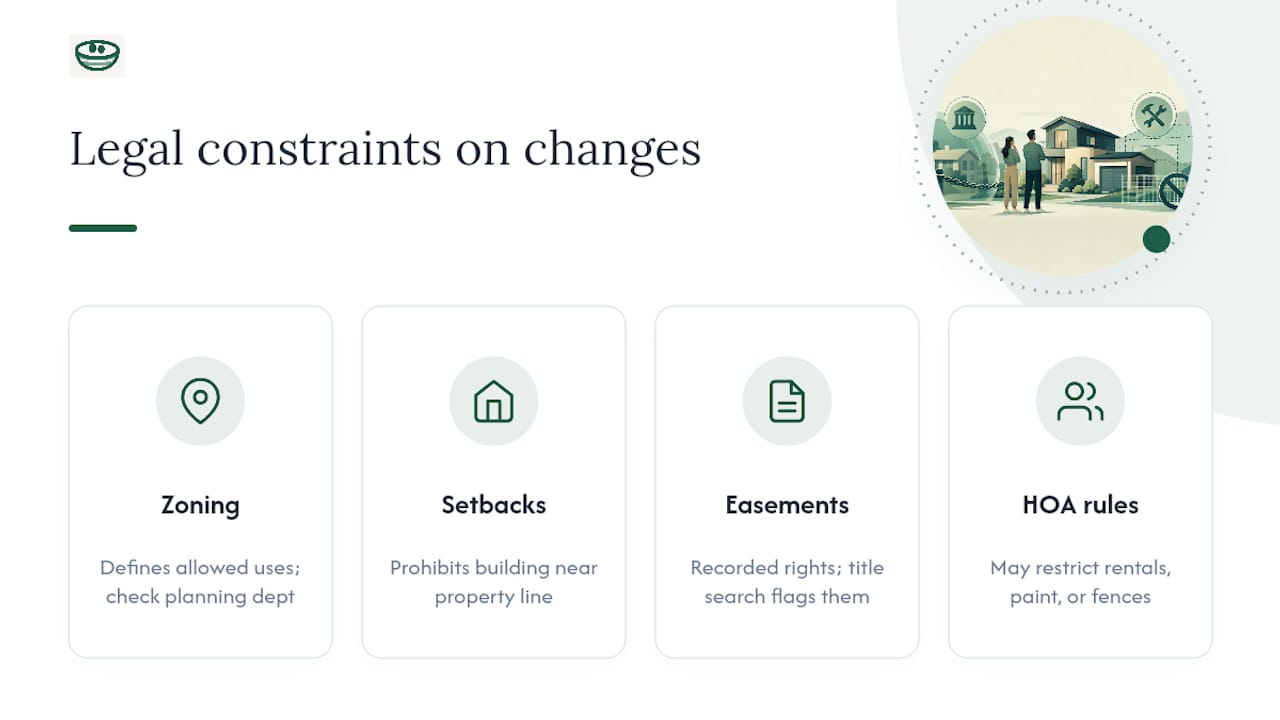
Pull the zoning classification and any recorded easements or deed restrictions before you write an offer, not after. Local planning department websites usually post this for free, and a title company can flag existing easements during the title search. Homeowners association rules deserve the same scrutiny. Some HOAs restrict rentals, exterior paint colors, or even the type of fence you can install, details that matter enormously if your plans depend on any of them.
Ignoring Renovations and Undisclosed Defects
A freshly renovated kitchen is a selling point, and it's also a place sellers sometimes hide shortcuts. Ask specifically whether renovations were permitted, and ask to see the permits. Unpermitted work can complicate your own resale later, and it can signal that other corners were cut where you can't see them.
Disclosure laws require sellers to reveal known material defects, but "known" is the operative word. A seller who never had the roof inspected can honestly disclose nothing, even if it's failing. That's exactly why a general home inspection and, where warranted, specialist inspections for the roof, sewer line, and HVAC system matter more than the seller's disclosure form. Ask your agent for the property's permit history from the local building department; a pattern of unpermitted additions is one of the clearest warning signs in the entire process.
Misunderstanding Contingencies Beyond Inspection
Inspection gets most of the attention, but appraisal and financing contingencies protect you just as much. The appraisal contingency lets you walk away or renegotiate if the bank's appraiser values the home below your offer price, since lenders won't loan more than that appraised value. Without it, you'd need to cover the entire gap in cash to close.
The financing contingency protects you if your loan falls through for reasons outside your control, a job change, a credit issue, or a lender's underwriting surprise. Waiving it means your earnest money is at risk even if the deal collapses through no fault of your own.
Both contingencies come with deadlines, typically 7 to 21 days depending on your contract, and missing one can mean losing the protection entirely even if you never intended to waive it. Track every contingency deadline the moment you go under contract, and confirm with your lender in writing that financing is on schedule before each one passes.
An Author's Perspective: The One Habit That Prevents Most Regret
Every mistake on this list traces back to one failure: buyers act before they've verified their own numbers or written down what they actually saw. Commit to real pre-approval, a written checklist for every house, and a searchable note system for every tour. That single habit, more than any market timing trick or negotiation tactic, is what separates buyers who feel good about their purchase a year later from the ones who don't.
— Antony
An Organizational Tool Built for Serious Home Buyers
If disorganization is the thread running through most of these house hunting mistakes, the fix isn't another spreadsheet you'll abandon by house number six. Nestnoted gives you a private space to log notes, ratings, and offer details on every property you tour, then compare them side by side instead of scrolling through old texts trying to remember which house had the flooded basement.

The platform syncs listing data from major real estate sites, sends price-drop alerts on homes you're tracking, and keeps every note private by default so you and your agent can be candid without worrying about anything leaking into a negotiation. It doesn't replace mortgage pre-approval, a home inspection, or shopping multiple lenders. Those remain the highest-leverage decisions in the entire process. What it does is make sure that once you've done that work, you never lose track of the details that matter. Set up a free account at Nestnoted before your next round of showings and start comparing homes the way a serious buyer should.
This article is general information, not a substitute for advice from a qualified financial advisor. Consult a qualified financial professional about your own circumstances before acting on anything here.
Sources
- Mortgage preapproval guide | Forbes Advisor
- Mortgages | Consumer Financial Protection Bureau
- House hunting tips buyers should know | Redfin