What is a home buying wishlist and why does it matter?
A home buying wishlist is a prioritized list that separates what you absolutely need in a home from what you'd love to have and what you're simply dreaming about. Think of it as a decision filter, not a fantasy list. Without one, you'll tour a dozen houses and walk away confused about why none of them felt right.
Freddie Mac recommends building your wishlist before you ever schedule a showing, so you can align your budget and lifestyle with what you're actually searching for. Weichert takes it a step further, suggesting three columns: Needs (must-haves), Wants (important but negotiable), and Wishes (aspirational features beyond your current budget). That three-column structure is the most practical framework buyers have for cutting through the noise.
The data backs up why this matters. According to the Zillow 2024 Consumer Housing Trends Report, 83% of buyers rate air conditioning as very or extremely important, bedrooms (73%), square footage (70%), private outdoor space (70%), and off-street parking (65%). Knowing which of those are your personal non-negotiables versus nice-to-haves is exactly what a wishlist helps you figure out.
Buyers who skip this step tend to suffer more decision fatigue, struggling to separate a cosmetic flaw from a genuine deal-breaker. A wishlist solves that by giving you a consistent measuring stick for every property you tour.
Core benefits of using a home buying wishlist:
- Keeps your search focused so you stop wasting time on homes that can't meet your real needs
- Gives your real estate agent a clear brief to work from
- Reduces conflict when you're buying with a partner or family member
- Helps you stay on budget by anchoring decisions to priorities, not emotions
- Creates a record you can revisit and revise as the search evolves
Table of Contents
- How to build and prioritize your home buying wishlist
- What features and categories belong on your wishlist
- How to use your wishlist effectively during house hunting
- Printable and digital templates to organize your priorities
- How future plans and resale value should shape your wishlist
- How budget and affordability fit into your wishlist
- What neighborhood characteristics belong on your wishlist
- Key Takeaways
How to build and prioritize your home buying wishlist
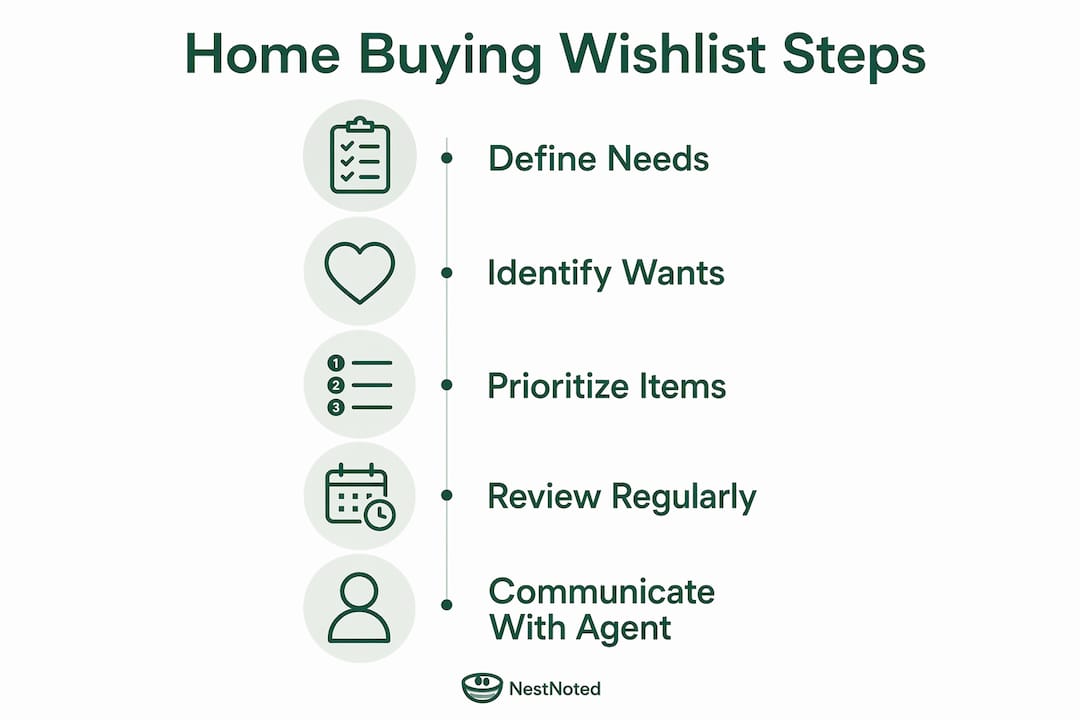
Building a useful wishlist takes about an hour of honest thinking. The process has a natural sequence, and skipping steps tends to produce a list that's either too vague or too long to act on.
Step-by-step process
-
Start by dreaming freely. Before you think about budget or market realities, write down everything you'd want in an ideal home. Big yard, chef's kitchen, home office, three-car garage. Get it all on paper. SoFi's guide calls this the "daydream" phase, and it's worth taking seriously because it surfaces desires you might not consciously recognize.
-
Sort everything into three buckets. Go through your dream list and label each item: Need, Want, or Wish. A Need is something you genuinely cannot compromise on. A Want is something that would influence your decision but won't kill a deal. A Wish is something you'd love but realistically can't expect to find within your budget.
-
Draft independent lists if you're buying with someone. When buying with a partner, each person should build their own list before combining them. Independent drafts surface hidden conflicts that a joint session might paper over. You'll often discover that one person's "Need" is the other's "Wish."
-
Trim your Needs list aggressively. A long Needs list makes your search nearly impossible. If you have more than five or six true non-negotiables, revisit the list a few days later with fresh eyes. Redfin advises buyers to reduce the number of needs to make home shopping more manageable.
-
Add a "Don't Want" column. Think about every place you've lived and what drove you crazy. No natural light, paper-thin walls, a galley kitchen with no counter space. These negatives are just as useful as your positives when filtering listings.
-
Rank within each category. Not all Wants are equal. Number them by priority so that when you're comparing two homes that each satisfy some but not all of your Wants, you know which trade-off costs you more.
-
Align the list with your actual budget. Some Needs are financially fixed, like price range. Others, like a finished basement, might be achievable through renovation if you budget for it upfront. Freddie Mac emphasizes that knowing what you can afford shapes which Wants are realistic to pursue.
Pro Tip: After every three to five home tours, sit down and review your wishlist. You'll often find that a feature you listed as a Need is actually a Want once you've seen what the market offers. Reclassifying items keeps your search sharp and prevents the frustration of holding out for something the local inventory simply doesn't have.
What features and categories belong on your wishlist
The most useful wishlists are organized by category, not just by priority level. Grouping features by type makes it easier to spot gaps and communicate clearly with your agent.
Location and neighborhood factors tend to be the highest-stakes category because they're fixed. You can renovate a kitchen; you cannot move a house closer to your job. Weichert's wishlist framework breaks location into proximity to work, schools, hospitals, supermarkets, parks, restaurants, and highways, plus public transportation access. Each of those deserves its own Need/Want/Wish label.
Home systems are the second category buyers often underweight. HVAC age, plumbing type, electrical capacity, and water heater setup all affect both livability and future costs. A house with a 20-year-old furnace might look perfect on a tour but carry a significant near-term expense.

Interior features cover floor plan, flooring type, kitchen layout, bedroom count, bathroom configuration, storage, and dedicated spaces like a home office or laundry room. These vary enormously in how fixable they are. Flooring is cosmetic and swappable. A closed floor plan that you want open is a structural project.
Exterior features include garage size, driveway, yard size and fencing, deck or patio, and pool. Lot size is a property constraint, not a feature. You can add a deck; you cannot expand your lot.
The key distinction Redfin draws is between modifiable features and fixed constraints. Wallpaper, carpet, and paint are cosmetic. School district, lot size, and neighborhood are permanent. Prioritize filtering by the permanent constraints first, then evaluate the cosmetic ones.
| Feature | Category | Need / Want / Wish |
|---|---|---|
| Central air conditioning | Home systems | Need (83% of buyers) |
| Number of bedrooms | Interior | Need (73% of buyers) |
| Proximity to work | Location | Need |
| Hardwood floors | Interior | Want |
| Fenced yard | Exterior | Want |
| Two-car garage | Exterior | Want |
| Home office | Interior | Want |
| Pool | Exterior | Wish |
| Chef's kitchen | Interior | Wish |
| Finished basement | Interior | Wish |
Features to categorize on your wishlist:
- HVAC system age and type (central air, forced hot air, radiant)
- Bedroom and bathroom count
- Kitchen layout and appliance condition
- Garage capacity and driveway
- Yard size, fencing, and outdoor living space
- School district rating (relevant even without children, for resale)
- Commute distance and public transit access
- Storage: closets, basement, attic
- Laundry setup (in-unit vs. shared vs. none)
- Neighborhood noise level and traffic patterns
How to use your wishlist effectively during house hunting
A wishlist sitting in a drawer does nothing. Its value comes from how consistently you apply it during the search.
Share it with your agent before you tour anything. A wishlist functions as a communication tool between you, your family, and your real estate agent. When your agent has your ranked priorities in writing, they can filter listings before sending them to you, saving everyone time. Weichert notes that clear communication with your agent reduces conflicts and speeds up decisions.
Use it as a scoring sheet during tours. Bring your wishlist to every showing, physical or virtual, and mark which items each home satisfies. This turns a subjective emotional experience into something you can compare objectively. Two homes that both "felt right" often look very different when you score them against the same criteria.

Track compromises, not just wins. When a home satisfies most of your Needs but misses on a Want, note it. If you find yourself making the same compromise repeatedly across five homes, that's the market telling you something. Either that Want is unavailable at your price point, or you've been searching in the wrong areas.
Document your impressions privately. After a tour, your memory of specific details fades fast, especially once you've seen a dozen homes. Tools like Nestnoted let you log notes, ratings, and observations on each property with privacy by default, so your candid reactions stay confidential and don't influence negotiations.
Best practices during house hunting:
- Bring your wishlist to every tour and score each home against it
- Note which compromises repeat across multiple properties
- Revisit and revise your wishlist every few tours as priorities clarify
- Avoid falling for cosmetic appeal at the expense of structural needs
- Check school district ratings on GreatSchools before touring, not after
- Ask about utility costs, HOA fees, and permit history at every showing
- Filter listings by fixed constraints first (location, lot size, school district) before evaluating features
Pro Tip: First-time buyers often overlook common pitfalls like skipping the wishlist entirely or treating every item as a non-negotiable. Both mistakes slow your search and increase the chance of buyer's regret.
Printable and digital templates to organize your priorities
The format of your wishlist matters less than the habit of using it consistently. That said, the right format makes it easier to share, update, and reference during tours.
Printable templates work well for buyers who prefer paper during showings. A simple three-column sheet with Need, Want, and Wish headers, organized by category (location, systems, interior, exterior), is enough structure for most buyers. Weichert publishes a detailed checklist that covers location proximity, neighborhood characteristics, home systems, and interior and exterior features, all formatted for easy marking.
Spreadsheet templates add the ability to score homes side by side. You can build one in Google Sheets or Excel with properties as columns and wishlist items as rows, then mark each cell as Met, Partial, or Not Met. Redfin offers a downloadable spreadsheet that combines a wishlist with a house-hunting tracker, so you can log both your priorities and your impressions of each property in one place.
Digital tools go further by syncing with listing platforms, enabling collaboration, and preserving your notes across devices. Nestnoted is built specifically for this: it lets you track listings privately, log impressions and ratings after tours, compare properties side by side, and share notes with your agent in a shared workspace. All notes are confidential by default, which matters when you want to record honest reactions without worrying about how they might look to a seller.
Advantages of using a structured template:
- Forces you to evaluate every home against the same criteria
- Makes it easier to explain your priorities to your agent
- Reduces the chance of forgetting a key detail after a tour
- Helps you spot patterns in what the market is and isn't delivering
- Gives you a record to revisit if you're torn between two properties
| Template type | Best for | Key limitation |
|---|---|---|
| Printable checklist | Paper-based note-takers, quick tour reference | Hard to compare multiple homes |
| Spreadsheet | Side-by-side property comparison | Requires manual data entry |
| Digital tool (e.g., Nestnoted) | Privacy, collaboration, syncing with listings | Requires account setup |
How future plans and resale value should shape your wishlist
Buyers who think only about their current life tend to outgrow their home faster than they expected. Building future plans into your wishlist from the start is one of the most practical things you can do.
Redfin recommends asking how your needs will change in five and ten years. Will your family grow? Will aging parents move in? Will you need a home office permanently or just temporarily? A home that fits your life today but not in three years creates a costly, disruptive move. If there's any chance of family growth, bedroom count and yard space deserve more weight on your wishlist than they might get from a purely present-focused evaluation.
Resale value deserves its own line on your wishlist, even if you plan to stay long-term. School district quality is one of the most consistent drivers of home value, and it matters whether or not you have children. Buyers in strong school districts tend to see more stable appreciation and faster sales when they eventually list. Location factors like walkability, transit access, and proximity to employment centers follow a similar pattern.
Features that buyers widely value, like the air conditioning and bedroom count that top Zillow's priority rankings, also tend to support resale. A home without central air in a hot climate will face a narrower buyer pool when you sell. That's worth factoring in when you're deciding whether to classify central air as a Need or a Want.
Maintenance capacity is another future-facing consideration. A large yard, a pool, or an older home with original systems can all be appealing at purchase and burdensome within a few years. Freddie Mac suggests asking yourself honestly whether you have the time and money to maintain what you're buying, not just whether you want it.
How budget and affordability fit into your wishlist
Your wishlist and your budget are not separate exercises. They need to inform each other from the beginning, or you'll end up with a list that's useless in the actual market.
The most practical approach is to assign a rough cost to each Want and Wish that you'd need to renovate for, rather than find move-in ready. If a finished basement is on your Want list but you can only find homes with unfinished basements at your price point, knowing that finishing typically runs $25,000–$50,000 (depending on size and market) helps you decide whether to reclassify it as a Wish or budget for the project. Freddie Mac frames this directly: knowing what you want and what you can afford is what lets you and your agent narrow in on the right home.
Price range itself belongs at the top of your Needs column, not as a soft guideline. It's the one constraint that shapes every other decision. If you're stretching to the top of your budget to get into a neighborhood, you may need to reclassify several Wants as Wishes to compensate. If you're buying below your maximum, you have more room to hold out for features you care about.
HOA fees, property taxes, utility costs, and expected maintenance are all part of the real affordability picture. A home priced at your ceiling with a $600/month HOA fee is a different financial reality than the same price with no HOA. Build those recurring costs into your budget before you finalize which features are realistic to pursue.
What neighborhood characteristics belong on your wishlist
Neighborhood factors deserve their own section of your wishlist because they're permanent in a way that home features are not. You can renovate a bathroom; you cannot change your neighbors, your commute, or your school district.
The Weichert framework covers neighborhood characteristics across several dimensions: traffic levels, noise, neighbor demographics, and child-friendliness. Those are worth rating as Need, Want, or Wish just like any home feature. A buyer who works from home and values quiet has a different neighborhood Need than one who commutes daily and prioritizes highway access.
Safety data, walkability scores, and local amenity density are all publicly available and worth checking before you tour. Walk Score rates neighborhoods by how easily residents can complete daily errands on foot, which is a useful proxy for both lifestyle fit and long-term value. Proximity to grocery stores, parks, restaurants, and medical facilities all factor into daily quality of life in ways that are easy to underestimate when you're focused on the house itself.
One detail buyers frequently overlook: the character of a neighborhood can shift significantly within a few blocks. A home on the edge of a desirable area may be priced like it's in the heart of it. Touring at different times of day, including weekday mornings and weekend evenings, gives you a more accurate read on noise, traffic, and activity than a Saturday afternoon open house ever will.
Key Takeaways
A well-built home buying wishlist, organized into Needs, Wants, and Wishes and revised regularly during your search, is the most reliable way to make confident, budget-aligned decisions in a competitive market.
| Point | Details |
|---|---|
| Use three categories | Separate features into Needs, Wants, and Wishes to avoid treating every item as a deal-breaker. |
| Start with fixed constraints | Filter by location, school district, and lot size before evaluating modifiable home features. |
| Revise after every few tours | Reclassify items as you learn what the market actually offers at your price point. |
| Budget is part of the wishlist | Price range belongs at the top of your Needs column; factor in HOA fees and maintenance costs. |
| Future plans affect priorities | Account for family growth, resale value, and maintenance capacity when ranking wishlist items. |
Ready to track every home you tour without losing your notes or compromising your privacy? Nestnoted gives you a free, private workspace to log impressions, compare properties side by side, and share priorities with your agent, all in one place.