

Yes, archive rejected homes into a private, searchable folder so every loss becomes usable intelligence instead of a dead end. A rejected listing still holds its price history, seller terms, and your own notes on why it didn't work. Save those details before they vanish from your memory, and you'll write sharper offers on the next house.
TL;DR:
- Archiving rejected homes enables buyers to track price changes, market signals, and reasons for rejection, informing better future offers.
- Recording details such as price, seller terms, rejection reasons, and notes within 24 to 48 hours supports pattern recognition and strategic adjustments.
- Regularly reviewing and tagging archived listings helps identify market trends and common obstacles, guiding parameter modifications before next home tours.
- Maintaining private notes protects sensitive negotiation insights, while sharing summaries with agents allows effective collaboration without compromising honesty.
- Consistent, structured archiving turns emotional losses into valuable intelligence, increasing the chances of turning future rejections into successful backup offers.
Table of Contents
- What Does It Mean to Archive Rejected Homes?
- What to Record for Every Rejected Listing
- How to Turn Archiving Into a Repeatable Workflow
- How Archived Rejections Change What You Offer Next Time
- Keeping Notes Private While Letting Your Agent Act on Them
- What Actually Separates a Good Archive From a Junk Drawer
- Turn Your Next Rejected Offer Into Next Month's Backup Win
- Sources
What Does It Mean to Archive Rejected Homes?
Archiving a rejected home means moving a listing you walked away from, or lost, into a permanent private record instead of deleting it or letting it get buried in old texts and email threads. It's the difference between a folder full of dead links and a working file you can search six weeks later when that same house drops its price.
Buyers who treat a lost offer as raw data, rather than a personal failure, tend to win the next negotiation. Analysis of repeat buyers shows the ones who study why they lost on price, terms, or financing strength come back stronger. An archive is what makes that study possible. Without it, you're relying on memory, and memory drops the exact number that mattered three houses ago.
Rejected listings also throw off signals long after the "no." A seller who held firm at $410,000 in March might accept $395,000 in June once the market cools. A property that went to a rival buyer can reappear on the market weeks later if that buyer's financing falls through, and the archive tells you instantly what you offered, what you were willing to pay, and whether it's worth a second look.
When archived listings become worth revisiting:
- The list price drops, even by a small margin, signaling the seller is now more flexible than when you first bid.
- The listing goes back to "active" or "back on market" after being under contract with someone else.
- A contingency in the winning offer (financing, inspection, appraisal) looks likely to fail based on public status changes.
- Enough time has passed that your original walk-away reason (budget, timing, competing offers) no longer applies.
Buyers who lose a bidding war and then simply "restart" their search from scratch throw away everything they learned. Guidance on restarting a home search after a lost offer points to the same lesson: the information from a rejection is worth more than the disappointment of it.
What to Record for Every Rejected Listing
A useful archive isn't a pile of screenshots. It's a small set of consistent fields you fill out the same way every single time, so a listing from January reads the same as one from October. Here's the checklist that actually matters:
- Address and MLS/listing ID — the anchor for everything else, and what lets you or your agent pull the listing back up instantly.
- List price and, if you can get it, the accepted price — the gap between the two tells you how much room the seller actually had.
- Listing date and days on market — a house that sold in two days behaved differently than one that sat for sixty.
- Seller terms and contingencies — closing timeline, inspection waivers, appraisal gap coverage, rent-back requests.
- Two-sentence pros and cons — written the day you toured it, not reconstructed from memory a month later.
- A "why rejected" tag — price, condition, location, lost bidding war, financing fell through, or simply changed your mind.
- Your walk-away price — the number you refused to cross, recorded before emotion revises it.
- Photos and documents — listing photos, your own walk-through photos, disclosures, and any written agent feedback, all timestamped.
Tagging matters as much as the raw data. A simple label like "backup candidate," "needs price drop," or "overpriced for condition" turns a static archive into something you can filter in seconds when you're deciding what to look at again this week.
Keeping this level of detail isn't unusual advice. Guides on tracking a home search consistently recommend saving photos, sold prices, and notes side by side, precisely because memory blurs listings together after the tenth open house.
Pro Tip: Record your walk-away price the same day you tour the home, before you've seen the next three listings. That number gets revised upward in hindsight almost every time.
How to Turn Archiving Into a Repeatable Workflow
A checklist only works if you actually run it on a schedule. Here's the sequence that keeps an archive useful instead of just full:
- Within 24 hours of rejection, run a structured debrief. Ask three questions: What was my walk-away price, and did I exceed it? Which specific term, price, financing, or contingency actually decided the outcome? What's the one action to schedule now, a backup offer, a monitoring alert, or a search adjustment? This three-question format comes straight from bidding-war recovery guidance built for buyers who've lost more than once.
- Give it 48 hours before re-engaging. The same guidance behind that debrief format recommends a short cooling period so decisions get made on facts, not the sting of losing.
- Set a weekly check-in cadence for anything tagged "backup candidate," rather than checking obsessively every day.
Once a listing is archived, monitoring and follow-up split naturally between buyer and agent:
- Buyers watch for price drops and status changes through alerts rather than manual searching.
- Agents contact the listing agent directly to ask whether the winning contract is firm, since documenting who's losing on price versus terms is exactly how agents diagnose what to change next time.
- Agents flag any archived property where a fallen-through contract creates a fast backup-offer window.
- Both sides review the tags monthly to prune listings that no longer fit the budget or the search area.
Buyers with dated notes and the right attachments already saved move faster than anyone starting from scratch, which is often the entire difference in who wins a backup-offer scramble.
How Archived Rejections Change What You Offer Next Time
The real payoff of an archive shows up months later, in the terms you write on a completely different house. If your notes show a seller cared more about a fast close than the top dollar figure, that's a pattern worth applying elsewhere: shortening your closing timeline can beat a higher price on the next similar listing.
A few concrete ways archived intelligence changes your next move:
- If your rejected offer lost by a small margin, that gap tells you what range above list price this specific seller's market actually runs, useful data for the next comparable listing.
- If three rejected homes in one neighborhood all cite the same objection (small lot, dated kitchen, busy street), that pattern might mean it's time to adjust your search parameters rather than keep bidding against the same constraints.
- If your notes show waived inspections cost sellers real leverage in negotiations, research on inspection-related outcomes can help you weigh how far to push that contingency on your next offer.
- If a property required structural repairs beyond your budget or a lot of size that never matched your needs, the archive is also where you decide, cleanly, that it's not worth re-chasing.
Reviewing several archived losses side by side, rather than one at a time, often makes patterns like these obvious in a way that a single rejection never does. A side-by-side comparison approach applied to old listings works the same way it does for active ones.
Pro Tip: If two or three rejected listings share the same objection, that's not bad luck. That's your search criteria telling you something. Adjust the parameters before you tour ten more houses with the same problem.
Keeping Notes Private While Letting Your Agent Act on Them
Candid notes only stay candid if you know they won't become public. A note that says "sellers seem desperate, I'd push hard on price" is useful intelligence for your negotiation and a liability if it ever reaches the listing agent. Private-by-default archiving protects that honesty.
That doesn't mean the archive has to be a locked box. Selective sharing lets an agent act on your intelligence without exposing every private impression:
- Keep raw notes and vibe ratings private by default, visible only to you.
- Share an agent-only view or an exported summary when it's time to write an offer or float a backup bid.
- Log every agent outreach and listing-agent response inside the archive itself, including a timestamp for when the feedback came in.
- Confirm your account has basic security controls, backups, and some form of access log, especially if you're sharing a workspace with a spouse, co-buyer, or agent.
This split, private reflection paired with a shareable summary, keeps your negotiating posture intact while still giving your agent the exact detail they need to move fast.
What Actually Separates a Good Archive From a Junk Drawer
Most buyers don't lack information after a rejected offer. They lack a place to put it before it evaporates. I've seen the same pattern over and over in how people talk about losing a house: the emotional sting fades in a week, but so does the memory of the seller's actual objection, and that's the part worth keeping.
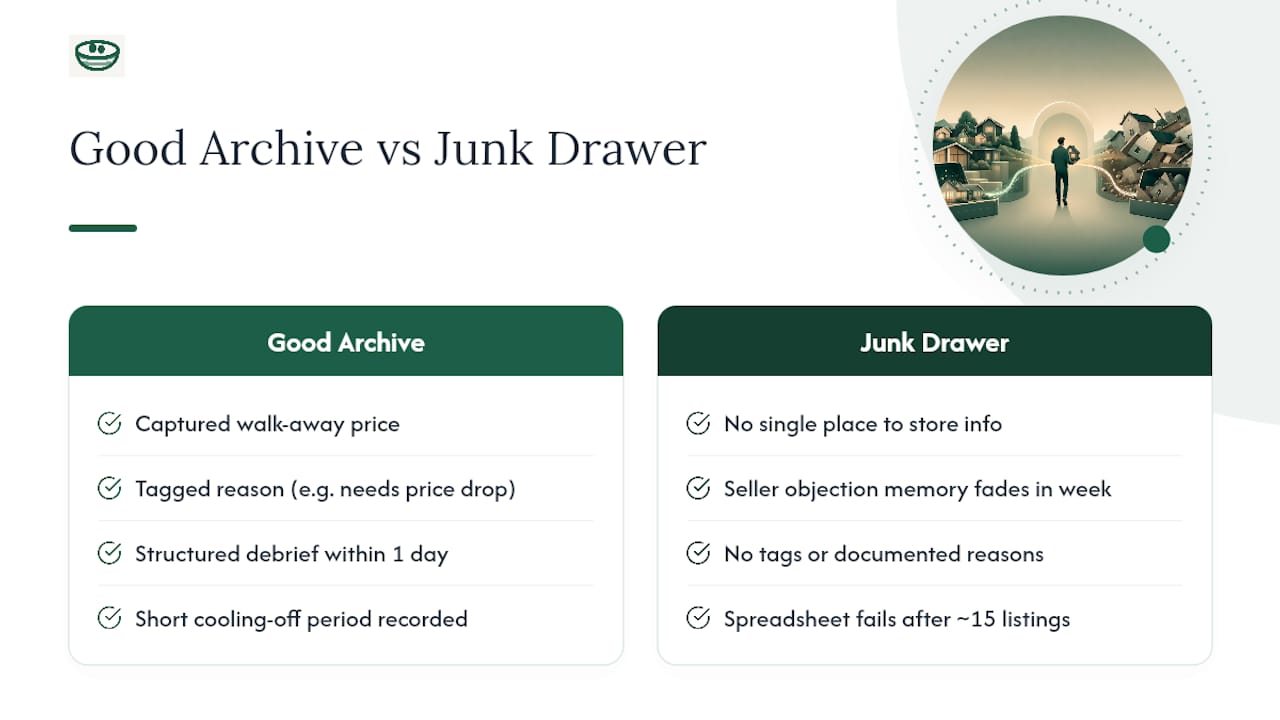
The buyers who come back stronger aren't the ones who "get over it" fastest. They're the ones who wrote down the walk-away price, tagged the listing "needs price drop," and moved on without needing to relitigate the loss in their head. A structured debrief within a day, a short cooling-off period, and one search tool doing the remembering for you, that's the whole system. Nothing here requires software. It requires consistency, and consistency is exactly what a spreadsheet fails at once you're past listing number fifteen.
For agents, the value compounds. An archive that shows a client's rejected listings, tagged reasons, and agent feedback across months becomes a negotiating brief no memory could reconstruct on demand.
— Antony
Turn Your Next Rejected Offer Into Next Month's Backup Win
A private folder like this workflow depends on helps buyers and agents manage multiple properties at once. Every field from the checklist above, address, price, seller terms, your own pros and cons, photos, and agent feedback, has a home inside a workspace that's private by default and shareable only when you choose.

Price drop alerts help you find out when an archived listing gets more affordable. Side-by-side comparisons help spot patterns across rejected homes in the same neighborhood. Notes can sync from platforms like Zillow and Redfin to avoid re-typing.
Start small: create a folder labeled "Rejected," pull in one listing you walked away from in the last few months, and fill out the fields while the details are still fresh. Sign up for Nestnoted and see how much faster your next offer comes together when the last one isn't forgotten.
Sources
- Why the Buyers Who "Lost" Are Often the Ones Who Won
- Restart your home search: tips for buyers who lost out
- Best bidding war strategy after losing multiple offers on houses
- When your offer gets rejected · Todd Spencer