

When house hunting stress hits hardest, do these three things first: stop touring for 48 hours, write down your non-negotiables in one sentence, and call your lender to confirm your exact budget ceiling. Those three moves address the three biggest triggers simultaneously: decision fatigue, scope creep, and financial uncertainty.
If you're mid-showing and your chest is tight, try box breathing: inhale for four counts, hold for four, exhale for four, hold for four. Repeat twice. It takes under two minutes and physically lowers your heart rate before you say anything you'll regret to your agent.
A Nationwide survey found that 71% of first-time buyers rated homebuying more stressful than finding their first job. So if you feel like you're barely holding it together, you're in the majority.
Do these now:
- Pause all new showings for 48 hours.
- Write one sentence describing your ideal home (budget, location, must-have feature).
- Call your lender and confirm your pre-approval ceiling and estimated closing costs.
- Verify your lender's license at NMLS Consumer Access before sharing any financial documents.
- Set a 24-hour decision rule: no offers within 24 hours of a first showing.
- Open a private tracker like Nestnoted to log impressions so nothing gets lost.
Pro Tip: Write one sentence of pros and one sentence of cons immediately after leaving each showing, while you're still in the car. That 90-second habit prevents the memory blur that makes every house feel the same after week three.
Key Takeaways
Managing house hunting stress comes down to one principle: build a system before the search gets hard, not after it already has.
| Point | Details |
|---|---|
| Pre-approve before touring | Get full pre-approval and a total-cost budget before viewing more than five homes. |
| Cap showings at three per week | More than three showings weekly blurs homes together and accelerates decision fatigue. |
| Use a scoring rubric | Score each home on five weighted categories immediately after the showing, before memory fades. |
| Apply the 24-hour rule | Never submit an offer within 24 hours of a first showing; 66% of buyers who rushed reported regret. |
| Nestnoted organizes impressions privately | Log private notes, pros/cons, and scores per listing to compare homes with facts, not feelings. |
Table of Contents
- What are the emotional stages of buying a house?
- What strategies actually reduce stress during the home search?
- Why does house hunting spike anxiety? What the surveys show
- How does staying organized reduce buying a house anxiety?
- How do you make trade-offs without regret?
- A 2-week plan to keep your search sustainable
- Why the process matters more than the perfect house
- Nestnoted keeps your search organized and your decisions clear
- Sources
What are the emotional stages of buying a house?
Buying a home follows a recognizable emotional arc. Knowing where you are in it makes the feelings easier to manage.
-
Excitement. You start with energy and optimism. Coping tip: Write your criteria down now, before emotion clouds them. You'll need that list later.
-
Overwhelm. Listings multiply. Every weekend is a showing. Coping tip: Cap showings at three per week. More than that and the homes blur together.
-
Discouragement. Nothing fits the budget, or everything good goes fast. Coping tip: Review your must-have list and confirm which items are truly non-negotiable versus nice-to-have.
-
FOMO (fear of missing out). A house sells in 48 hours and you panic. Coping tip: Enforce your 24-hour rule. A home you rushed into is worse than one you missed.
-
False hope. You fall hard for a place that's slightly out of reach. Coping tip: Run the numbers with your lender before you emotionally commit. Facts first.
-
Offer anxiety. You submit an offer and wait. Coping tip: Write down what you'll do if it's rejected before you hear back. Having a plan removes the sting.
-
Rejection. Your offer loses. Coping tip: Give yourself one hour to feel bad, then ask your agent what the winning offer looked like. Use it as data.
-
Cautious optimism. An offer is accepted. Coping tip: Don't cancel the search mentally yet. Stay organized until the inspection clears.
-
Inspection dread. The inspector finds issues. Coping tip: Get repair estimates before deciding. Most issues are fixable; the cost is what matters.
-
Appraisal anxiety. You wait to see if the home appraises at value. Coping tip: Ask your lender in advance what happens if it comes in low. Knowing the contingency plan is calming.
-
Closing fatigue. Paperwork, wire transfers, last-minute lender requests. Coping tip: Prepare a document checklist with your lender two weeks before closing.
-
Relief at close. You sign. Coping tip: Don't let relief push you into skipping the final walkthrough. Check everything.
-
Post-purchase doubt. "Did I pay too much?" Coping tip: Remind yourself that a PR Newswire report found 66% of buyers have some regret. Mild doubt is normal; it usually fades within six months.
The two stages most likely to trigger rushed decisions are stage 4 (FOMO) and stage 12 (relief at close). At both points, slow down deliberately. A one-line rule for each: never offer within 24 hours of a first showing, and never skip the final walkthrough because you're relieved.
What strategies actually reduce stress during the home search?
Uncertainty drives most of the anxiety in a home search. The strategies below target specific stressors rather than offering generic "stay positive" advice.
Get pre-approved before you tour more than five homes
Full pre-approval, not just pre-qualification, tells you your exact ceiling. JVM Lending's guidance is direct: proactive lender communication materially reduces stress at every major transaction point, including offers, appraisal, and closing. Ask your lender upfront: "What's the total cost to close, including taxes and insurance escrow?" That one question eliminates the most common surprise.

Tighten your search filters to cut choice overload
More listings equal more decisions equal more fatigue. Narrow your criteria to three hard requirements (price ceiling, minimum square footage, specific zip codes) and filter everything else out. If you're seeing more than 20 listings a week, your filters are too loose.
Structure your showings
Cap in-person tours at three per week. Schedule them on the same day when possible so the comparison is fresh. After each showing, spend five minutes logging notes before you drive away. The homes you saw in week one will be completely blurred by week four without a written record.
Build a small, trusted team
Your agent, lender, and inspector are your stress-reduction infrastructure. A high-communication agent who sends you a brief update every few days cuts the anxiety of silence. Verify your lender's license at NMLS Consumer Access before you share tax returns or bank statements. Trust is not a soft benefit here; it's a practical anxiety reducer.
Schedule non-negotiable breaks
Block one full weekend per month with zero house-related activity. Buyers who don't build in recovery time burn out around week six and start making offers out of exhaustion rather than conviction.
Stress-point checklist by transaction stage:
- Offer stage: Confirm your max number before submitting. Have your agent ask about competing offers.
- Inspection: Attend in person. Ask the inspector to explain every finding verbally.
- Appraisal: Ask your lender what the low-appraisal contingency looks like before the appraisal happens.
- Closing: Request the Closing Disclosure three days early. Read every line.
Pro Tip: Ask your lender this exact question before you submit your first offer: "What's the one thing that could delay or kill this deal at underwriting?" Their answer tells you what documents to have ready and what to avoid doing (like opening a new credit card) before closing.
Why does house hunting spike anxiety? What the surveys show
The stress isn't in your head. It's structural.
Nationwide's survey found 71% of first-time buyers rated homebuying more stressful than finding their first job, and 59% said it was harder than planning a wedding. The top stressors were unexpected costs and difficulty finding trusted resources — two things that pre-approval and lender verification directly address.
Best Interest Financial's analysis adds a behavioral layer: nearly half of recent buyers said they followed their heart more than their head, and two-thirds reported some regret. The pattern is consistent. Emotion-driven decisions, made under time pressure, produce regret. The antidote is a system that separates the feeling from the choice.
These numbers map directly to the strategies in the previous section. Unexpected costs (the top stressor) are addressed by full pre-approval and a total-cost budget. Regret from paying too much is addressed by a scoring system and a 24-hour cooling-off rule. Difficulty finding trusted resources is addressed by NMLS verification and a high-communication agent.
A PR Newswire release on buyer surprises found the most common post-purchase shocks were hidden costs, unexpected DIY demands, and quick repairs. Buyers who built a full-cost budget before touring reported fewer surprises at closing.
How does staying organized reduce buying a house anxiety?
Organizing impressions reduces regret. That's not a soft claim. When you can compare 12 homes side by side with written notes and scores, you make the final choice with evidence rather than a feeling you can't fully explain.
A 4-step workflow:
- Prepare. Before each showing, write your three must-haves and two deal-breakers on a notecard or in your tracker.
- Capture. Immediately after the showing, log a score (1–10), one sentence of pros, one sentence of cons, and one photo of the detail that stood out most.
- Compare. At the end of each week, pull up all your notes side by side. Look for patterns in what you scored highest.
- Decide. Use your scores and notes, not your memory of how a place felt on a good day.
Scoring rubric (copy this):
Nestnoted is built around exactly this workflow. Its pros and cons template lets you log structured impressions per listing, and the side-by-side comparison view puts multiple homes on the same screen so you're comparing facts, not fading memories. The price updates feature sends alerts when a listing drops, so you're not manually refreshing Zillow every morning. All notes are private by default, which matters more than it sounds: buyers who keep candid notes without worrying about public exposure write more honest assessments and make better decisions.
A quick scenario: You've toured nine homes over three weeks. You think you remember which one had the best kitchen, but you're not sure. With a private tracker, you pull up your notes, see that home #4 scored 8/10 on layout and you flagged the kitchen specifically, and home #7 scored 9/10 on location but 5/10 on condition. The decision becomes obvious. Without the notes, you're choosing between two feelings.
Pro Tip: Log your notes immediately after each showing, not at the end of the day. Memory degrades fast. The detail you meant to write down at 10 PM is usually gone by then.
How do you make trade-offs without regret?
Use predetermined decision rules and a numeric scoring system. Emotion is unavoidable in a home purchase, but it doesn't have to be the deciding factor.
Lifehacker's behavioral reporting identifies four cognitive traps that show up repeatedly in house hunting:
- Endowment effect: Once you mentally "own" a house, you overvalue it. Countermeasure: Score it before you imagine living there.
- Price anchoring: The listing price shapes what feels like a deal. Countermeasure: Research comparable sales before you see the asking price.
- Herding: Multiple offers make a home feel more desirable than it is. Countermeasure: Ask your agent for the home's days on market and price history before the bidding starts.
- Choice paralysis: Too many options make any decision feel wrong. Countermeasure: Cap your active consideration set at three homes at a time.
Sample trade-off scoring table:
Multiply each score by its weight and sum the column. The math won't make the decision for you, but it will surface trade-offs you hadn't consciously acknowledged.
Pro Tip: Apply the 24–72 hour rule before submitting any offer. Sleep on it at least once. If the home still feels right after 24 hours and your scores back it up, move forward. If you're only offering because you're afraid someone else will, that's FOMO, not conviction.
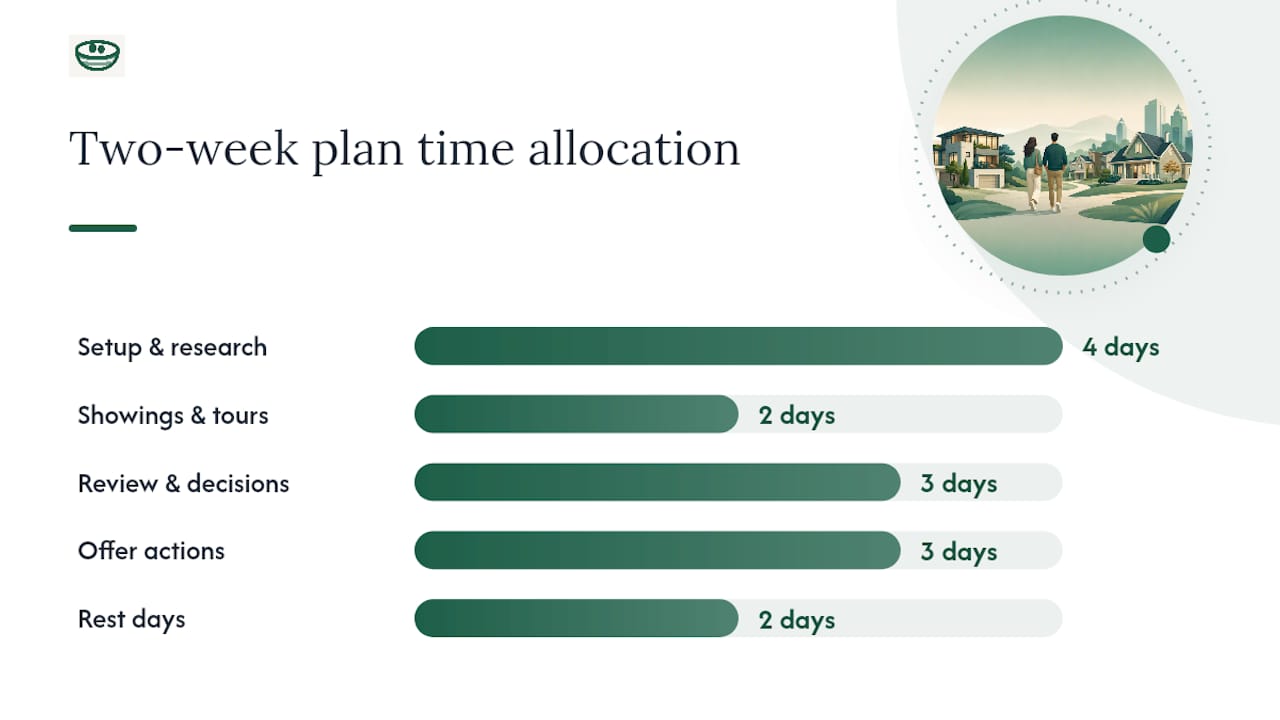
A 2-week plan to keep your search sustainable
Following a short, fixed plan reduces fatigue and keeps momentum without panic. Here's a realistic two-week schedule for an active buyer.
Week 1
- Day 1: Confirm pre-approval and total-cost budget with lender.
- Day 2: Set search filters (price, location, size). Import saved listings into your tracker.
- Day 3: Research three neighborhoods: commute times, school ratings, recent sale prices.
- Day 4: Schedule up to three showings for the weekend.
- Day 5: Rest. No house-related activity.
- Day 6: Tour homes. Log notes immediately after each one.
- Day 7: Review week's notes. Score each home. Identify your top candidate.
Week 2
- Day 8: Ask your agent for comparable sales on your top candidate.
- Day 9: Schedule a second showing of your top candidate if warranted.
- Day 10: Rest day. Deliberately.
- Day 11: Review your scoring table. Confirm budget with lender.
- Day 12: If ready, prepare offer strategy with your agent.
- Day 13: Submit offer or decide to continue searching.
- Day 14: Debrief with your agent regardless of outcome. Adjust criteria if needed.
Printable checklists:
Pre-showing:
- Confirm showing time and address
- Review your must-haves and deal-breakers
- Charge your phone for photos
- Bring your scoring rubric
Post-showing:
- Log score, pros, cons, and one standout detail
- Note any repair concerns
- Flag for second showing: yes/no
Budget checklist:
- Down payment confirmed
- Closing costs estimated (typically 2–5% of purchase price)
- Emergency repair fund set aside
- Monthly payment stress-tested at a rate 1% higher than current
Closing watchlist:
- Closing Disclosure reviewed three days before closing
- Final walkthrough scheduled
- Wire transfer instructions verified directly with your title company
Signs of burnout to watch for: You're irritable after every showing. You've stopped logging notes. You're considering homes outside your stated criteria just to end the search. When two or more of those apply, pause for a full week. If anxiety is affecting sleep or daily function, talking to a therapist is a practical step, not an extreme one. The American Psychological Association recognizes major life transitions as legitimate stress triggers.
Why the process matters more than the perfect house
The conventional wisdom about house hunting is that you'll "know when it's right." That framing is responsible for a lot of regret. The feeling of rightness is heavily influenced by how tired you are, what you saw that morning, and whether your agent seemed excited. None of those are reliable signals.
What actually works is a system that keeps your criteria visible and your impressions documented, so the decision at the end is made by the version of you who thought it through, not the version who's been touring homes for eight weeks and just wants it to be over.
I've seen buyers skip the scoring rubric because it felt clinical, then spend months second-guessing a purchase they made on a Saturday afternoon feeling. The rubric doesn't remove emotion. It gives emotion a structure to work within. That's a meaningful difference.
If the search is genuinely overwhelming, talk to a therapist. Not because something is wrong with you, but because a major financial decision made under sustained stress produces worse outcomes. A few sessions during the search is a better investment than years of regret about a rushed offer. And if you need a private place to track your thoughts without judgment, a tool like Nestnoted exists for exactly that reason.
Nestnoted keeps your search organized and your decisions clear
The single sharpest advantage Nestnoted gives active buyers is this: it separates what you felt from what you found. Every home you tour gets its own private record, with scores, photos, pros, cons, and status, all in one place and visible to no one but you and whoever you choose to share with.
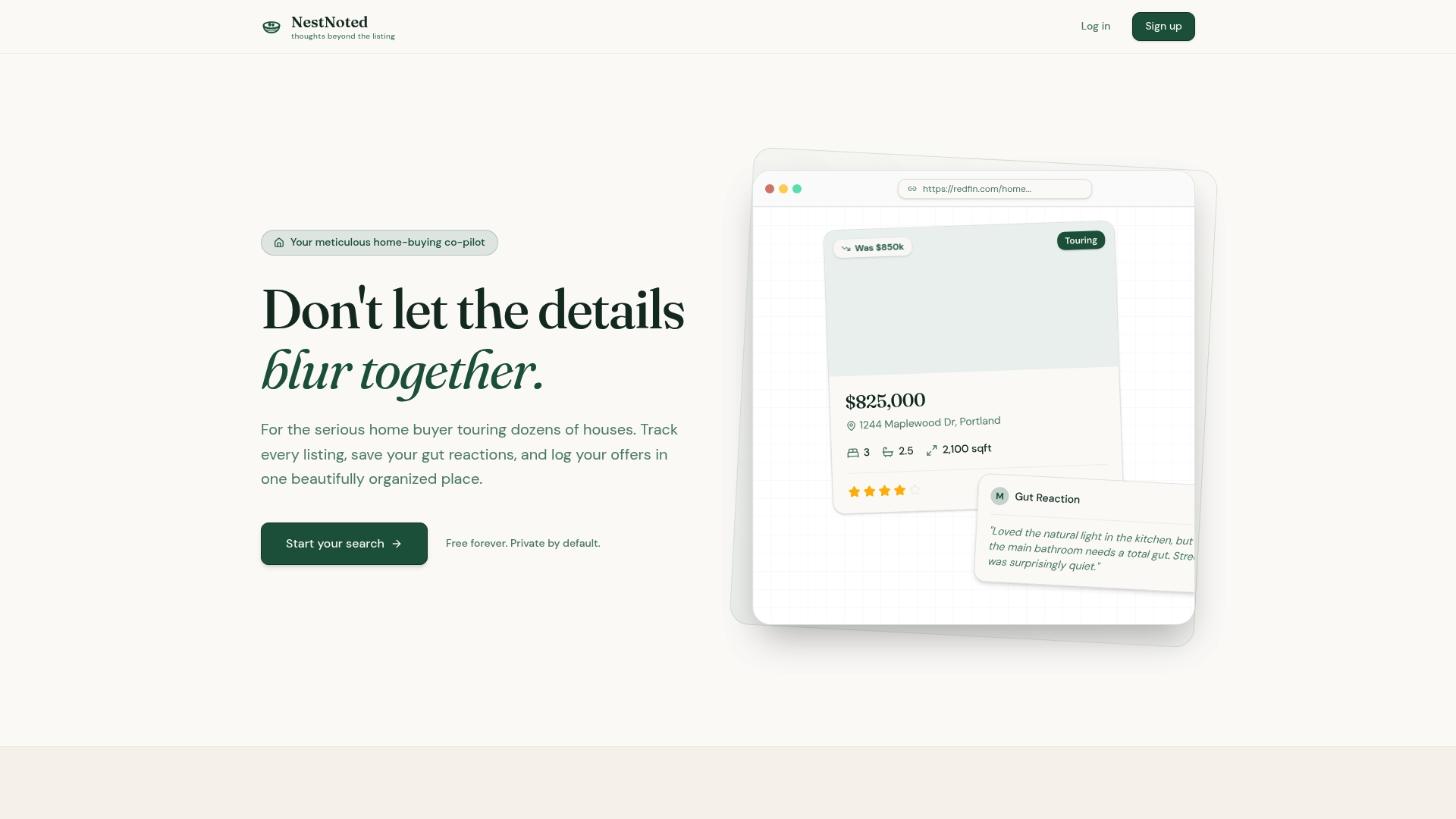
Where spreadsheets fall apart (and they do, usually around home number seven), Nestnoted holds. You can import listings directly from major platforms, log notes right after a showing, and pull up a side-by-side comparison before your next offer conversation. Price drop alerts mean you're not refreshing listings manually. The status pipeline moves each property from "interested" through "touring," "offer," and "under contract" so you always know where things stand.
It's free to start. Sign up at Nestnoted, import your saved listings, and have your notes ready before your next showing.
Sources
- Survey: More Stressful Than a Wedding: First-Time Buyers Share the Shocks of Homeownership
- Stress and Emotions Drive 66% of Home Buyers Into Regret - PR Newswire
- Why Is Buying a House So Stressful? (And How to Fix It) - JVM Lending
- Six Psychological Traps to Avoid When House Hunting - Lifehacker
- NMLS Consumer Access
This article is general information, not a substitute for advice from a qualified doctor. Consult a qualified healthcare professional about your own circumstances before acting on anything here.